
Five-minute major for slashing trans rights
Why USA Hockey is banning trans women, and why you should be angry
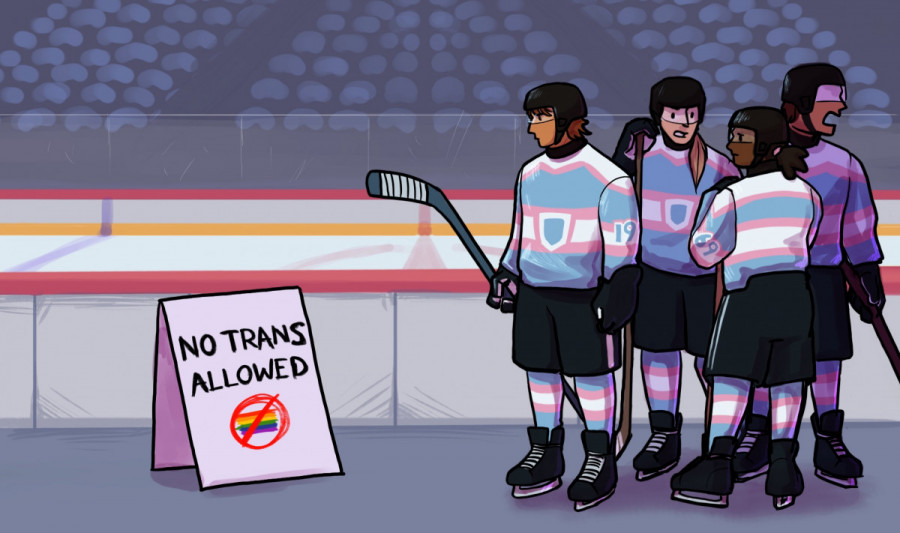
While the recent success of Heated Rivalry seemed to signal a shift toward increased queer representation and visibility in hockey, it seems to be a classic case of one step forward, two steps back.
Recently, a major blow was dealt to inclusion in the sport.
Starting on April 1, trans women will be effectively banned from any female hockey competitions within the U.S., and depending on how it is interpreted and enforced, it could also prevent trans men from competing in men’s leagues.
This new policy replaces the 2019 USA Hockey regulations, which allowed trans women to compete in women’s hockey leagues provided they met certain requirements.
For example, in girls' recreational hockey, an athlete would need to submit a letter affirming their gender identity (or one from their parents if they were a minor) and confirmation of their gender identity from a healthcare professional or another qualified professional unrelated to the athlete.
For girls' competitive hockey, athletes would need to undergo at least one year of testosterone suppression. While these requirements were far from perfect, as a trans athlete might not even be out to their parents or a health care professional, it was at least possible to play competitive hockey as a trans woman.
Speaking of competition, many seem to think that some sort of testosterone suppression is needed in order to ensure fair competition. However, the science does not entirely support this assumption.
A recent meta-analysis of 52 studies published in the British Journal of Sports Medicine concluded that while the evidence is low and varied, it “does not support theories of inherent athletic advantages for transgender women over cisgender.” While the paper did find that trans women tended to have higher lean mass, it also found that this did not translate to higher physical fitness after one to three years of gender-affirming hormone care.
Furthermore, the study highlights the need for further research, pointing out that very few studies controlled for differences in diet, training history, baseline fitness and other key variables.
But the popular notion that we should exclude trans women from women’s competitive sports is completely unsupported by science. So where did it come from?
Even before the question of trans women in sports became a popular political flashpoint, policing the “femininity” of female athletes has a long and complicated history. Track and field enthusiasts might remember the SRY tests used to detect the Y chromosome in female athletes, and the story of Spanish hurdler María José Martínez-Patiño, who passed her test in 1983, receiving her “Certificate of Femininity.”
Yet two years later, her test results were inconclusive. Later, it was revealed that she had an androgen sensitivity, causing her to carry a Y chromosome without the associated testosterone messages that would cause the sex of a person to “become male.”
Sadly, World Athletics indicated its intent to move back to gender testing last September, despite the inconclusive and invasive nature of the tests.
The practice of policing the "femininity" of athletes continues to this day, as we saw at the Paris 2024 Olympic Games, where the International Boxing Association claimed Lin Yu-ting and Imane Khelif failed their gender tests.
Despite the test being disavowed by the Olympic Committee, public figures like Donald Trump, Elon Musk, and J.K. Rowling spewed anti-trans rhetoric, even though neither of the athletes are trans.
In these examples, we can clearly see the overlap between transphobia towards trans women and the policing of women’s bodies in sport more broadly.
However, a more recent trend of supposedly benevolent actors who simply want to “protect” women has swept across the media. This phenomenon displays itself most clearly in the Riley Gaines saga.
Gaines barely merits inclusion, but she is nonetheless important to this new wave of transphobia masked under the guise of protecting women. For those unaware, Riley Gaines was an NCAA (National Collegiate Athletic Association) swimmer who, after competing against a trans woman named Lia Thomas, dedicated her life to anti-trans "activism."
One might assume that she finished second behind Thomas, or that Thomas dominated the competition so thoroughly that she felt compelled to speak out. However, Gaines became a rampant transphobia promoter because she tied with Thomas… for fifth place.
Gaines became relevant because she refined and popularized trans-exclusive radical feminist talking points similar to those of J.K. Rowling: convince those who are either ignorant or simply uninformed that you can be a transphobe and get away with it, so long as you claim to be protecting another group.
Do not underestimate the scope of this ideology. U.S. President Donald Trump certainly hasn’t, as we can see in the litany of anti-trans legislation pushed out since he took office for his second term.
Trump's anti-trans executive order from the beginning of his second term had inflammatory titles like “Protecting Children From Chemical and Surgical Mutilation” and “Defending Women From Gender Ideology Extremism and Restoring Biological Truth to the Federal Government.”
Those are just two examples of the many anti-trans orders from Trump's first day in office, and since then, he has continued to push his anti-trans agenda politically and personally. Most recently, he did a disturbing and blatantly transphobic "impression" (if one can even call it that) of a transgender weightlifting athlete.
Let me be absolutely clear: we are witnessing the scapegoating, disenfranchisement and persecution of trans and gender nonconforming people in real time. Their rights are being incrementally trampled on and taken away from them right before our eyes. The USA Hockey ban is only the most recent example.
So let’s not let Team USA’s performance at the Olympics make us forget about this; spread the word about the bigoted ban, comment under USA Hockey's social media posts, and if you are American, contact your elected officials to voice opposition.




4_600_375_90_s_c1.jpg)