Hive Free Lunch program fails to collect signatures for fee levy
Number of signatures and miscommunication confuse student groups
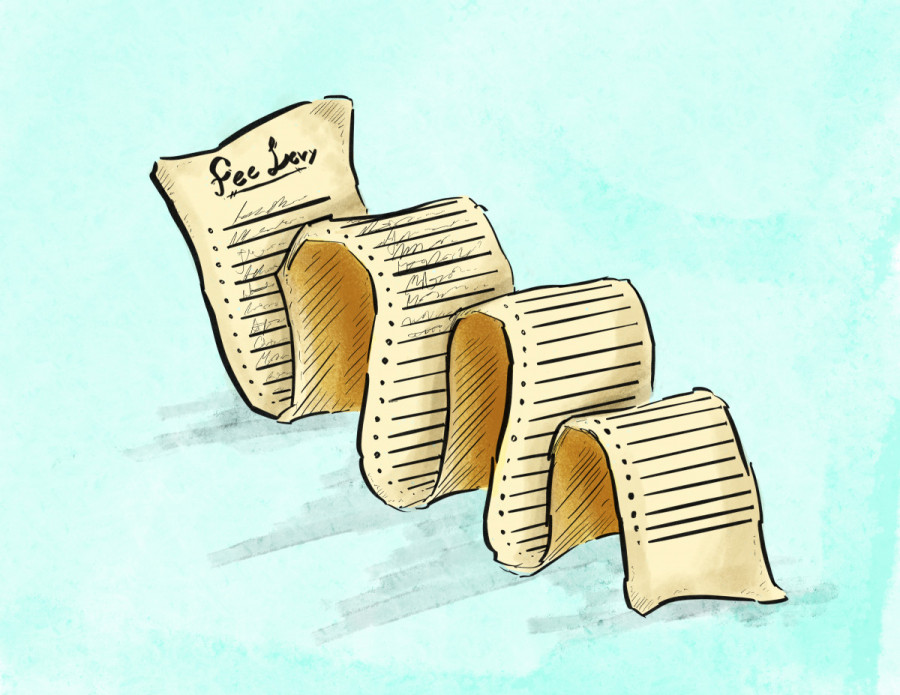
Some Concordia University staff and students are raising concerns with a 3,000-signature requirement after the Hive Free Lunch program failed to collect enough signatures to bring its request to become a Concordia Student Union (CSU) fee levy group to a student vote.
As per the Policy on Fee Levy Applications, applicants looking to create a new fee levy must submit a petition signed by at least 3,000 undergraduate students to the student union to be eligible to run in CSU elections.
Certain CSU executives are questioning the requirement—including Loyola coordinator Aya Kidaei, who believes that though the signatures show necessary student interest in the group, the fee levy increase would be voted on by students anyway.
“Do they really need 3,000 signatures? Maybe not. That might be entirely too much,” Kidaei said. “I do think we need to find a balance of how much we're asking from these groups."
The 3,000-signature requirement was put into place in September 2021, replacing the past requirement of 750 signatures, according to CSU general coordinator Vanessa Massot.
However, Kidaei claims that up until last week, the CSU website only listed 750 signatures as necessary for a new fee levy, leading to confusion among student groups.
“I would not be able to accept a petition with only 750 signatures, because it would be a violation of policy, which would make us liable,” Massot said. “But at the same time, it doesn't really feel great to not be able to honour something that's on our website.”
Collecting enough signatures is one of the many barriers Concordia groups can face when applying to increase or create a new fee levy.
An application for a fee levy modification requires that a group provides an audit or review engagement prepared by an accountant, minutes of its last annual general meeting and its last published annual report, alongside other documents. According to Concordia Food Coalition (CFC) general coordinator Gabriela Lopes, the requirements can be confusing for applicants.
To apply for an increase, the fee levy policy states that groups need to provide “a description of the university unit that administers the fee,” a term that Lopes says she is still trying to find a definition for.
“Nobody knows. I asked four people,” Lopes said. “I went between the Dean of Students office and the CSU. I spoke to executives. I spoke to permanent staff. I spoke to the dean, and nobody knew what this meant.”
The CFC was able to succeed in their bid for a fee levy increase in the fall, but only after the CSU council blocked two groups from reaching the ballot—something that group representatives at the time said they felt was due to political disagreement.
“In my opinion, as an individual—not the view of the student union—they were voted against purely for political reasons," Massot said. "I took that as kind of a direct attack on democracy."
There are 20 different active CSU fee levy groups, with each receiving funding through fees collected alongside students’ tuition.
The CFC receives 32 cents for every credit taken by Concordia undergraduate students, an amount which would be extremely helpful to the Hive Free Lunch program, says the program’s administrative coordinator Alanna Silver.
The program currently provides free breakfast and lunch to community members five days a week and free dinner three days a week, while paying 11 employees, on a budget of around $200,000 a year, according to Silver.
“We're trying to find as many ways as possible to get their funding up,” Kidaei said.
In September, the CSU awarded the Hive Free Lunch program $50,894 from its Student Space, Accessible Education, and Legal Contingency (SSAELC) fund, a large fund the union can use “for specific projects set out in the CSU bylaws.” This enabled the Hive to secure enough funding and to launch its free dinner program.
“But obviously they give away all their food for free, so they'll always need more funding to keep the service going,” Kidaei said.
Silver said that with a CSU fee levy, the program would be able to look beyond the day-to-day and start to think long-term.
“That's something we desperately need but can't afford,” Silver said.
Silver added that the fee levy would help the program renovate its space on the Loyola campus, increase staff pay, expand dinner services to five days a week, and possibly offer grocery gift cards, among other initiatives.
The Hive Free Lunch program will once again apply in the fall to create a new CSU fee levy, according to Silver.
“The overall goal that I have is that no one goes hungry on this campus,” said Silver. “I want everyone on this campus to know that if they're hungry, they can come here even if they're not coming at a meal time.”
This article originally appeared in Volume 46, Issue 10, published February 24, 2026.