Behind the scenes of Montreal flyers
As promotion moves online, Montreal designers keep the DIY poster tradition alive
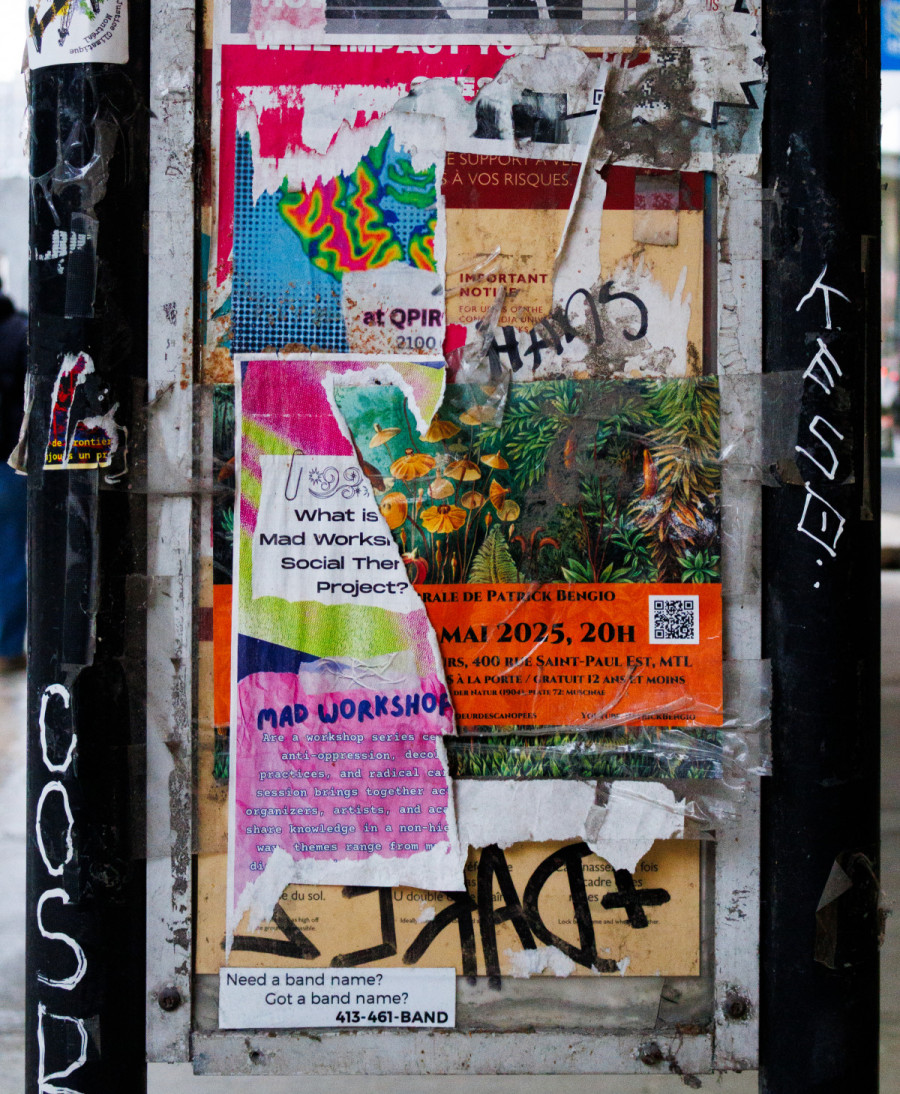
Montreal’s music and art scenes are filled with promotional posters.
Walk down any street in the city, and you’re sure to find many, whether they are tacked to corkboards, taped to lampposts or stacked on counters in coffee shops.
The initial use of flyers was purely commercial, conceived as disposable advertisements that were meant to be seen and then discarded. However, as design techniques continue to evolve, these seemingly simple 8.5-by-11-inch sheets of paper have transformed into an art form of their own, opening new opportunities for artists to experiment with typography, colour and texture.
In Montreal’s DIY music and art scenes, posters are more than promotion. They are often the first glimpse into a show’s aesthetic or a collective’s identity.
Even as event promotion moves online, there remains a community of people who value the impact that a unique and eye-catching poster can have, and are working to keep this art form alive.
Hew Miller, a graduate from the design program at Concordia University, is a freelance graphic designer whose interest in designing for the arts began when he was a teenager.
Though his focus in school was on furniture design and architecture, Miller began to do freelance graphic design shortly before graduating.
“It happened through osmosis and being involved in the music scene here,” Miller says. “I had friends who were in bands, and I asked to do covers for them, or posters. The goal was to build a portfolio, but it just snowballed.”
Miller now designs posters on commission, while also working with recurring clients. He experiments with a combination of digital and analogue processes to create his designs.
“I’m big on Photoshop and Illustrator, but I do a lot of analogue work,” Miller says. “I try to do some collage, and I scan a lot of stuff to do digital collage to get some texture. I will often sketch something first on paper and then bring it into digital.”
“One flyer I did was entirely pixel art that I was doing dot by dot, and that took me a week to do,” Thexton says. “I was seeing pixels by the end of it.”
Miller says he likes to listen to the music of the artist whose poster he’s designing in order to capture their visual vibe. However, he says, inspiration can be found in many different places.
Marik Thexton, who often goes by the name of The Bald Girl, has been throwing raves with their friends under the collective Strawberry Gothcake since 2020. This led Thexton to start designing posters, pulling inspiration from early 2000s rave culture, childhood memories and nostalgia.
“I love browsing on Pinterest for inspiration,” Thexton says. “I look at flyers, but also photos and other random things. I was once inspired by a photo of a nail set that I liked.”
Since flyers rely heavily on text to convey necessary information, Thexton likes to begin their designs by choosing the right font.
“A serif font versus a sans-serif font is not the same at all, so I will start with that,” Thexton explains.
The time it takes to design a poster depends on the artist and the technique being used. Miller says a typical poster for commission usually takes a few hours to make, while Thexton says designing for their own events can take days.
“One flyer I did was entirely pixel art that I was doing dot by dot, and that took me a week to do,” Thexton says. “I was seeing pixels by the end of it.”
Over the years, artificial intelligence has begun to infiltrate the world of art as a means of automation, though artist-assisting tools have existed for decades.
For example, the Magic Wand tool in Photoshop, which has been around since the late 1980s, allows users to quickly select a portion of an image based on the colours of the pixels.
However, many modern generative AI models have gone beyond being tools that assist artists to ones that can replace them entirely.
“Artistically, do I worry about it? I just focus on doing my own thing,” Miller says in response to the rise of AI in art.
“The whole point of art is that there is humanity in it which AI can never replicate, so I don’t think it can ever take over,” Thexton says. “Especially in a scene that is inherently creative, there’s something very contradictory about an artist wanting to hire AI to design an event flyer.”
Aviva Majerczyk is the head music director at CJLO, Concordia’s campus radio station. She also runs a booking and promotion business for DIY music events in Montreal, for which Miller has designed a poster.
Majerczyk explains that human artists can understand the vibe of different bands and transform this into art in a way that AI can’t.
“I love being able to collaborate with an artist and then be surprised and excited by what they end up producing in a flyer,” Majerczyk says. “That collaboration and social element can’t exist if I were to just plop a prompt into an AI model.”
Like most promotional materials, event flyers are often limited to the confines of the online world. Physical posters have increasingly become a novelty item, similar to collecting CDs and records in an age where streaming takes precedence.
“Everything is online now, so my flyers will always be the exact same dimensions,” Thexton explains. “There’s no real room to play around with that because they are mainly being shared on Instagram. It kind of sucks, but it’s an unavoidable part of it.”
Despite this, Montreal remains a city with a vibrant music scene and culture, thanks to the local artists who are helping to keep it alive.
“It is unfortunate that the ‘signpost’ is Instagram, usually,” Miller says. “But you go to any street corner in Montreal, in the Plateau or Mile End or Rosemont, and you see a million posters.”
This article originally appeared in Volume 46, Issue 11, published March 17, 2026.