Cinema Politica screens documentary on Jocelyne Saab
Screening produced in collaboration with activist film collective, Regards Palestiniens
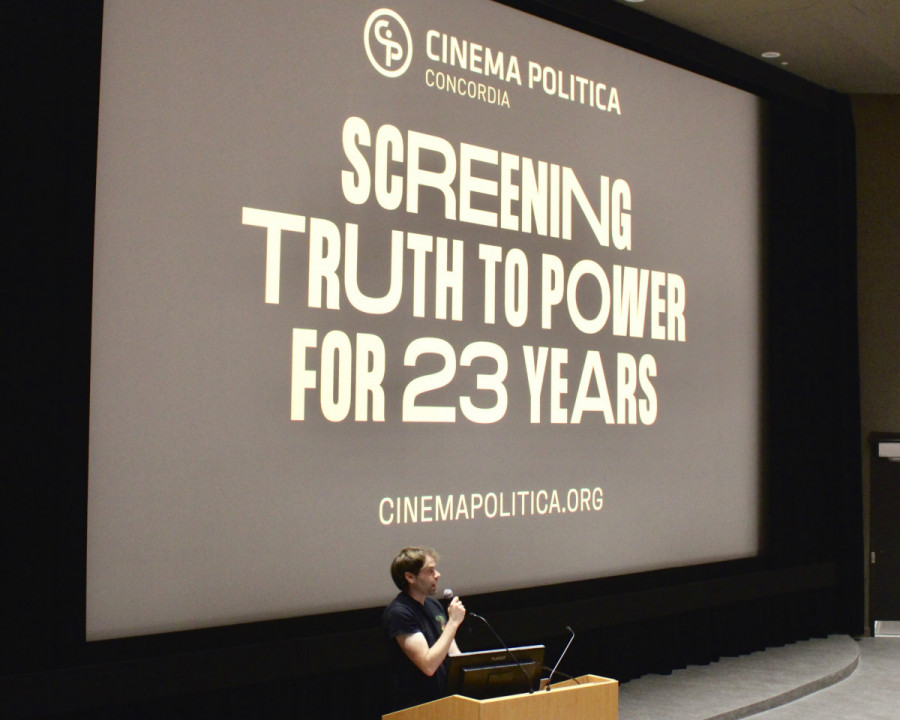
On Nov. 23, activist film network Cinema Politica hosted a public screening of Palestinian filmmaker Mohanad Yaqubi’s latest documentary Revolutionaries Never Die, which was produced using archival footage from Lebanese journalist and documentarian Jocelyne Saab.
The film documents the history of revolutionaries from Lebanon to Morocco in the 1970s. Saab was born and raised in West Beirut and studied at Sorbonne University in Paris. Saab began her documentary career when she was sent to Egypt and Syria to cover the October War in 1973 for a French television channel.
Saab continued to create documentaries on conflicts in Southwest Asia and North Africa from the 1970s through the 2000s. Her films include The Sahara Is Not For Sale and Beirut, My City.
Much of Saab's early work focused on the displacement and resistance of Palestinian refugees in Lebanon.
Samaa Elibyari, an activist and a contributor at CKUT 90.3 FM, a McGill University campus-community radio station, saw the film at Concordia University’s Sir George Williams campus. Elibyari is from Egypt and lived in Lebanon before the civil war there.
“[The film] brought up so many memories, and at the same time, unfortunately, I see that the same struggles are going on today. Whether it's on the Palestinian front, or when she talked about Egypt and the city of the dead,” Elibyari said.
In 2018, Saab sent an email to Yaqubi suggesting they work together. However, she did not receive a response and died five weeks later in January 2019. After the bombing of his family home in Gaza in 2024, Yaqubi was motivated to share her story and perspective as a filmmaker who helped document the Palestinian struggle. He was granted access to Saab's expansive archives, which covered more than 40 years of work.
Fadi AbuNe’meh, a PhD candidate in film and moving image studies at Concordia, spoke during the Q-and-A session after the screening.
“I feel respecting [revolutionaries’] memories is by trying as much as possible to reflect the actual causes and ideas they carried,” AbuNe'meh said.
Yaqubi uses archival footage to express the repetitive nature of marginalization and violence across Southwest Asia and North Africa. He works in dialogue with Saab, which is exemplified by the contrast between scenes of dancing and the destructive images of the bombings in Beirut and beyond.
Leo Stillinger, a filmmaker and research assistant at McGill, highlighted the importance of portraying these realities on film.
“I think, if the goal of activism is political mobilization, then film mobilizes you as a viewer, as a body in a room,” Stillinger said. “It affects you very differently than reading theoretical texts about resistance, and gives a very different, more vibrant, complex and more living portrait of political resistance and political action.”
The documentary also asserts the importance of archival work and its use for mobilizing activists both domestically and abroad.
According to a 2026 report issued by the United Nations Educational, Scientific and Cultural Organization, over 164 historical, archival and cultural sites in the Gaza Strip have been attacked and destroyed by the Israeli army. In 1982, Israeli forces raided the Palestine Liberation Organization’s film unit and took thousands of films into custody, many of which have not been seen since.
Stefan Christoff, who coordinates speakers and engagement at Cinema Politica Concordia, said films are a way to push back against erasure.
“They create a social space like we're seeing right now for people to talk and to connect and to recognize the collective experience and the human struggle of people who might not be recognized in Western contexts often,” Christoff said.