Concordia University at a crossroads
Navigating Quebec’s tuition hikes and French-language quotas

For years, Quebec's debate over the future of the French language has largely centred on immigration, workplaces and the changing linguistic makeup of Montreal.
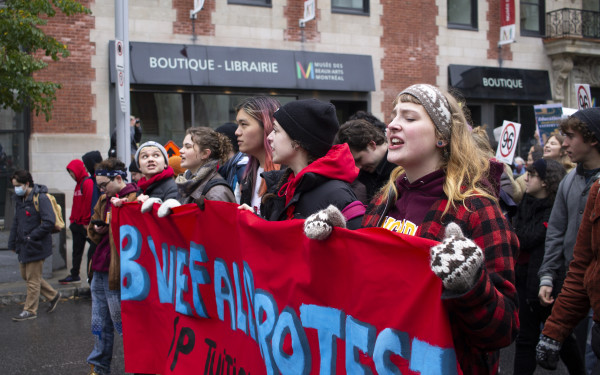
In 2023, the province's English-language universities became another front in the debate when the government announced it would raise tuition for new Canadian students from outside the province attending English-language universities. The hikes resulted in increases up to $12,000 a year, up from about $9,000.
The increase took effect in fall 2024. International students have also faced substantially higher costs due to federal tuition increases, and former Quebec Premier François Legault defended the changes as part of a broader effort to rebalance the province’s university system and strengthen French-language institutions.
The policy has already had consequences for Concordia University. It reported that its international student population fell from about 24 per cent of its student body in 2022-23 to 20 per cent in 2024-25. But tuition is only one part of the government's approach.
In June, Concordia, McGill University and Bishop's University reached an agreement with Quebec to promote French-language learning among new international and out-of-province undergraduate students.
The goal is for 60 per cent of those students to reach Level 4 in oral skills on Quebec's 12-level French proficiency scale by graduation, a lower bar than the 80 per cent at Level 5 the government demanded in 2023.
The province will provide the three universities with up to $20 million a year over eight years to support French-language initiatives.
The government has framed both measures as efforts to strengthen French in Quebec's university system, through changes to university funding and initiatives encouraging students from outside the province to learn the language.
When the government announced the tuition increase, the province said the policy would help strengthen the francophone university network and provide more resources to attract international students, particularly French-speaking students.
According to Statistics Canada, 51.7 per cent of Quebec residents could hold a conversation in English in 2021, the highest proportion recorded in a census. According to census data by Statistics Canada, 85.5 per cent of Quebec residents reported speaking French at home regularly.
For the government, English prominence in the province is part of a larger concern about French. However, for students arriving from elsewhere, Montreal can simply look like a city where both languages are part of everyday life.
Denis Liakin, current director of Concordia's département d'études françaises, said reaching a particular proficiency level does not necessarily mean students feel comfortable speaking French.
“Students need opportunities to use French in meaningful situations and to see its relevance to their academic, professional and social lives,” Liakin said.
Concordia's new French initiatives, including its FRAI immersive courses, are designed around oral comprehension and communication. The university has said its agreement with Quebec does not make participation in these programs mandatory.
Liakin said students are more likely to continue using French when it becomes part of their lives rather than something confined to a classroom.
His emphasis on daily use highlights a distinction between the government's two measures: one sets the price of attending an English-language university, while the other focuses on how students engage with French. A student who pays thousands of dollars more to attend an English university in Montreal is not necessarily more likely to speak French because of that price.
Higher tuition could have the opposite effect if it discourages students from coming to Quebec in the first place.
“Students need opportunities to use French in meaningful situations and to see its relevance to their academic, professional and social lives,” — Denis Liakin, current director of Concordia’s département d’études françaises
Richard Franco, a Concordia computer science student from Brazil, said he hadn't realized how important French would be to his life in Montreal. He now believes he would be better off studying and looking for work in Ontario.
“The language requirement is a big obstacle in an already tough job market,” Franco said.
Students arriving from several participating countries are treated differently under Quebec's international tuition rules.
The Quebec government has student mobility agreements in place with the French government and the government of the French community in Belgium. These agreements allow students in bachelor's programs to pay the preferential rate applicable to Canadian students from outside Quebec rather than the additional international tuition increase.
Other international organizations and countries have also signed agreements that grant a certain number of exceptions. At the graduate level, eligible French students can pay Quebec tuition rates.
Max Juppin is a third-year communications student who came from Paris and is enjoying the North American student experience while still being able to converse in his native language.
“What attracted me to Montreal was being able to have the North American student experience while still being in a French environment,” Juppin said.
Juppin believes the province is not simply trying to reduce the number of students arriving from outside Quebec; it is also attempting to influence which students arrive and how they engage with French.
Federal and provincial caps on study permits are also adding to the pressure. Statistics Canada estimates that the number of full-time international students at public postsecondary institutions in Quebec fell by about 14 per cent between 2023-24 and 2025-26.
The issue is not simply whether international and out-of-province students will learn French. It is whether the combination of higher costs, immigration restrictions and French-language expectations will change who considers Montreal a viable place to study.
“What attracted me to Montreal was being able to have the North American student experience while still being in a French environment,” — Max Jupin, a French Concordia University student
For the government, the objective is to reinforce French and redirect resources toward the francophone university network. For universities such as Concordia, the challenge is to promote French without undermining the international and interprovincial diversity that has helped define their campuses.
Liakin said the two goals do not necessarily have to conflict.
“Students need structured learning and the academic expertise that a department like ours can provide, but they also need low-pressure opportunities to speak French, make mistakes, meet people and gradually build confidence,” Liakin said.
Montreal is unlikely to stop attracting students from outside Quebec simply because studying here has become more expensive. The city still offers an English-language university system, a large francophone environment and a distinct position between Canada and the wider world.
However, the profile of incoming students may change. For students considering Montreal, the calculation is becoming more complicated.
Choosing a university is no longer simply a question of finding the right program. For students considering Montreal, it also means weighing tuition costs, French-language expectations and whether the city still offers enough to make those commitments worthwhile.
This article originally appeared in Volume 47, Issue 6, published November 24, 2026.