An uncertain future for Concordia’s new French immersive courses
With limited-term contracts cut and Quebec’s court ruling against French requirements, the future of francization is unclear
In the months following Concordia University’s announcement that it will not renew any limited-term teaching contracts, many have raised concerns for affected professors and their classes. But, some Concordia faculty warn that students hoping to learn French may also suffer the consequences.
The decision to cut limited-term appointments (LTAs), announced in early November 2025, came as the university continues to fight significant budget challenges and aims to hit its $31.6 million deficit target for the 2025-26 fiscal year.
Now, some professors warn the decision could affect the university’s recent francization efforts, precipitated in early 2025.
New French immersive courses
In April 2025, Concordia announced that it would launch new French language courses available to all students.
The announcement came amid broader tensions between the university and the Quebec government over higher-education policy, including a legal dispute over tuition increases for out-of-province and international students attending anglophone universities.
The Coalition Avenir Québec (CAQ) government subsequently added a requirement for 80 per cent of out-of-province graduating students in English universities in Quebec to learn French at an intermediate level.
The requirement is part of ongoing government efforts toward francization—the expansion of French language use by social groups who had not before used the language as a common means of expression in daily life.
On April 28, 2025, Concordia announced that Quebec’s Superior Court ruled in Concordia’s favour in its case regarding tuition hikes and mandatory French requirements, meaning French-language proficiency requirements were removed.
Despite the win, the university stated in the same announcement that it had a “deep commitment to helping students achieve French-language proficiency.”
According to Concordia spokesperson Vannina Maestracci, the university is still in discussion with the government on the specifics around the mandatory French courses.
Now, in January, some faculty question whether the French courses offered under the program announced in April may have a shaky future.
Concordia’s new French curriculum was created by a full-time professor, while limited-term instructor Geneviève Bibeau taught FRAI 201 and 202 and contributed to course development. Bibeau’s contract, along with those of her 62 other LTA coworkers, will not be renewed after expiry. Some professors at Concordia question whether the program can feasibly continue without Bibeau.
One of those professors is Stephen Yeager, former chair of the English department and current English professor at the university. Yeager says LTA positions at Concordia are tied to “really important program needs.”
“Every year, as chair, I had to write requests for LTAs, and I had to justify them according to our program needs,” he said. “If I had not been able to do that in a really compelling way, they would not have approved the LTAs. They didn't just hand these things out. So the 63 positions are all 63 positions that are extremely important in one way or another.”
Chair of Concordia’s French studies department, Denis Liakin, said that grievances have been filed, though he did not specify the nature of the grievances or to whom they were filed. Liakin further stated that he hopes for a “successful resolution of problems,” but declined to comment on the situation further.
Bibeau also declined to comment, stating that there was insufficient information at the time of publication for an interview.
Maestracci says that despite the LTA cuts, the program is not in jeopardy.
“We have expertise in teaching French,” Maestracci said in an email to The Link. “This expertise does not depend on a single LTA position. Once the francization pathway is fully implemented, it could lead to an increase in demand and we will reassess our teaching needs then, if that is the case.”
Anna Sheftel, principal of and professor at Concordia’s School of Community and Public Affairs (SCPA), believes that for any program to run, there needs to be proper university support.
“To actually develop the curriculum, you need continuity, you need some kind of stability,” Sheftel said.
LTAs and public support
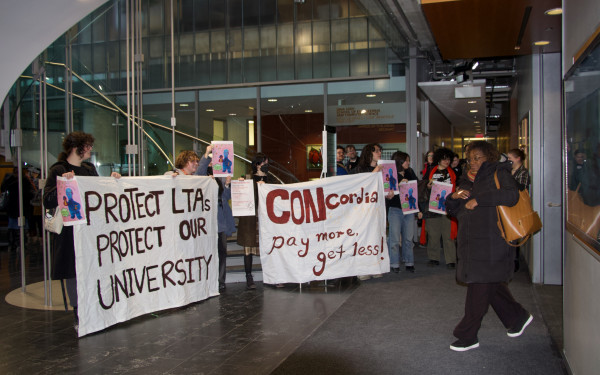
In the months following the announcement that LTAs will not be getting their contracts renewed, Concordia’s community has voiced its disapproval.
“Every year, as chair, I had to write requests for LTAs, and I had to justify them according to our program needs. If I had not been able to do that in a really compelling way, they would not have approved the LTAs.” — Stephen Yeager, former chair of English
The advocacy group Concordia Academic Solidarity Coalition created an open letter early this month, calling for “more democratic governance and decision making.”
Since its creation on Jan. 9, the letter has received over 700 signatures, and counting.
Saraluz Barton-Gomez, a SCPA and political science student, worked alongside Sheftel over the summer to gather data about Concordia’s administration and the university’s financial constraints.
“In the Senate meeting in November 2025, the administration was questioned, with senators asking the university to justify these decisions with data and numbers,” Barton-Gomez said. “The university’s leadership strategically makes their finances and data on staff extremely inaccessible.”
During the Senate meeting, a faculty member stated that they had not been provided any evidence supporting the need for lay-offs or numbers on budgets.
“We have never been given this information; so while we do not disagree that there's a crisis, I disagree that there's only one way to deal with it, because I've been given no evidence that this is the only way,” said the faculty member.
Barton-Gomez believes that the administration’s financial decisions affect their most vulnerable faculty first.
“These [LTA] professors each teach about seven classes, and are essential to the university,” they said. “They are hired on a yearly basis. Their contracts make them some of the most vulnerable faculty in the university.”
Maestracci reiterated that no LTA contracts will be renewed, but will be honoured until their expiration.
Yaeger thinks the university should take more time in updating its faculty, staff and students on its francization process.
“The basic principle of making Concordia more bilingual is a very sound one for many reasons,” Yaeger said. “If there's a new plan that's refined based on what they put into place last April, I don't think they should hide that.”
With files from India Das-Brown.
A previous version of this article linked Concordia University’s legal challenge over tuition hikes and mandatory French requirements to Bill 96. This is incorrect, the creation of the French language courses were unrelated to Bill 96. Additionally, the article incorrectly stated that the new French curriculum was created by limited-term instructor Geneviève Bibeau. While Bibeau contributed to course development, the curriculum was created by a full-time professor. The Link regrets these errors.
This article originally appeared in Volume 46, Issue 8, published January 27, 2026.




_600_375_90_s_c1.jpeg)