
The future of French at Concordia
How Concordia staff prepare to comply with new French measurements
English universities in the province have been a source of debate within the Quebec government since 2024, when hikes were announced for all anglophone universities.
The hike was a 33 per cent increase, pushing tuition from $9,000 to $12,000 for all out-of-province students. The decision stands to this day despite legal battles with Concordia University and McGill University.
Since the hikes were first announced, Concordia and other universities have been in talks with the government. A deal was finally reached in June.
The provincial government agreed to give Bishop's University, McGill and Concordia a total of $20 million in funding. The universities, in return, are expected to have 60 per cent of out-of-province and international students, starting in Fall 2026, graduate with a Level 4 of French proficiency according to Quebec’s 12-level scale. Level 4 is defined as being able to understand the general meaning of short conversations related to everyday activities or situations.
Caroline Baril is an executive director of the Provost and Vice-President Office at Concordia University. She wants to help non-French-speaking students learn the language so they are better equipped in Quebec.
“On an institutional level, everybody is really excited about this,” Baril said. “We've already been doing things; there’s already an institutional commitment.”
Baril emphasized that they have already helped by launching the Bureau de la valorisation Française (BVF). This bureau is in charge of connecting students to the broader Montreal francophone culture. They do this with events like the upcoming Parcours Francoville, a festival organized by Université de Montréal in partnership with Concordia and other universities.
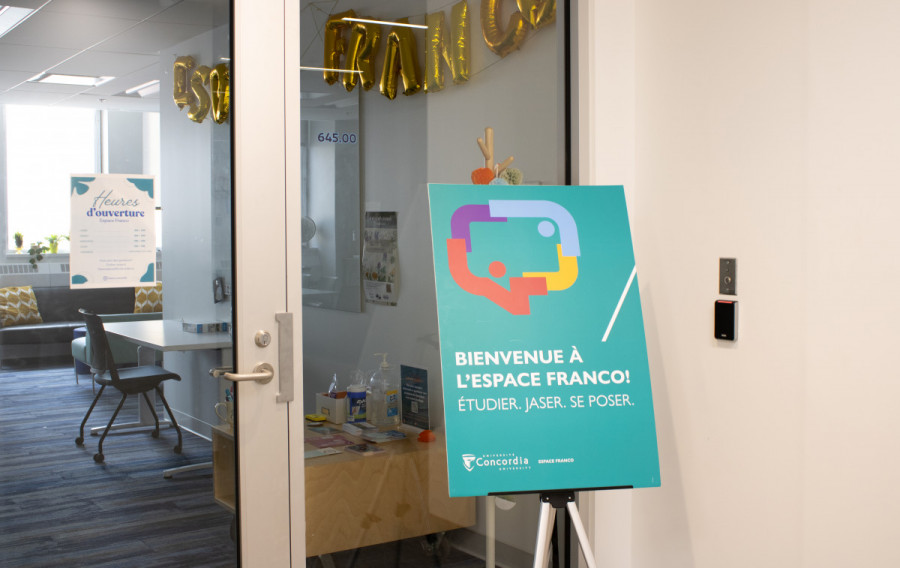
Since the deal was announced, the provost's office has started to integrate the French language into student life, professional tools and academics. Among the institutions they have been working with are the Student Success Centre, Homeroom, residences and Espace Franco.
Each student organization has its own plan to add French to its operations so that there’s something available for all students.
According to Baril, residences are arranging to have francophone resident advisors at Sir George Williams and Loyola to help promote the French language with activities such as movie nights for students living on campus.
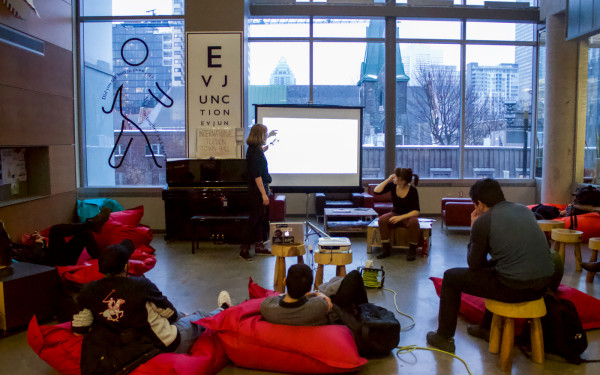
Commuter students have access to the Franco pods in the Homeroom. “Pod” is how the Homeroom refers to its smaller groups; a pod usually has around 15 students. Baril explained the new Franco pods are meant to provide peer-to-peer support and encouragement to practice French in a low-pressure environment. The pods are available throughout the year and will also provide students with tips for navigating the city, as well as priority access to Quebec cultural events.
Student leaders are also looking for ways to accommodate peers who prefer a casual, social approach to language learning.
Grace Demara is the academic coordinator for the Arts and Science Federation of Associations (ASFA). She is trying to make learning French more accessible and less time-consuming by thinking of creative ideas that ASFA can implement by the end of the year.
“[We’ll have a weekly] French club with a native speaker managing it so students can drop in and be assessed by [them],” Demara said. “[We’re] working with other bodies at Concordia like the Concordia Student Union.”
On a professional level, Concordia has rolled out some projects aimed at helping students gain field knowledge of their major in French.
“There’s a lot of advantages on the future career plan for students,” Baril said.
She added that some of the available tools to explore are the LexiConcordia website, a professional lexicon developed by the BVF, meant to help students learn French jargon related to their field.
The long-term plan is to host immersive French programs tailored to specific departments. This has been done previously by the fine arts department, which developed a nine-credit course with the Musée d’art contemporain de Baie-Saint-Paul to help non-francophone students practice the language while they gain practical experience.
Baril noted that they are still working on creating similar programs for other faculties, as the BVF is still figuring out where the interests of students and departments lie.
Academically, the French department is ready and confident in doing its part to achieve the 60 per cent goal.
“If we are asked to open 10 new [class] sections in French, we will open them. We just need to have the demand,” Denis Liakin said, who is the department chair.
The French department’s highlights are the newly added French immersive courses, which can be found under the course code FRAI. Liakin assures that these are a real investment for the department.
The professor in charge of imparting these courses is Geneviève Bibeau.
According to Bibeau, these courses are primarily for students who are not necessarily in French studies and are in programs that are very competitive.
She underlined that these can be taken without a student’s GPA being impacted.
FRAI courses are evaluated on a pass/no pass grading scale, making them a perfect fit for students who might be anxious about negatively affecting their GPA.
Bibeau remarked that FRAI classes place more importance on oral communication skills. “[They are] what’s most important when you want to take part in a society,” Bibeau said.
According to Liakin, the last course in the set, FRAI 203, is very important because it is where students are taught the required material to achieve Level 4 of Quebec proficiency.
The French department has launched the Learn French as a second language website. Students can look into which class pathway suits them best.
The provost's office has introduced the Oui Can Help website.
“We put together the hub, which has the information about all the [French] initiatives and support for students,” Baril said.
“It's been a few years now where we've been very careful about doing anything new or shiny, because of [budget] constraints” she remarked. “Now we have support to do something that's really nice and valuable for our students, it's exciting,” she added.
This article originally appeared in Volume 47, Issue 1, published September 8, 2026.



_600_375_90_s_c1.jpg)