What happened last year at Concordia University
A look back at protests, arrests and security at the university and how the administration responded
From September 2024 through spring 2025, Concordia University saw on-campus policing, arrests during two protests, the hiring of private security and advisory council resignations.
This retrospective traces the flashpoints, how decisions were justified, who was affected and what demonstrators can take into this year.
The flashpoints
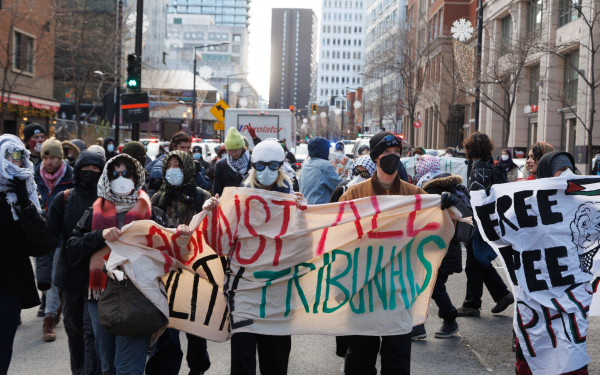
Sept. 25, 2024 – Walkout and three arrests. A daytime Palestine solidarity walkout travelled from the Henry F. Hall Building through campus tunnels and out onto the street. SPVM officers arrested three people at the Guy-Concordia Metro station on allegations of mischief, assault and obstructing a police officer, according to police quoted at the time. The arrested students were aggressively handled by police officers, with one woman yelling that she couldn’t breathe as an officer kneeled on her back, according to eyewitnesses. Concordia later said Campus Safety and Prevention Services (CSPS) had alerted the SPVM in advance and that one CSPS agent was assaulted while intervening in response to vandalism in the tunnel.
Oct. 31, 2024 – Cops Off Campus and two arrests. A demonstration opposing police presence on campus ended with two student arrests. The SPVM and a university spokesperson said officers intervened after the students allegedly assaulted a CSPS agent. One protester alleged that one CSPS officer began chasing a student through the tunnels before the student was detained by SPVM officers in the LB building.
How Concordia’s art gallery entered the picture
The Leonard & Bina Ellen Art Gallery was, perhaps unexpectedly, drawn into the year’s conflicts. In November 2024, a scheduled artists’ talk became a surprise silent protest against the arrests of students in the vicinity of the gallery and the dismissal of gallery director Pip Day. Artist Ésery Mondésir criticized the gallery’s use as a “detention centre” during an Oct. 31, 2024, protest and alleged that the community has reason to believe Day was fired because of her support for Palestine.
By January 2025, five of the gallery’s eight advisory council members resigned. In their public letter, they pointed to “disturbing events” during the previous semester, including the arrests and the director’s departure. They also argued that the university failed “to recognize the legitimate right of the entire Concordia community to peacefully and meaningfully express their solidarity with the Palestinian people.”
The university did not confirm any connection between the director’s dismissal and activism on campus.
More recently, on Aug. 18, artists scheduled for a gallery screening withdrew “in protest against the use of their work to artwash Concordia’s suppression of Palestine solidarity at the Gallery and on campus,” according to an Instagram post by Regards Palestiniens, Artists Against Artwashing, and Academics and Staff for Palestine Concordia.
How Concordia’s security strategy shifted
In November 2024, The Link reported that some students, particularly those from marginalized communities, said they felt surveilled and at times mistreated by campus security.
“You can see the shift,” said a former student union executive at the time. “Security has become more aggressive with students connected to pro-Palestinian activism.”
A Concordia spokesperson told The Link that she encourages students who feel targeted by security to file a complaint with the Office of Rights and Responsibilities.
For 14 days during the Fall 2024 semester, Concordia hired Perceptage International, an external firm founded by a former Israel Defense Forces soldier. According to university records obtained by The Link, the firm’s agents were issued CSPS logo patches and tasked with “crowd control and special intervention.”
A video posted on Nov. 22, 2024, on the Solidarity for Palestine's Honour and Resistance (SPHR) Instagram page, appeared to show the extent of security officers’ intervention in student activism. In the video taken during the student strikes for Palestine, Perceptage and other CSPS officers appear to be aggressively pushing students away from picketing actions and into the stairway of the Hall building, while students shouted: “Don’t touch them, don’t shove them, these are Concordia students.”
Concordia’s deputy spokesperson claimed the Perceptage agents were Canadian Armed Forces veterans and said supplemental staffing was added after reports of “aggressive behaviour, assault and vandalism” at demonstrations. Student organizers criticized the optics and reported rough handling during pickets.
Concordia also publicized protest “behaviour guidelines” at the start of the 2024 Fall semester, outlining existing rules for picketing, encampments and classroom access, and noting that breaches can trigger investigations and sanctions.
How student leaders responded
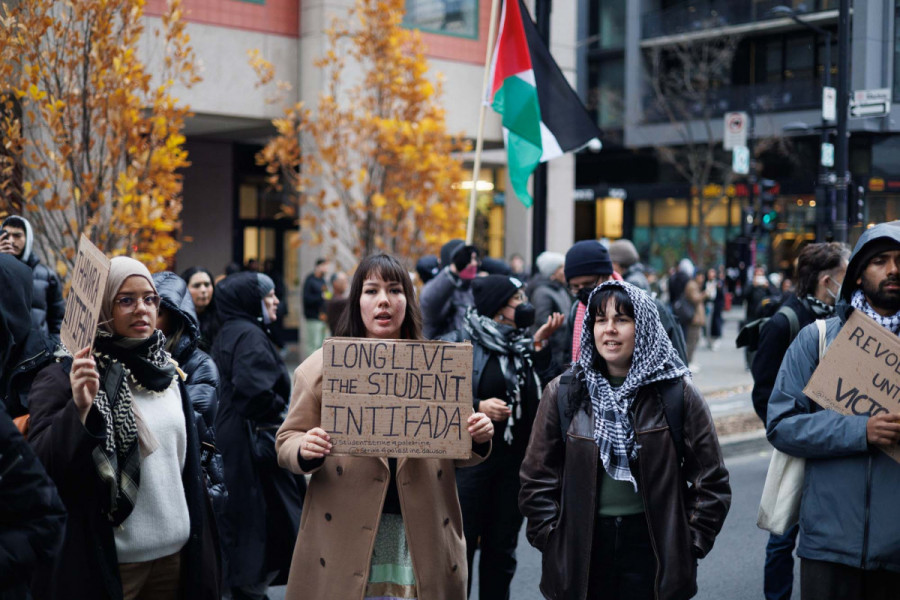
Following the September and October 2024 arrests, the Concordia Student Union (CSU) held a press conference with allied groups, alleging police brutality and racial discrimination at the university, while demanding that police be kept off campus.
On Jan. 29, 2025, over 800 undergraduates voted to mandate the CSU to adopt two Boycott, Divestment and Sanctions motions for “financial investments which are currently held in funds complicit in or which benefit from militarized violence, war, colonialism, apartheid, and genocide.” Concordia president Graham Carr released a statement the next day saying that such boycott campaigns run “contrary to the value of academic freedom.”
A week later, Concordia opened an investigation into how the special general meeting was conducted and suspended the CSU’s ability to book campus spaces, citing alleged policy breaches, pending the outcome. After the CSU sent a legal demand and sought relief in court, Concordia temporarily restored limited booking rights so elections could proceed.
Can you still protest safely?
Knowing Concordia’s protest guidelines can be helpful. Being aware of the limits—such as restrictions on blockades or classroom access—can help participants anticipate when police might be called.
Documentation is one of the strongest forms of protection. Protesters who record events through video, photography or even audio recordings create a public record that can later be used to clarify disputed accounts. It is also helpful to plan exits in advance and identify safe meeting points should a demonstration be dispersed.
In practice, protests on campus may not be risk-free―but no protest is without risk. How 2025-26 feels on campus remains to be seen.
This article originally appeared in Volume 46, Issue 1, published September 2, 2025.