Image+Nation’s LGBT2SQueer film festival returns for its 38th edition
The festival showcased queer stories from all around the world and from home

From Nov. 20 to 30, Image+Nation returned for its 38th edition of Montreal’s LGBT2SQueer film festival, screening a variety of queer and Indigiqueer films throughout its 10-day programming.
With more than 125 movies from 38 different countries, the festival offered a wide range of stories told from diverse perspectives.
"Our voices need to be strong and our stories seen as we enter a moment in history that does not favour difference,” festival organizer Charlie Boudreau said.
This year’s edition also introduced its first-ever “student night” dedicated to showcasing student films from across film schools in the province, highlighting the next generation of Quebec-based filmmakers.
It also celebrated the 25th anniversary of Queerment Québec, an initiative that aims to give a platform to local queer creators.
“It is a gift and a reminder that our indigenous languages hold our stories and our people together.” — Isabelle Ruiz
The opening night began with a cocktail hour at the Outremont Theatre, followed by a red carpet featuring the cast and crew of Blood Lines, the second feature from Métis writer, director and actress Gail Maurice, along with festival organizers and partners.
Speeches given before the screening of Maurice’s Blood Lines highlighted the importance of the festival and the need to continue sharing queer stories.
The ambience was welcoming and friendly, and the excitement could be felt throughout the room.
The film blended drama and comedy. While it centred on a queer romance, it also tackled issues in the Indigenous community, such as the separation of children from their parents at birth. It tells a love story of two Métis women who meet when one of them arrives in the community in search of her biological parents.
Isabelle Ruiz, member of the Indigenous Screen Office, talked about the Michif language spoken in the film, which today has only around 1,000 speakers left, including Gail Maurice
“It is a gift and a reminder that our indigenous languages hold our stories and our people together,” Ruiz said.
Maurice and some of the actors were in attendance and stayed for a Q-and-A after the screening. Also present was acclaimed filmmaker Alanis Obomsawin, internationally renowned for her documentaries on indigenous issues, whose surprise appearance was warmly received.
The biggest and most anticipated event was the Heated Rivalry world premiere on Nov. 23, ahead of its Crave release, complete with a red carpet for members of the cast and crew.
Hundreds of fans of the original book series gathered at Concordia University’s Sir George Williams auditorium for the screening of the first episode.
The energy was electrifying. Fans were excited, and many dressed up in hockey jerseys to match their favourite characters.
The “red” carpet, which was changed to blue to fit the show’s aesthetic, featured the main actors Hudson Williams and Connor Storrie, author of the book series Rachel Reid, as well as TV director Jacob Tierney and François Arnaud.
“When I read the script, I fell in love. It just made sense to me. I knew I had to do it,” Williams said about his casting.
A number of queer Quebec-based influencers were also in attendance. Sami Landri, known for her funny videos and appearance on Canada’s Drag Race, and Xénia Gould, who hosts a podcast with Landri, were both on the red carpet and in attendance for the screening.
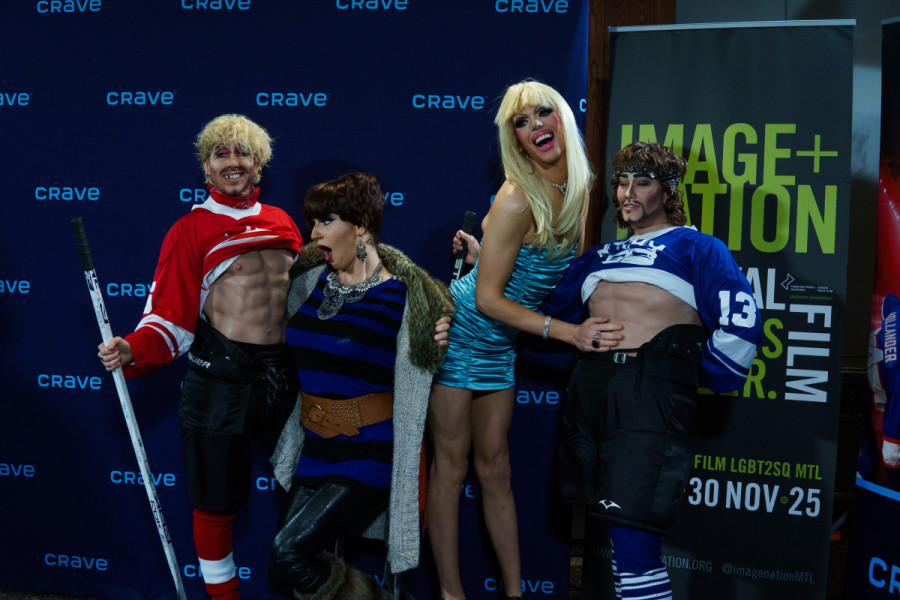
The energy inside the auditorium surpassed even the red carpet. The fans’ reaction was everything a cast and crew could hope for. They came together after the screening to discuss the show and the filming process.
Some other highlights of the event included the French feature film Des preuves d’amour by Alice Douard; Montreal, ma belle by Chinese-Canadian filmmaker Xiaodan He; Sophie Hyde’s Jimpa featuring Olivia Colman; and a variety of themed short-film nights.
“We are proud of the thrust we are given and excited to do our part in showing queer Canadian cinema, and contribute to a culture that reflects all of our voices,” Boudreau said of the festival’s programming.
Other themed events included the student night, the “KINO Night,” which featured more experimental and independent shorts, and the “Lesbo-Queer: Sapphic Scenes” program centred around sapphic storytelling.
“Documents: Queer Histories,” an exhibition of documentary shorts, explored the complex realities of the queer experience through many different lenses. From Nova Scotia to the Czech Republic, this night featured films from all around the world, representing people across diverse sexualities and gender identities.
“Indigiqueer Night,” on Nov. 27, was dedicated to Indigenous queer shorts. With an overwhelming lack of representation in Hollywood and mainstream media, it was meaningful to see such a prominent space given to Indigenous filmmakers at the festival.
“This is an important milestone that really speaks to the excellence and the breadth of indigenous cinema at this moment,” Ruiz said.
By the end of its 10 days, Image+Nation once again proved why it remains a cornerstone of queer cinema in Montreal: it brings communities together, platforms voices too often overlooked, and keeps pushing the boundaries of whose stories get to be seen.