The catalogue of stories at the Webster Library
Tracing a bigger story about underfunded public spaces in Montreal
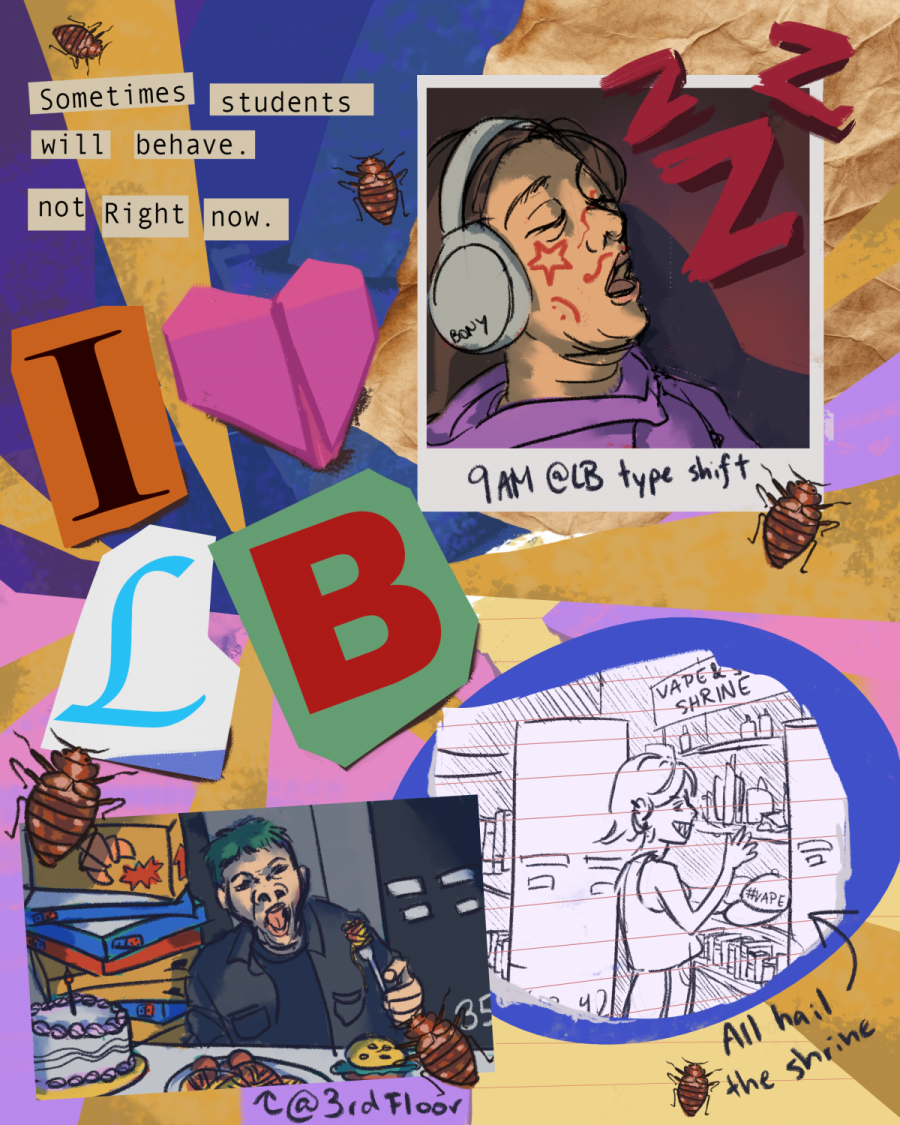
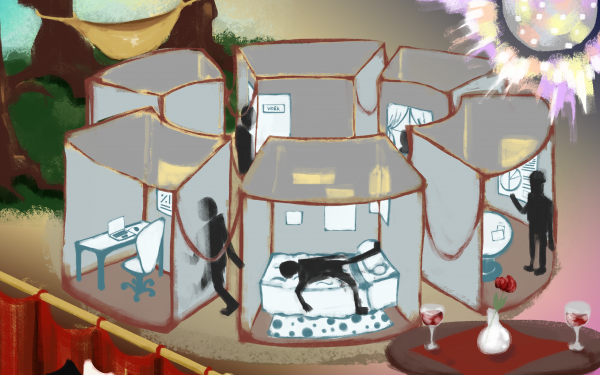
From abandoned coffee cups scattered across desks to rumours of bedbugs jumping around the second-floor couches, it's almost impossible not to have at least one funny, interesting or perhaps even stinky anecdote from our beloved Webster Library.
Renovated almost 10 years ago, Concordia University’s library has become more than just a space for long study sessions; it’s also a key part of the university's social life. It’s not uncommon to overhear personal stories or conversations, or to see full meals being eaten even in closed areas.
This is without mentioning the more peculiar ways some outside visitors have used it.
I myself have witnessed entire take-out meals left open and hanging around, especially on the lower floors, as well as groups of uniformed high schoolers making noise and taking up crucial space during finals week.
It would be easiest to simply blame the lack of library etiquette among our student body, or to point fingers at other universities and CEGEPs whose students may have too much access to this space. But the university and the city itself also deserve some of the blame for failing to provide better alternatives. Not to mention, the university’s decision to cut expenses and tighten its budget will only worsen the already packed atmosphere at the library.
While the garbage, noise and poor manners of a few individuals can’t be fully solved through policy, it's the university’s responsibility to give students the spaces they need—and the city’s responsibility to address broader social issues.
Realizing exactly how directly policy shapes our day-to-day well-being can be a wake-up call. It also serves as a reminder of how much care our public spaces need at a time when they’re getting increasingly less and less of it.
While the new Reggie’s terrace, as well as the Hall building's floor renovations, may bring some relief, it's hard to ignore the deterioration or lack of space to socialize in many (if not most) different areas. The issue of underfunded spaces is especially brutal in the winter, when options for roughly 35,000 undergraduates to eat and hang out become even more limited. Not to mention staff, graduate students, and passing visitors who add to the lot.
Yet this isn’t just an internal problem. Montreal's own housing crisis spills directly onto our downtown campus. As of 2025, more than 5,000 people in Montreal are living without stable housing, and visible homelessness across Quebec has risen roughly 20 per cent since 2022.
For a library open into the early hours, that reality can manifest as reports of needles left in LB’s first- and second-floor washrooms, or people in visible medical distress in the stalls.
Concordia is a public university, which means more than half of its operating revenue comes directly from the Quebec government, and its library is free and open to the public. That accessibility should stay intact without question, but whether students’ own needs inside that space are getting enough attention is still up in the air.
From the student's side, we should try to strive to push these policies both inside and outside our university. For many university students, this is the first time navigating adult life largely on their own.
Realizing exactly how directly policy shapes our day-to-day well-being can be a wake-up call. It also serves as a reminder of how much care our public spaces need at a time when they’re getting increasingly less and less of it.
While gossip about meet-cutes and make-out sessions behind the rolling boards will never truly leave Webster, we can hope its catalogue of stories will become less about uncomfortable anecdotes and sticky situations, and more about how it can be the library Concordians actually need.
This article originally appeared in Volume 47, Issue 1, published September 8, 2026.