
Concordia alumnus curates a video art screening on family memory
Local artists Andrés Solis Barrios and Guillaume Vallée discuss their approach to experimental filmmaking with Daniela Paglione
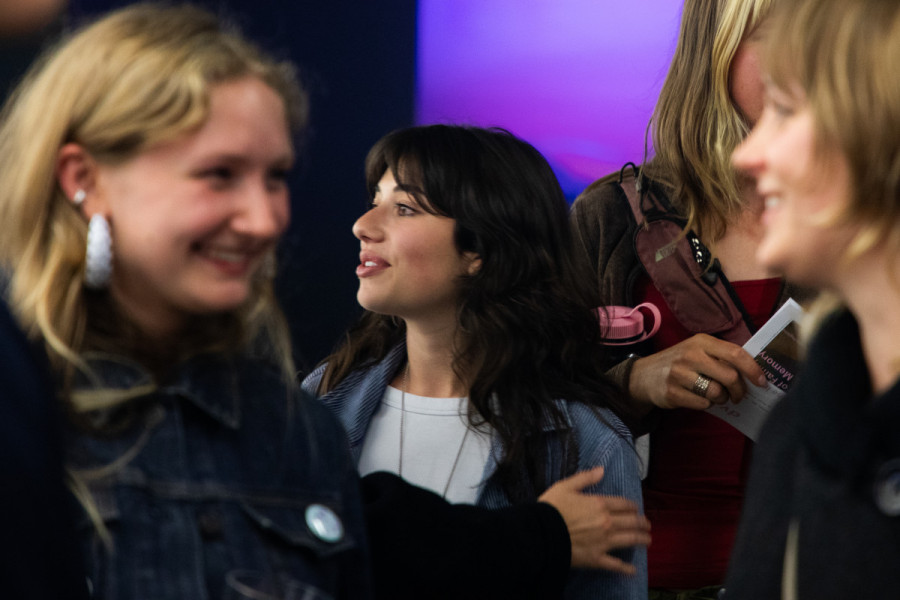
Concordia University alumnus Daniela Paglione hosted the latest edition of dv_vd titled Après l’image: les traces de la mémoire familiale at Dazibao on Thursday, Sept. 24.
It is central to our mission to continue celebrating the works in our collection, not just recent works, but to remember what the collection is all about. — Alexandra Boilard-Lefebvre, executive director, Vidéographe
The 10-year film art program curated by Paglione aims to showcase Vidéographe’s collection, the artist-run distribution centre established in 1971.
“The goal is to foster encounters, whether between people or with works of art, and to promote experimental film and video art,” Vidéographe executive director Alexandra Boilard-Lefebvre said.
The program included pieces from 1984 to 2022 by Luc Courchesne, Vern Hume, Andrés Solis Barrios, Guillaume Vallée and Louise Bourque.
“It is central to our mission to continue celebrating the works in our collection, not just recent works, but to remember what the collection is all about,” Boilard-Lefebvre said.
Inspired by Marianne Hirsch’s concept of familial gaze, Paglione explores how family shapes memory through specific social and cultural constructs. In her current filmmaking and curatorial practices, she investigates how experimental films create their own type of memory.
“I come from a very close-knit Italian family. The concept of family has always been very important to me. All of these moments that I spent with my family are moments that obviously I wish I could preserve,” Paglione said. “In my mind, these beautiful memories play on a loop until the passage of time.”
After the screening, Paglione conducted a 15-minute interview with artists Andrés Solis Barrios and Guillaume Vallée to discuss their artistic intentions.
“I was curious to see how other artists create, manipulate, and express themselves through these images of their family pasts,” Paglione said.
In his piece The Needle and The Drum, Solis Barrios draws the portrait of his grandparents through their respective attributes. He creates a dream-like space of memory by distorting archival footage with film grain, playing with rhythm, patterns, colours and essayistic voice-over.
“For me it's still like a home movie, whenever I show this to my parents from time to time to remember and see,” Solis Barrios said.
Similarly, Vallée explores his grandmother's death in Grand-Maman Piano. Starting with a voicemail of his mother announcing his grandmother's passing, he compiles her last footage and moments from her funeral, combining 35-mm photos, Super8 film and printed digital stills.
He relied on different hand-processing and rescanning techniques, notably scratching and solarization, which involves flashing light onto the film strip during development.
“I didn't use any archival footage for the film. I created my own archival footage of my grandmother; I treated my images like found footage,” Vallée said.
Together, the artists explored the medium's physicality and its capacity to relate to the perception of memory and its degradation over time.
“Especially with Guillaume and Louise's work, the image is almost not even there anymore. Archives are never fixed traces; they’re never going to be this perfect image. We can see the deterioration of the image become an actual visible substance of memory,” Paglione said.
After the event, the audience, artists and organizers gathered in Dazibao’s exhibition space for casual refreshments.
"When we hear the artists speak, it's something that's very touching. Family archives are so universal," attendee Sophie Alexander said.
Claire Heisz, another audience member, added her thoughts.
“It's oftentimes the most meditative moments of a work of art that bring back the most visceral memories for me,” Heisz said.
The pieces showcased in the program are available on Vithèque, Vidéographe’s streaming platform. The next edition of its vidéo-club program Spectateur, ennemi will take place on Oct. 20 at Cinéma Moderne, with a program showcasing video works by Brazilian Indigenous artists curated by Daniel Dinato.



_600_375_90_s_c1.jpg)
_600_375_s_c1.png)