Through the looking glass
Martin Dansky, stalwart of the Montreal art scene, never stops
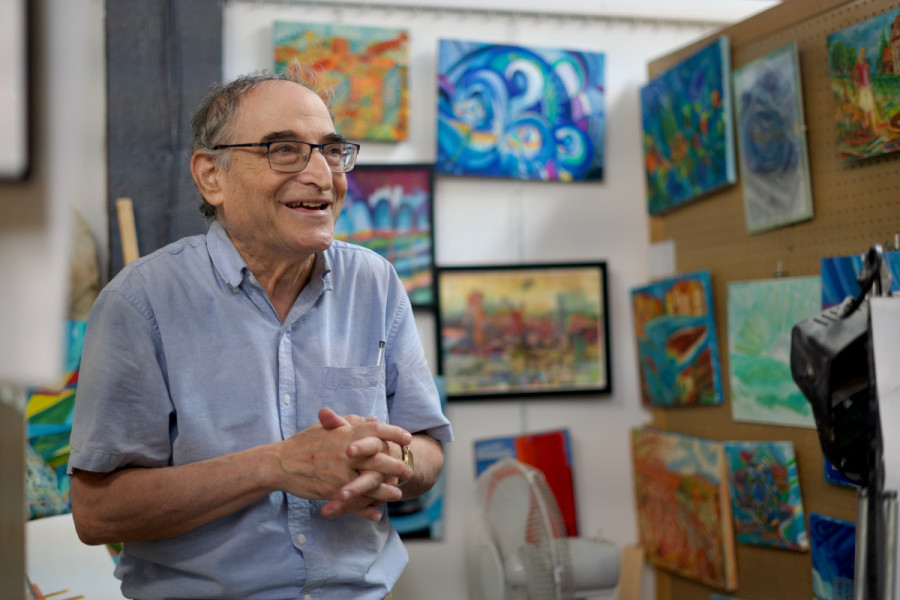
Martin Dansky peeks out from the opening of his stall like a vendor through a hole in the wall, a seller of wares, on the second floor of the Montreal Art Center and Museum in Griffintown, which has more in common with a labyrinth than a museum or an art centre. Baroque mannequins and antique furniture fill spaces previously used as studios. This transformation was led by owner and artist Allan Diamond.
Artists’ works awkwardly present themselves simultaneously as museum artifacts and pieces of expression. A few of Diamond’s artworks hang on the walls of some rooms alongside other artists who call the centre home, either as exhibitors or as artists renting a studio space. Dansky is the latter.
In Dansky’s space, pictures hang at slight angles on the makeshift walls. Pamphlets are shyly displayed behind one another. Postcards supporting Ukrainians at war sit for sale, highlighting Dansky’s heritage.
Dansky fidgets around his stall, seeming overwhelmed. His movements and eyes portray uncertainty.
His studio space comes off a little untidy since he is not there often and spends most of his time working at home. Most of Dansky’s art is at his home, though he brought in artwork to his shop to present and discuss for the interview with The Link.
Dansky is most interested in showing his most recent works: abstract geometric forms that use bright primary colours in stark contrast to one another. Some are more figurative than others; one is a cityscape entitled Cityscape Abstract II. Given that Dansky calls Montreal home, it could have been mistaken for a representation of the city, but Dansky clarifies that it is more general than that.
“It’s an interpretation of a cityscape,” Dansky explained.
The bulk of his recent paintings, which are done in acrylic, use strong, rigid lines with an almost fabric-like texture across the canvas.
The result can be quite jarring, a busy painting that elicits no sense of place. They are well-composed and situate the viewer in an uncomfortable position, looking at something beautiful but unfamiliar.
I’m in the business of making things that please people too. The artist does what he feels, [so] that he can communicate with people. There obviously has to be feedback from them. — Martin Dansky, Montreal-based visual artist
This style works well when directed towards certain themes. For example, his painting Multidimensional Circuit evokes the shifting geometric scales that make up the interior workings of computers. This aligns with Dansky’s fascination with multidimensions, which intentionally runs through all his latest work.
“Multidimensional means that you can see this from various perspectives," Dansky explained. "Everything has several planes, and the planes are juxtaposed. They compete for attention. It helps create this vibrancy. So you have these ripples that seem to be on different planes. And they overlap."
A noticeable difference separates Dansky’s contemporary work from his earlier paintings. The latter uses a warmer colour palette and has more familiar subject matter. Quotidian scenes are gently depicted.
For instance, one piece shows a summer’s day out on his apartment balcony. A watermelon and menorah are set on the balcony table on the left. To the back-right, an open glass door reflects the scene from another angle, perhaps pre-empting his later interest in multiple views.
Windows and openings feature heavily in Dansky’s earlier pieces. Figures who seemed stuck in the frame look through gaps to the viewer. Geometric shapes serve as an escape, or otherwise as windows between worlds.
Dansky is a sensitive person, and that sensitivity extends into his art, as shown in his full adoption of an abstract world populated by geometric shapes. This is not a retreat from the real world, but an acceptance of its shifting views. That is the strength of his multidimensional approach to art.
“That square is like a window on life. It's kind of suggestive. She's got a past, let's say, or has a future, and the idea is: how do I show that a person has a past?” Dansky said, describing a painting which shows a young girl with a frame on her chest.
The girl in the piece wears a jumper that Dansky’s grandmother made.
“She’s got a soul,” Dansky said.
Fellow artist Roxanna Kibsey has worked alongside Dansky at the museum in Griffintown since he first took up a studio space in 2012.
“Every artist has their own style. As much as you try and change it, it’s difficult," Kibsey said. "We evolve so much, but you are who you are as a person, and you are who you are as an artist. I think Martin is very much that.”
Alongside the visual arts, which is Dansky’s mainstay, he also writes and acts. Small books containing his poems and paintings, which keep him creatively busy, were also for sale in his studio-shop.
Kibsey points to Dansky’s acting as the area where he most fully developed a personal style, especially in his work for several community theatre productions.
Miriam Posner has known Dansky for over half a century, the two having met when they were teenagers.
“He’s always been driven by, and motivated by, the arts,” Posner said.
His creative endeavours are outpourings of passion, and his entire life’s work is a testament to what can be done when one pursues what is in his soul, as Kibsey puts it.
“Kudos to him. How many people do you know who, from their late teens, never ever wavered? How many people can one say never put money over passion?” Posner asked.
In her house hang portraits of her animals that Dansky painted.
“And he’s a very kind, gentle, thoughtful person. And that comes through in his paintings as well,” Posner added.
Dansky’s part-time tutoring jobs and teaching contracts have helped fund that lifelong ardour. That is not to downplay his success as an artist. Dansky knows his art relies on the patronage of his customers, and he is not naive about their demands.
“I’m in the business of making things that please people too. The artist does what he feels, [so] that he can communicate with people,” Dansky said. “There obviously has to be feedback from them.”
This back-and-forth relationship encapsulates Dansky’s relationship with his patrons and admirers.
Dansky is still preoccupied with creating and exhibiting his art, mostly paintings nowadays. He has a forward-looking approach to his work, no small feat for someone in their early seventies. He is currently busy preparing for an exhibition at the Leonardo Da Vinci Centre on Nov. 10.
Dansky seems unwilling to slow down, keeping a positive view of the future. He is aware of Montreal's highly competitive art market, but he remains resolute in the thick of it.
This article originally appeared in Volume 47, Issue 3, published October 6, 2026.