Concordia does not care about its disabled students
Is the university really ready to support its students and faculty?
As a human relations student at Concordia University, I have had a plethora of opportunities to examine my own privileges. One of the biggest privileges I have—and anyone can have—is an able body.
But Concordia seems to forget that many of its students and faculty don’t have this privilege. In fact, they seem more than content to push aside those who need a little extra support. Students and faculty alike face academic hurdles when seeking accommodations for non-visible disabilities and physical obstacles like missing mobility ramps and elevators.
As of 2025, 5071 students are registered with the Access Office for Students with Disabilities (ACSD). That is roughly 10 per cent of the student body, not a small amount at all. These disabilities range from attention-deficit/hyperactivity disorder (ADHD) to mobility, hearing, vision and more. While the ACSD provides in-class accommodations, campus building accessibility is out of their control.
Last semester, during an experiential learning exercise designed to identify limitations for physically disabled students in a given environment, my classmates and I found 18 barriers for disabled students accessing classrooms or bathrooms in a single hallway in the Central (CC) Building on Loyola campus.
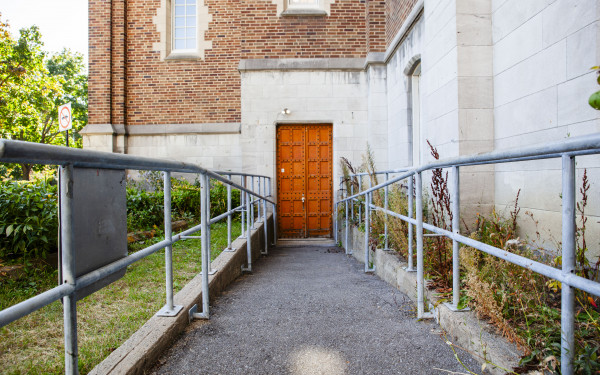
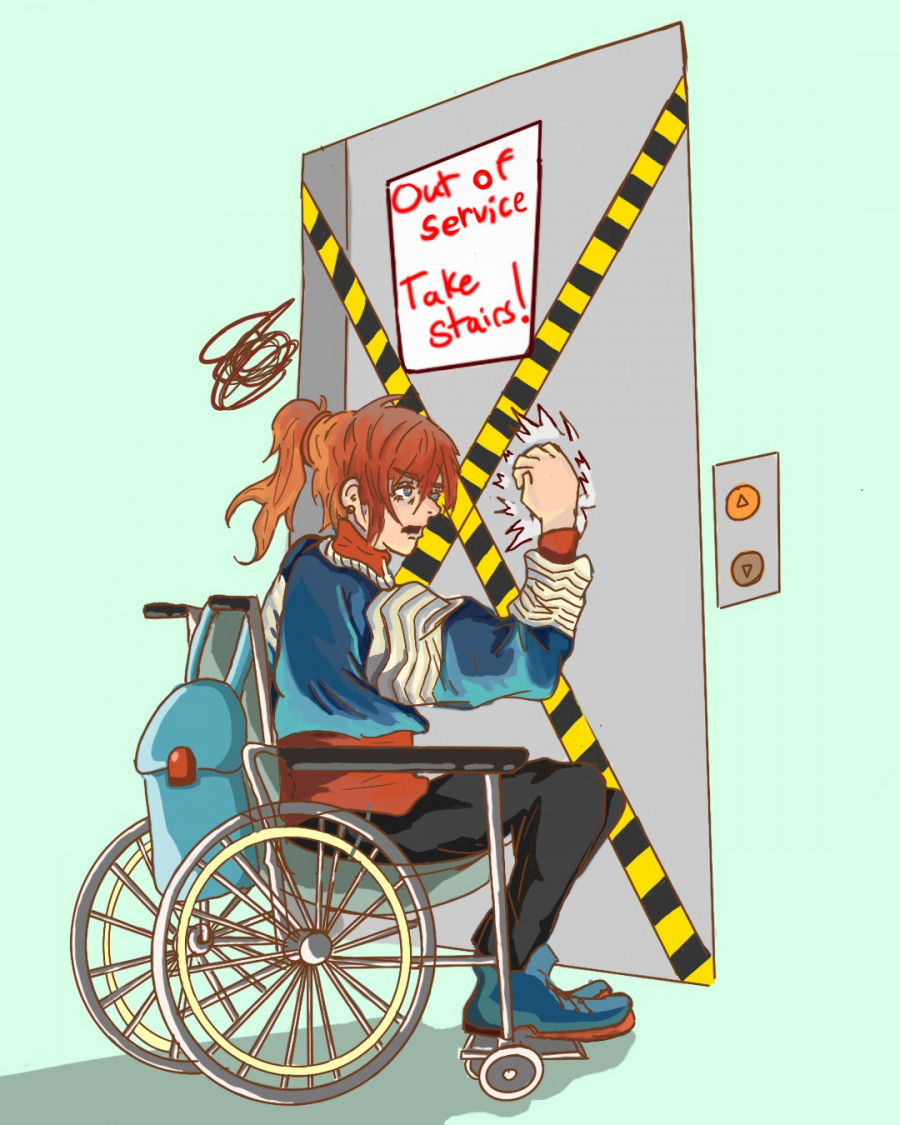
Elevators, escalators and wheelchair lifts are frequently out of order. Many club annexes and older spaces lack proper retrofitting, and numerous interior doors lack automatic push-buttons. Those that do have buttons are often non-functional. While campus maps do state which buildings are accessible, critical layout details, like the exact placement of accessible doors, ramps and functional elevators, are often missing from standard campus maps.
You begin to ask yourself: Are they trying to make it as hard as possible?
The facilities department at Concordia claims to enhance accessible and inclusive facilities on campus. But the lifts and elevators that have been out of order for longer than is acceptable say otherwise. One user on the Concordia Reddit page shared that they submitted a ticket identifying an issue and received an email weeks later saying it was fixed. Still, when they checked, nothing had actually been done.
This is not even to mention the lack of elevators at the Guy-Concordia metro station, despite it being one of the busiest stations in the city. While not explicitly in the university’s control, this is a serious barrier to physically disabled students and faculty when planning their commute to school. The Société de transport de Montréal (STM) claims to prioritize the addition of elevators near schools, yet Concordia seems to have been forgotten.
Why hasn’t the university taken it upon itself to advocate for its students with the STM by demanding they implement accessibility measures in the metro? Having safe and reliable transport to school should not be at the bottom of its list of priorities.
Disability is not a small problem affecting few people that we can simply ignore out of existence. Disability can happen to anyone in the blink of an eye, and Concordia has proven that it cannot—or will not—do what needs to be done for its students.
Instead of fixing elevators and broken lifts and enhancing services that help vulnerable Concordians complete their education more easily, Concordia University has shown time and again that it thinks the best allocation of its funds is to give Graham Carr another raise.
This article originally appeared in Volume 47, Issue 3, published October 6, 2026.