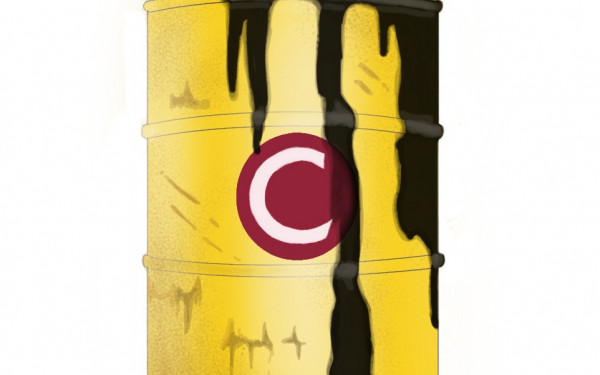
Ten years of sustainability at Concordia
The university completed less than a quarter of its sustainability targets for 2025

In 2016, Concordia University’s Board of Governors enacted a sustainability policy, which it presented as a “mindset and a process that leads to reducing our ecological footprint and enhancing social well-being while maintaining economic viability.”
Ten years later, the policy has morphed into the Sustainability Action Plan (SAP), an initiative broken down in five-year increments intended to lead the university to its 2040 climate goals. A new version of the action plan is underway for September 2026.
The topic began percolating at Concordia in 2003, when Sustainable Concordia became a student fee-levy group after the university conducted an assessment of sustainability for its campus.
The Sustainability Action Fund (SAF) was then launched in 2007 and is still an active fee levy group today. The SAF collected almost $400,000 in revenue in the 2024-25 academic year for sustainability projects at the university.
In 2017, work towards the action plan began with community consultations, which led to the action plan being divided into five subsections with distinct sustainability objectives: sustainable food systems, zero waste, climate action, sustainability in research and sustainability in curriculum.
The development of the policy was “quite a multi-stakeholder process that took some time,” according to Cassandra Lamontagne, sustainability manager of Concordia’s Office of Sustainability.
The first five-year plan ran from 2020 to 2025.
Now, according to Lamontagne, a new plan is being drafted, keeping the successes from the previous edition, but tweaking and rethinking where the plan has failed. The drafting committees—one for every subsection—comprise Concordia faculty and staff, the Concordia Student Union’s sustainability coordinator, and management members of relevant student-led initiatives on campus.
Lamontagne said that every subcategory has set long-term goals to be reached by 2040.
“The idea is the context will change so much at the university in a 20-year span, the resources available will change, the technology will change, and the university will change,” she explained.
She added that, this time around, the committee has opted to create periodic plans to achieve long-term goals through short-term strategies and targets.
The progress of every target is published on the Office of Sustainability website. The university had set 28 targets for the first five-year plan, and managed to complete five by its 2025 deadline, with a majority in the Sustainable Food Systems subcategory.
“You could think of those long-term goals as part of a living plan at Concordia that will continue to adapt,” Lamontagne said. “The lessons learned from the first one are definitely helping us in determining how we are going about the second one.”
Students were able to vote until Feb. 22 this year on what proposed projects were of the highest priority to them.
Some of the proposed projects included retrofitting the Guy-De Maisonneuve Building to reduce energy consumption, expanding the electric vehicle charging infrastructure, increasing the number of contracts awarded to Quebec and Indigenous vendors, and enhancing participation in on-campus biodiversity monitoring.
Some call it ‘greenwashing’
CSU sustainability coordinator Mia Kennedy said she believes the SAP is the reason why a lot of students enrolled at Concordia.
“It was such a public, broadly reported promise that it stuck with a lot of students,” Kennedy said.
She added that one of Concordia’s main promises, made in 2019, was to fully divest from fossil fuels by 2025. The university shifted its divestment approach in 2023, opting to only divest from the top 200 publicly-listed fossil fuel companies, and still hold over $850,000 in fossil fuel stocks as of August 2025.
“Graham Carr makes more money than Mark Carney, and students are not able to put food on the table, and they are not able to afford rent.” — CSU sustainability coordinator Mia Kennedy
Kennedy is in the process of developing the next edition of the SAP and finds the experience rewarding but challenging.
“I have heard rhetoric that I don’t agree with, that I think is actively negative for students,” Kennedy said. “I have been invited into spaces to talk about food insecurity, and the reason those spaces have been created is to talk about student retention, not the well-being of students.”
Kennedy added that, in her experience, the university’s goal is not to increase the well-being of students, but to support students enough so that they stay enrolled.
She believes that Concordia could be “greenwashing,” a practice where an organization uses a false image of environmental responsibility as a marketing tactic to mislead consumers.
Kennedy said she wants to have conversations with the administration about how this could be fixed.
“Graham Carr makes more money than Mark Carney, and students are not able to put food on the table, and they are not able to afford rent,” Kennedy said. “If students are in a financially precarious situation where they need to select between food and tuition, they are obviously going to choose food.”
Lamontagne argued that the university is “fairly proud of what has been accomplished” and considers that a lot of the sustainability efforts have been attained in partnership with students, adding that Concordia has supported student-run initiatives financially through the action plan when it was possible to do so.
In 2024, Concordia received a gold rating from the Sustainability Tracking, Assessment and Rating System (STARS), as dictated by the Association for the Advancement of Sustainability in Higher Education (AASHE). The university scored 74.37 out of 100 points, and this certification will be valid through 2028.
In the report, three categories were published with the status “not pursuing.” Those were Affordability and Access, Student Success, and Water Use.
AASHE defines Affordability and Access as ensuring that education programming is affordable to and inclusive of low-income and first-generation students. Student Success is defined as the institution ensuring that students succeed irrespective of economic status, gender identity, indigeneity or racial/ethnic identity.
Concordia’s deputy spokesperson Julie Fortier said that they could not pursue those categories because the university did not have the necessary data.
Shaky finances
Concordia is facing a period of financial instability, with the latest budget update showing a projected decline in revenues necessitating “deep structural change.”
“Our administration is very communicative about the challenges we are facing as a university,” said Lamontagne on how Concordia’s finances may impact 2040 sustainability objectives.
Lamontagne said that a clearer portrait of how the university's financial situation will influence the implementation of the SAP will be drawn before the next five-year plan is launched in September.
“It is going to be very clear what is available to us, and we are going to make sure that translates into what goes into the plan,” she said.
Still, that won’t stop Concordia from being ambitious and securing funding elsewhere to make sure they go “above and beyond,” Lamontagne added. .
Fortier said that the university is performing a costing exercise alongside the prioritization exercise. A full four-year funding plan will be allocated to the projects when they are selected in the inclusion plan.
However, some projects are currently under consideration for the plan and may not be included in the final version if there are “insufficient resources to allocate to them,” according to Fortier.
Amidst this climate of austerity, Kennedy wishes that grassroots initiatives at the university were better supported.
“All these student-run organizations run on shoestring budgets, and they end up spending a lot of their really precious hours working just applying for grants,” Kennedy said. ”What drives them to do this work is their love for students, their love for the community, and [to] make sure that people are well fed and have access to basic resources.”
A previous version of this article stated that Sustainable Concordia became the Sustainability Action Fund. This is incorrect, the two are different groups. Additionally, a quote was incorrectly attributed to Cassandra Lamontagne, which has been removed. The Link regrets these errors.
This article originally appeared in Volume 46, Issue 10, published February 24, 2026.