The future of Quebec healthcare following Bill 2
With the controversial bill recently rescinded, doctors and medical students discuss their hopes and concerns going into 2026

In late October 2025, doctors across Quebec were introduced to the newly-passed Bill 2, which would have implemented drastic changes to the province’s healthcare system.
Many of these doctors were left theorizing extreme consequences to the bill, leading to several of the bill’s major measures being rolled back following negotiations between the government and Quebec family doctors.
“Bill 2 would have closed our medical clinic,” said Dr. Michael Kalin, a family physician and the director of the Santé Kildare family medicine group in Côte Saint-Luc.
“Bill 2 was incompatible with family doctors and family medicine in Quebec,” Kalin added.
Among other changes, Bill 2 would have seen Quebec family doctors take on 1.2 million new patients by January 2027. It would also have seen a new payment system in which doctors’ compensation would be linked to the number of patients taken on, in addition to being given a colour-coding system categorizing patients from low to high risk.
Dr. Jhanzaib Sherwani, the owner and medical director of Novomed, a clinic based in Parc-Extension, echoed Kalin’s concerns. Sherwani said that his own clinic had been on the verge of closure as well.
“This neighbourhood was going to lose a beacon of hope,” Sherwani said.
He added that Parc-Extension is already a “medical desert,” in which very few healthcare services exist, despite it being a densely populated area of Montreal.
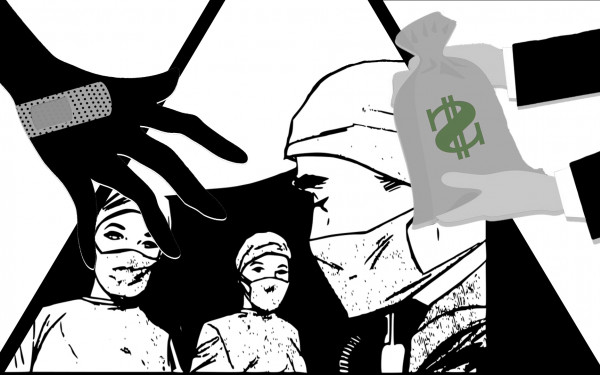
Under the bill, for any low-risk patient—colour-coded as green in the new system—Sherwani said he would have been paid $9.
“For the year, whether I see that patient 10 times or one time, I get paid $9,” Sherwani said, an amount of money that he equated to “a cup of coffee and a muffin.”
Provincial government scraps Bill 2
Following intense backlash from the medical community, a new tentative deal with family doctors was proposed in early December. The deal would undo many of the controversial decisions outlined under Bill 2, such as the mandatory performance targets, the new payment system and the subsequent patient colour-coding system.
On Dec. 19, Bill 2 was rescinded after the agreement was put to a vote and passed by an overwhelming majority. With the new agreement, instead of a mandatory 1.2 million patients being taken on by 2027, a new goal was set for family doctors to take on 500,000 patients by June 2026, a non-mandatory goal with a monetary incentive to reach it.
Yet, even with these changes, medical professionals such as Sherwani and Kalin remain cautious.
“[The new goal] is a tall ask because we are 2,000 family doctors short [in Quebec],” Kalin said. “It’s the same problem just dressed in different clothes: asking the family doctors to do more with less.”
He added that he believes the provincial government's recent healthcare legislation suggests a narrative that family doctors are being lazy.
“Doctors will gladly take on new patients if we have the means to do so," Kalin said. “I think [the government] is confusing ‘lazy’ with attentiveness and thoroughness. Some patients are complex and require additional time.”
Meanwhile, Sherwani suggested that the goal of 500,000 new patients is “doable,” but only under a more realistic capitation system that does not compensate doctors with minimal payment for taking new patients on.
Bill 2 and Quebec’s future healthcare practitioners
Despite the new agreement, Sherwani expressed that enough damage has already been done to the medical system due to Bill 2, especially when it comes to messaging to future physicians and family doctors in Quebec.
“It’s created this really bad landscape of how the government treats doctors,” he said. “What it’s done is it’s scared those students and those residents that are basically finishing their residency, or going into a residency.”
For many medical students in Montreal, Bill 2 represented another attempt to kick future doctors out of the province.
“It’s the same problem just dressed in different clothes: asking the family doctors to do more with less.” — Dr. Michael Kalin, physician
“There is already Bill 83 that forces medical students to stay in Quebec for when they start their residency,” said Ryan Kara, executive president of the McGill University Medical Students’ Society (MSS).
Kara said that MSS recently ran two surveys, one before Bill 2 was announced, and one after, to measure medical students’ intentions to practice in Quebec.
“Before Bill 2, we had a regular amount, as every year, of students wanting to practice family medicine, and an overwhelming percentage wanted to stay in Quebec,” Kara said. “But once Bill 2 was voted, this percentage decreased by a lot.”
Addressing the root problem
According to Kalin, the province is currently at a fork in the road when it comes to addressing the core concerns of the healthcare system.
“We have to make a fundamental, existential decision: do we want to continue to centralize and de-personalize healthcare? Or, do we want to look for a solution that is patient-centred, that values the principles of good family medicine, where we embrace the relationship between the doctor and patient, and we support it?” Kalin said.
For him, the solution lies in revamping the whole healthcare system, a system, he said, whose policies have failed for the past quarter of a century.
“We need to give users their voices back, we need local governance, we need physicians who are spending time with patients, not working on paperwork,” Kalin said. “We need to strengthen our primary care network, not find ways to make it work on less and less.”
Kara reinforced Kalin’s view that the government needs to change its view on the healthcare system.
“Med students are already from Quebec, and they want to stay in Quebec because their families are here, their friends are here,” Kara said. “Try to work with everyone to make sure that the healthcare system works and puts the patient first, instead of focusing on [forcing] people to stay if they already want to stay.”
For students like Kara, hope lies in the ongoing negotiation processes between Quebec’s medical federations and the government to ensure that compromises can be made.
“It’s really encouraging to see the federations and the government having fruitful conversations and coming to solutions, as future healthcare practitioners,” Kara said.
This article originally appeared in Volume 46, Issue 7, published January 13, 2026.