Doctors and medical students criticize new Quebec bill
New bill targets doctors and sanctions strike actions
_1_900_566_90.jpg)
Just days ago, while shadowing a surgeon, Ryan Kara, the executive president of McGill University’s Medical Students’ Society (MSS), watched a doctor nearly die from sheer exhaustion while treating a patient.
“He hadn’t slept for four days, four days in a row. When the transplant finished, he fell asleep on the wheel and he hit the bus that was parked, almost died,” Kara said. “Now, he sees on the news that he's being told, ‘Well, you don't work enough.’”
On Oct. 25, in a flash vote right before 4 a.m., the Quebec government passed Bill 2, “An Act mainly to establish collective responsibility with respect to improvement of access to medical services and to ensure continuity of provision of those services.”
The bill seeks to link the compensation of doctors to the amount of patients they care for and includes a section prohibiting what the bill calls “concerted actions” to challenge the government’s policies.
The special legislation was passed after the government and doctors’ unions were unable to reach a negotiated deal over a new salary structure with doctors.
Since the announcement of the bill, doctors have begun organizing protests and promised to challenge the provincial government in court.
What is Bill 2?
According to the Quebec government, the bill “aims to improve access to medical services.”
To achieve that promise, the bill will put in place a number of restrictions, requirements and fines. One of the main objectives is to ensure that 17.5 million appointment slots are made available per year in Quebec for general practitioners, that 98 per cent of surgeries are performed within one year of the surgical request and that 95 per cent of patients in emergency rooms are seen by a doctor within 90 minutes of being triaged.
In 2024, according to data by the Régie de l'assurance maladie du Québec (RAMQ), 780 general practitioners and specialists left the public system, an increase of 22 per cent compared to the year prior. Additionally, 1.5 million Quebec residents do not have a family doctor.
The bill also introduces a new payment model for doctors, based on a “blended remuneration method.”
Currently, doctors are paid based on what medical acts they perform. The new system, however, will pay out doctors based on fixed amounts, which are calculated through the patient's health and vulnerability status.
According to section 201 of Bill 2, the government will impose fines of up to $500,000 per day for doctor federations or representative groups that organize disruptive actions. Fines will also target individual doctors who disrupt work, from $4,000 to $20,000 per day.
Section 159, meanwhile, states that sanctions will also be implemented if a doctor is “non-compliant” with the new obligations set under the bill. The RAMQ can deduct 40 per cent of their pay for each day of that non-compliance.
Doctors over 63 years old are the only group exempt from the changes in the bill.
Public backlash and doctors’ concerns
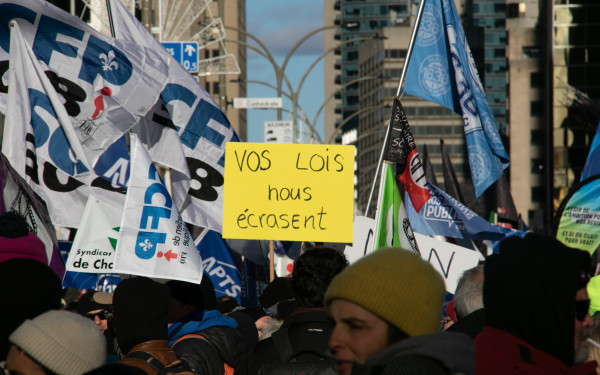
On Oct. 26, a day after the bill was announced, around 300 health practitioners gathered at the Maison de Radio-Canada building to protest the new bill.
Family doctor Elise Huot said the bill has failed to listen to doctors' concerns.
“Emotionally, we are exhausted, frustrated, sad,” Huot said. “We are scared. I am scared for my friends, I am especially scared for my patients.”
Huot criticized the government for setting unrealistic expectations for doctors, which are set to come into effect in January 2026.
“If I have a colleague who has cancer, or a colleague who is a mom coming part-time whilst the kids are in a daycare, every time it's one less person there to hit those objectives,” she said.
According to Canadian Medical Association (CMA) president Margot Burnell, the government’s implementation of the bill does not help doctors.
“CMA and physicians want to increase access for patients to primary care teams, to primary care models and to subspecialties,” Burnell said. “The premise of this [bill] is that the fault lies with physicians [...]. If you mandate physicians treating an increased number of rostered patients without increasing resources in team-based care, then you will sacrifice quality of care.”
According to CMA’s 2025 National Physician Health Survey, 46 per cent of physicians report high levels of burnout.
Established, practicing doctors are not the only ones concerned with these changes.
“As students, what we want is to be able to work in a system where the people that keep it alive and make it work are also the ones that are consulted to know what would help it,” Kara said. “We hope to be able to practice in a system that actually thrives, which doesn't seem to be the case at the moment.”
MSS held a general assembly on Oct. 26, where over 60 per cent of McGill’s medical students gathered to discuss Bill 2 and how it would affect them. Of those present, 64.2 per cent voted in support of a strike.
Violet Williams, a McGill medical student who was granted a pseudonym to protect their identity, says the bill made them and their peers consider leaving the province.
“I've grown up in Montreal. I love Montreal. [...] I have no reason to move,” they said. “[My parents are] seeing the news.They're telling me it makes no sense. I should go and try to find residency elsewhere so I can potentially stay there and get a job.”
Williams, who was present at the general assembly, said it’s a much-needed step forward.
“Part of being a medical student is advocacy,” Williams said. “It's not just about advocating for your patient when you're deciding on a treatment plan, but also advocating for patients as a whole. I'm really proud of our cohort in that sense.”
The Fédération médicale étudiante du Québec (FMEQ), which is made up of the four medical student associations of Quebec, filed an application for judicial review of several sections of Bill 2 on Oct. 29.
A FMEQ press release stated that the move “aims to preserve the democratic space in which medical students can debate, mobilize, and express themselves freely, without fear of financial or disciplinary sanctions.”
As a response to Bill 2, FMEQ has asked people to wear blue squares as a sign of opposition to the bill. Kara sees the square as the most non-aggressive way to show your disagreement with the bill and has asked students and medical staff to wear it in solidarity.
The Link reached out to the Quebec Health Ministry for comment, but did not receive a reply by the time of publication.
With files from Ryan Pyke.
This article originally appeared in Volume 46, Issue 5, published November 4, 2025.