Fashion that finally fits
Mala Mtl is reshaping the plus-size community experiences secondhand fashion
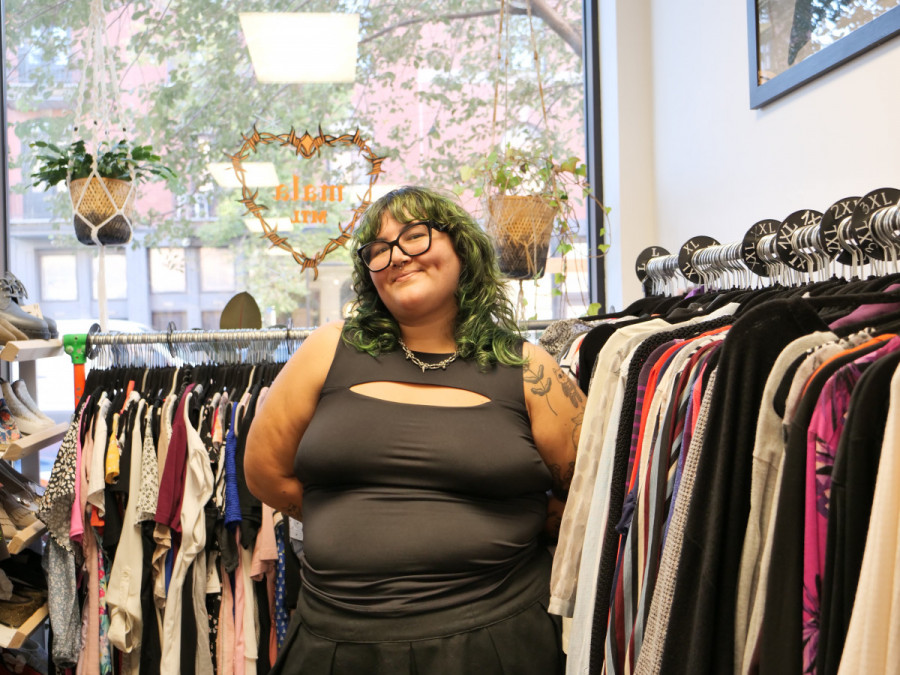
Since 2018, Mala Mtl has carved out space for plus-size thrifters in Montreal.
The Latina-owned boutique, founded by Sandra Muñoz Diaz, offers vintage and pre-owned clothing ranging from size L to 6X, with a focus on sustainability, accessibility and inclusivity.
Located on St. Laurent Blvd., Mala has grown into a community hub, a place where people come not just to shop, but to feel seen, represented and celebrated.
Building Mala from the ground up
“I have always been plus-size myself, so to be able to shop in person, second-hand and plus-size, was very difficult when I was younger,” Muñoz Diaz said. “So to create a space that holds that community and can offer a range of accessible pieces for different styles, all in plus-size, was what we needed as a community.”
Mala began as an online project with Muñoz Diaz selling clothing in Facebook groups, where her account quickly gained attention.
“My account started growing, so I thought it was a very good idea to maybe create a website,” she said.
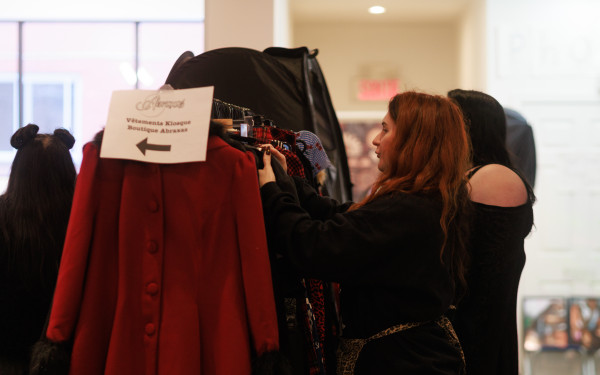
After gaining traction online, Muñoz Diaz began hosting pop-ups where customers could try items in person.
“That was the best way to reach the most people,” she said. “Then, when the pandemic started in 2020, I had to go back to selling online, and I would deliver [clothing] door to door to my clients.”
Mala evolved through the pandemic, eventually moving into a studio space with shopping available by appointment.
“It was very one-on-one with me, so that was a cool experience too,” Muñoz Diaz said.
In July 2024, Mala finally opened its current location on St. Laurent Blvd., offering a larger, public boutique.
Building a space from scratch
Originally from Chile, Muñoz Diaz immigrated to Montreal at age 15. Her experience as an immigrant shaped both her perspective and her business.
“Owning your own store as an immigrant feels very cool,” she said. “My parents helped me build it from scratch. I feel very grateful to have their support, because not everyone has that chance.”
While she says her cultural background doesn’t define the store’s mission, it adds a deep sense of pride for her.
“The fact that I’m Latina doesn’t change the mission,” she said. “But when other Latinos come in and realize I’m from Chile, it’s very cool. There’s pride in being a Latina immigrant with her own business here.”
Muñoz Diaz’s shop shares the street with other independent Latinx-owned spaces, like Carlota Boulangerie Mexicaine and Barros Luco Montreal.
“It’s nice to share the area with other Latino entrepreneurs,” she said. “The Plateau and Mile End have such a mix of backgrounds; it feels like a true community.”
Circular fashion and accessibility
For Muñoz Diaz, sustainability and accessibility are non-negotiable.
“It’s very circular,” she said. “About 75 to 80 per cent of the store comes from my clients themselves. It keeps the cycle going and helps people access fashion sustainably.”
She notes that maintaining size inclusivity within that model doesn’t come easy.
“Fashion wasn’t inclusive in the past, so older clothes rarely come in 3X or 4X,” she said. “That’s why I work so closely with my community; it’s the best way to keep a good selection available.”
Muñoz Diaz also says she prioritizes affordable pricing.
“As an immigrant, you sometimes don’t have a lot of money to buy new clothes,” she said. “So it’s very important for me that people can find, for $3 or $5, something to wear.”
A place to feel seen
For many regulars, Mala represents more than a store—it’s a safe, affirming space.
Charlotte Galarneau, a long-time client and the owner of the jewelry brand Ça L’fait, first discovered Mala during the pandemic.
“It’s amazing. It’s like a beautiful, safe space,” she said. “It’s not like going to Renaissance or Value Village, where you never know if you’re gonna find something that fits you.”
Galarneau recalled the early days when Mala operated out of Muñoz Diaz’s apartment.
“We had to book appointments because of COVID. It was such a welcoming environment,” she said. “Sandra made you feel at ease.”
Another customer, Marianne Lefebvre, said that finding Mala changed how she shops.
“I used to hate thrifting because I could never find my size,” Lefebvre said. “Now I actually enjoy it. I’ve met other people like me here. It feels like community.”
Galarneau often returns to the boutique to browse as there is always something new. .
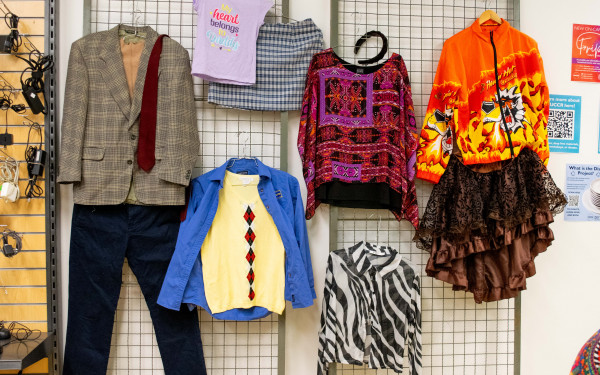
“There’s something for every taste; masculine, feminine, Y2K, baggy,” she said. “You can play with your style depending on your mood.”
Galarneau also participates in the Thiick Witch market, a plus-size artisan fair that Muñoz Diaz co-organizes twice a year.
“I participated last April,” Galarneau said. “Seeing all plus-size artists, people selling plus-size clothes, and only plus-size people coming to shop. It was so beautiful. It felt like a safe space.”
Muñoz Diaz describes the event as one of her proudest projects.
“We collaborate with plus-size artists, jewelry makers and designers; people who represent fat bodies in their art or work,” she said. “It’s about giving space to our people. We do it twice a year, and it grows every time.”
Holding space in a shrinking market
Despite her personal efforts, Muñoz Diaz has noticed that inclusivity in the fashion world is shrinking.
“When I started eight years ago, there was more inclusivity,” she said. “Now, even big brands that used to carry plus sizes in stores have stopped. You can only shop online. That’s why keeping a physical space like Mala is so important; it lets people try things on and feel good.”
That physical connection to clothes and to one another remains at the heart of Mala’s purpose. For Muñoz Diaz, what she’s built isn’t just a business but a reflection of care.
“Every time someone new comes in and tells me it’s life-changing to find clothes that fit, it reminds me why I do this,” she said. “It’s not easy to be an entrepreneur, but when you have a community like this, it’s worth it.”
This article originally appeared in Volume 46, Issue 4, published October 21, 2025.