Every Child Matters march highlights National Day of Truth and Reconciliation
The Native Women’s Shelter organized the march for the fourth year in a row

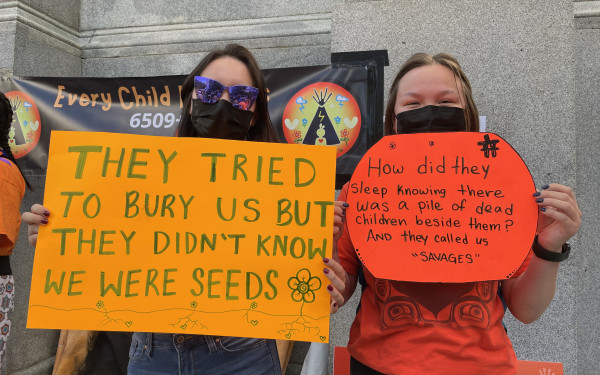
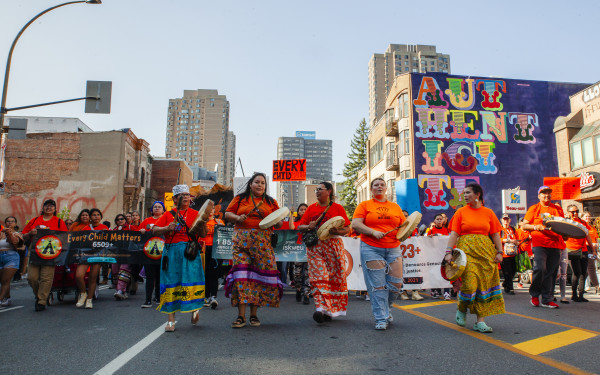
Over 500 people gathered on Wednesday, Sept. 30, for the annual Every Child Matters march.
The National Day of Truth and Reconciliation, otherwise known as Orange Shirt Day, honours victims of the Residential School system.
Na’kuset, the organizer of the march and executive director of the Native Women’s Shelter, explained why it’s important to keep marching.
“It's important to have this march because Indigenous people were forced to go to residential schools for over 100 years. [...] The government gave an apology in 2006, and nothing has really changed,” Na’kuset said, referring to former prime minister Stephen Harper’s 2008 apology.
The march started with speeches around 1 p.m. at Westmount Park, then the walking started around 1:45 p.m.
The former grand chief of the Mohawk Council of Kahnawà:ke, Kahsennenhawe Sky-Deer, said the march also highlighted the legacy of the residential school system in her speech.
“There is so much that was taken away from our people at residential schools. Our language, our culture, our identity, our dignity, our humanity,” Sky-Deer said.
Simik Komaksiutiksak, an Inuk performer and instructor born in Rankin Inlet, Nunavut, weighed in on the impacts of residential schools.
“It's very important to march here on Orange Shirt Day, to honour and remember our ancestors who went to residential school. [For] some of us, [it’s] our parents, grandparents, our aunties, our uncles,” Komaksiutiksak said.
Komaksiutiksak and Sky-Deer added that it was important to recognize the ongoing trauma that Indigenous communities are facing.
“Our people are still suffering the impacts of what happened in those schools. They don’t see it every day, but we know what happens in our communities. [...] The physical violence, the sexual violence,” Sky-Deer said.
“Indigenous people keep coming to the table, keep talking about what our truths are, [...] asking for help, and we are ignored. That’s a problem. The government needs to do better, and they need to come and actually talk to indigenous people.” — Na’kuset, organizer of the march and executive director of the Native Women’s Shelter
In 2015, the Truth and Reconciliation Commission released its report with 94 Calls to Action. At the time of writing, the Canadian government has completed only 15 of the 94 recommendations, with 28 projects proposed and 34 underway.
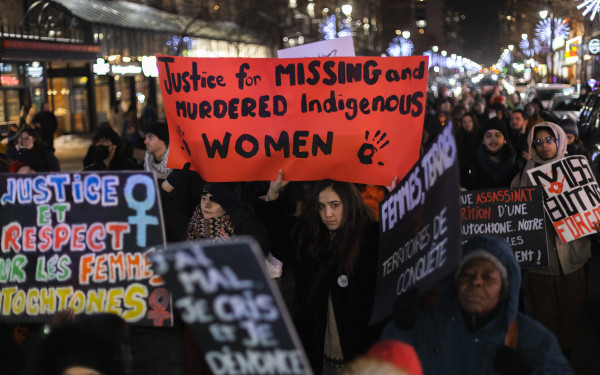
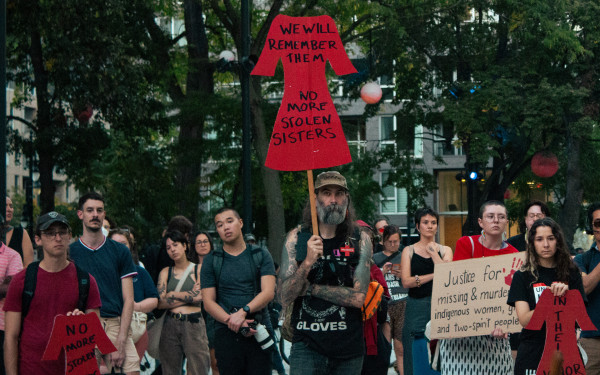
Additionally, the National Inquiry into Missing and Murdered Indigenous Women and Girls published its report with 231 Calls for Justice, of which only two have been completed, with 161 marked as being in progress.
Na’kuset considers this lack of action a failure on the Canadian government’s part.
“Indigenous people keep coming to the table, keep talking about what our truths are, [...] asking for help, and we are ignored. That's a problem,” Na’kuset said. “The government needs to do better, and they need to come and actually talk to indigenous people.”
With the upcoming provincial elections and talk of separating from Canada appearing, Sky-Deer wants to remind politicians that they are on unceded indigenous land, and any plan to separate must consult Indigenous peoples.
“There's talk about an impending separation of the province from the country. Recognize whose territory and whose land you're on. It's not your place to separate,” Sky-Deer said.
Other provincial policies also have impacts on Indigenous peoples. Sky-Deer said a $900,000 budget cut is on the table for Projets Autochtones du Québec, an organization that manages the only emergency shelter in Montreal specifically for Indigenous people.
“That's going to stop the daily assistance that these people need. It's not just a place for them to sleep; it's actual programming: getting them training so that they can get back on their feet,” Sky-Deer said.
Despite promises from former prime minister Justin Trudeau’s government in 2015, many Indigenous communities still lack clean drinking water.
The march concluded with music and dance performances at Cabot Square and dispersed around 4:30 p.m.