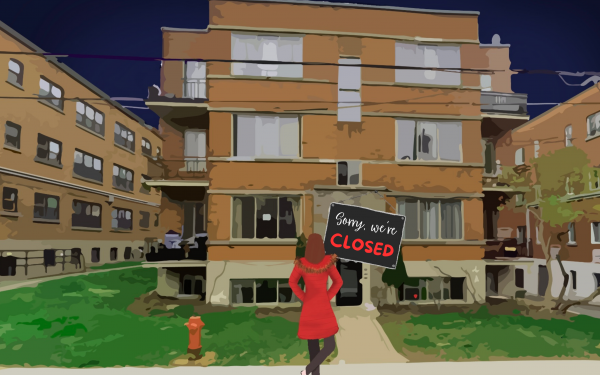
Should Quebec reduce more immigrants to address the housing crisis?
Temporary immigrants declined while both rental prices and vacancy rates rose
The political parties running for the upcoming Quebec election have taken a wide variety of stances on immigration and the housing crisis.
The Parti Québécois (PQ) aims to reduce temporary immigration, while Québec solidaire (QS) champions rent control and social housing to address Quebec's housing crisis.
PQ leader Paul St-Pierre Plamondon linked the current housing crisis to immigration. He claimed the current immigration system under the Coalition Avenir Québec (CAQ) government is “broken” during his Aug. 29 election campaign in Chauveau.
“In 2023, Quebec accepted 225,000 new people in the territory but didn’t even build 40,000 homes,” St-Pierre Plamondon said in Quebec City on Sept. 9.
The migratory growth was 217,600 in 2023, according to the Institut de la statistique du Québec (ISQ).
St-Pierre Plamondon announced that his party will cut temporary immigration from more than 500,000 to between 200,000 and 250,000, and permanent resident admissions to 35,000 per year.
The total number of temporary immigrants in Quebec was 514,050 as of Jan. 1, 2026, down about 51,000 from the previous year. Work and study permit holders decreased by 37,103 and 14,247, respectively, according to the ISQ 2026 report.
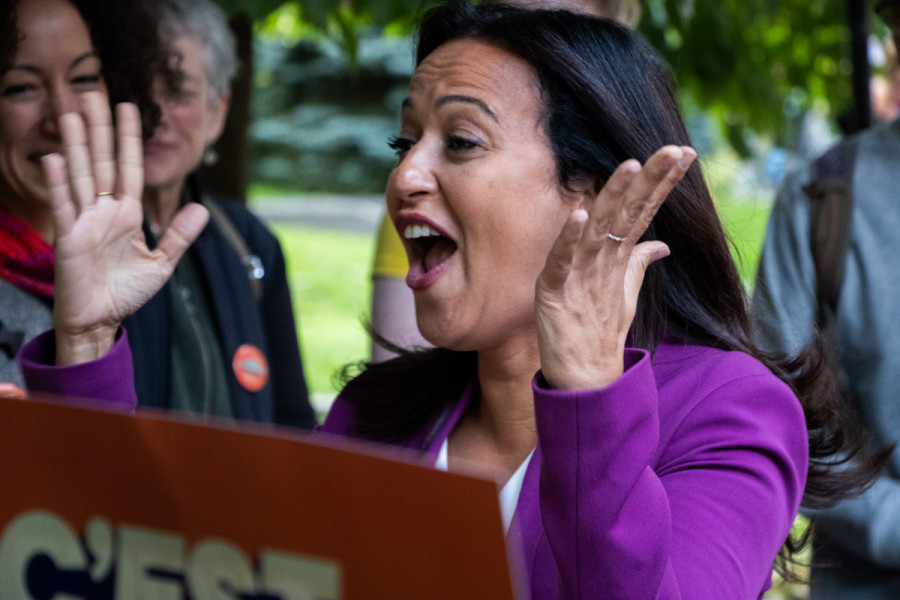
Québec solidaire co-spokesperson Ruba Ghazal claimed that immigration is not the main cause of the housing crisis in an interview after the Mercier constituency debate on Sept. 21.
“The housing crisis existed even in 2019,” Ghazal said. “In 2019, there weren’t so many temporary immigrants.”
The temporary immigrant population in Quebec was 263,000 at the end of 2019, about half of the 2026 figure, though it had a record net growth of 60,700, according to the ISQ 2021 report. The vacancy rate in Greater Montreal in 2019 was at a 15-year low of 1.5 per cent, according to Radio-Canada.
“In 2023, Quebec accepted 225,000 new people in the territory but didn’t even build 40,000 homes.” — Paul St-Pierre Plamondon, Parti Québécois leader
“The housing crisis existed even in 2019. In 2019, there weren’t so many temporary immigrants.” — Ruba Ghazal, Québec Solidaire Co-spokesperson
Higher vacancy rate and rent
Florian Mayneris, an economics professor at the École des Sciences de la Gestion of Université du Québec à Montréal, said the rise in the vacancy rate is mostly due to new condos.
“Construction costs have increased by a lot over the past couple of years; building new units is costly,” Mayneris said.
In Greater Montreal, average rent for a two-bedroom apartment rose 7.2 per cent, outpacing the 3.7 per cent increase in average hourly wages in Quebec, according to the Canada Mortgage and Housing Corporation’s rental market report.
The vacancy rate was 2.9 per cent in 2025, up from 2.1 per cent in 2024. Vacant units were often newly built with higher average rents than occupied units.
“These rents, like new condos, the asking rent remains high,” Mayneris said. “Sometimes the owners will prefer waiting for a bit before having a tenant instead of decreasing the rent immediately.”
He doubts that changing immigration policy can solve the housing issues in the short or long run.
Can rent control address the issue?
Ghazal said QS will implement a one-year cap on annual rent increases and then revise the measure to calculate rent increases.
“[The cap will be tied] to inflation, or a maximum of 3 per cent. Because the Tribunal administratif du logement, right now, isn't a ceiling; it's a floor. This doesn't work,” Ghazal said.
Mayneris said capping direct rent increases would obviously have a direct effect, but should be implemented carefully, because it may cause owners to leave their rental units vacant.
“To avoid this situation, introduce both stringent rent control, [and] for example, a vacancy tax,” Mayneris said.
The PQ and St-Pierre Plamondon did not respond to The Link's requests for an interview regarding the party’s position on rent control.
“These rents, like new condos, the asking rent remains high. Sometimes the owners will prefer waiting for a bit before having a tenant instead of decreasing the rent immediately.” — Florian Mayneris, economics professor at the École des Sciences de la Gestion of Université du Québec à Montréal
Does Quebec need more non-profit housing?
QS set a goal to provide 50,000 social housing units in the next four-year mandate, constructing 25,000 and buying another 25,000 units from the housing market.
PQ targets adding 20,000 social housing units, offering a Québec Sales Tax reimbursement up to $45,000 and doubling the tax credit to $3,000 for first-time buyers.
The Parti libéral du Québec proposed 40,000 social and affordable housing units over five years.
The CAQ aimed for 2,000 affordable housing units for seniors.
The Parti conservateur du Québec proposed exempting units rented for more than $2,500 per month from rent control, including fully renovated units within the last five years after a tenant leaves or vacant units for one year.
It also cited excessive regulation and uncontrolled immigration as causes of the housing crisis.
“Social housing and co-ops, which function differently from the private market, are an option,” Mayneris said, emphasizing that Quebec’s non-profit housing market is much smaller than in other countries.
Quebec’s estimated share of households living in social and affordable housing in 2022 was 4 per cent and 6.6 per cent in Montreal, according to the ISQ.
The Organisation for Economic Co-operation and Development (OECD) social rental housing made up 7 per cent of the housing stock on average. In the Netherlands and Austria, the ratios were nearly 35 and 25 per cent, in 2022 respectively.
Mayneris said non-profit co-operatives may wait longer for a return on investments and also benefit from economies of scale. He added that they can build or purchase more units and provide affordable housing.