Meet the dance pioneer who wants to save hip-hop
Angelo Ameur saw its birth; he hopes no one has to see it die

He had only been back for 24 hours, but he was already in the thick of it.
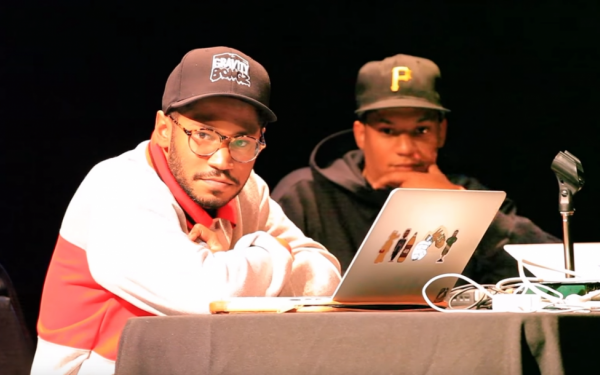
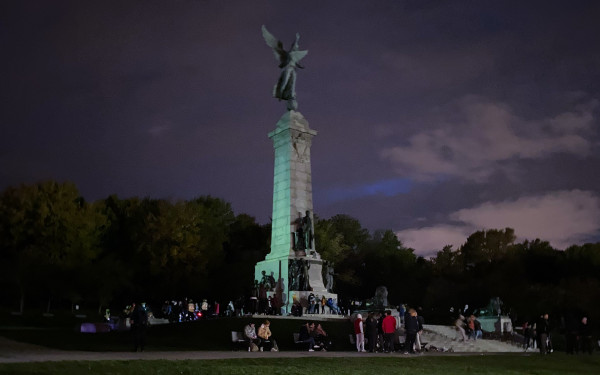
As smooth rhythms pulsated through a downtown Montreal park and the gathered crowd watched dancers take to the stage one by one, their bodies moving to the music, one man sat just behind the action. His eyes were totally fixed on the display in front of him, his hand hovering as he scratched the occasional note on a paper pad.
Flanked by two fellow judges with equally steely stares, you wouldn’t think that the aging man judging Montreal’s latest street dance battle had just flown 15,000 kilometres to be here.
But for Angelo Ameur, hip-hop dance is everything.
A longtime figure in the Montreal scene (or an ‘OG’ as he prefers), Ameur arrived from the United States to study at Concordia University in 1987. At the time, he said hip-hop dance was still in its infancy in the city.
So, when he began dancing, people took notice.
“They was like, wow, what kind of dance is that?” Ameur recalled, “How do you do that?”
“It's hip-hop,” he explained back then.
Today most people know hip-hop as a genre of music. Actually, it is the name for a wide-ranging culture that emerged from New York City's African American neighbourhoods in the 1970s.
Pierre-Michel Jean-Louis, better known as Bboy Afternoon, is a Montreal street dancer, teacher and competition judge with over 20 years of dancing experience. He described hip-hop culture as encompassing dance, music, lived experience and visual arts.
Jean-Louis said hip-hop dance began with the emergence of breakdance, or breaking as the community calls it. However, the acrobatic, difficult-to-perform movements did not suit relaxed social settings, so people adapted them.
“In a party space, not everyone is going to break, so there has to be some type of dance that is a little bit more accessible to everyone,” Jean-Louis said.
While hip-hop and its dances have since become global phenomena, Ameur emphasized the fact that there are no strict rules and that its roots lie in freedom of expression.
“Hip-hop is not a certain step. It’s a feel, it’s a groove, it's soulful,” Ameur explained.
After years of teaching at different studios, Ameur and his then-partner, Cindy McAuliffe, established Urban-Element Zone in 1999, the first dance school in Montreal dedicated to just teaching hip-hop.
Ameur said interest was instant.
“People came right away. They were like, ‘Whoa, what is this?’” Ameur said. “We were packed. We had waiting lists.”
But after an entire career teaching hip-hop dance, Ameur now finds himself worrying about its future.
“Nowadays, what’s happening is that it’s a free-for-all. Whoever has the money, whoever has the power, can just decide to do whatever they want with the culture.” — Pierre-Michel Jean-Louis, Bboy Afternoon
He is particularly concerned about how social media platforms like Instagram and TikTok are turning hip-hop into a commodity detached from its culture.
“Hip-hop is not about popularity. Hip-hop is about sharing,” Ameur said. “Hip-hop nowadays, for me, it's washed out.”
Jean-Louis shared the same concerns but went further. He explained that hip-hop’s mainstream popularity has allowed money-driven interests to turn it into a product for consumption.
“Nowadays, what’s happening is that it’s a free-for-all," Jean-Louis said. "Whoever has the money, whoever has the power, can just decide to do whatever they want with the culture.”
For those in hip-hop, it is not just a hobby, but a real culture born from resistance and the lived experience of being Black in North America.
And of all people, Ameur would know. After all, he was there when it began.
Born in Madagascar in 1968, Ameur moved to the United States as a teenager, at the perfect moment to experience the birth of hip-hop culture. Soon enough, he was immersed in it, constantly dancing with friends and taking part in dance battles.
Now in his fifties, rather than sit back, Ameur is more determined than ever to pass on his firsthand cultural knowledge to the next generation.
So, he did the only thing he knows how: he started a new dance school.
Founded in 2021, Educate ‘n’ Dance aims to reconnect hip-hop with its roots as a dance developed in the streets. Instead of making students copy a teacher, the philosophy is to help students find their own way of expressing themselves through a connection to music and understanding of their own bodies.
“It was very challenging, especially when I started,” said Timothée "Timo" Ly Jean-Claude, one of the school’s first students.
“[Before] I would just follow somebody, but now I have to follow the music for it to tell me what I have to do,” Jean-Claude said.
He said the approach helped change his relationship with dance.
After dropping out of high school for a while and even quitting dance, he began training again at Educate ‘n’ Dance, where he gradually regained his confidence. His hard work eventually paid off when, after a couple of years, Ameur asked him to start teaching classes alongside him.
Unfortunately, things have not been easy for Ameur.
In 2014, he was diagnosed with osteoporosis, a condition that triggers a slow weakening of the bones. Since then, he has undergone a hip replacement and is currently waiting for surgery to replace both his knees.
Still, that has not stopped him from dancing.
“If I don’t dance, it’s like I’m not even alive,” Ameur said.
Looking ahead, he hopes his new school will do more than only teach and support the next generation of hip-hop dancers.
“It’s to keep that culture alive,” Ameur said frankly.
Ultimately, he believes that responsibility will fall to his students.
"My wish is that they take what I've started and keep on going with it and keep it alive as long as they can,” Ameur said.
For him, continuing to teach and preserve hip-hop despite his age and physical challenges is part of the same philosophy he tries to pass on to his students through dance.
"Life is about fighting for what you want to do, what you believe in, what you want to achieve," Ameur said.
This article originally appeared in Volume 47, Issue 2, published September 22, 2026.