Concordia University says no to open bargaining
CREW, the union representing TAs and RAs, has been denied an open bargaining meeting during this negotiation period
Concordia University has refused to allow open bargaining for negotiation sessions with the Concordia Research and Education Workers Union (CREW-CSN), which represents Teaching Assistants (TAs) and Research Assistants (RAs).
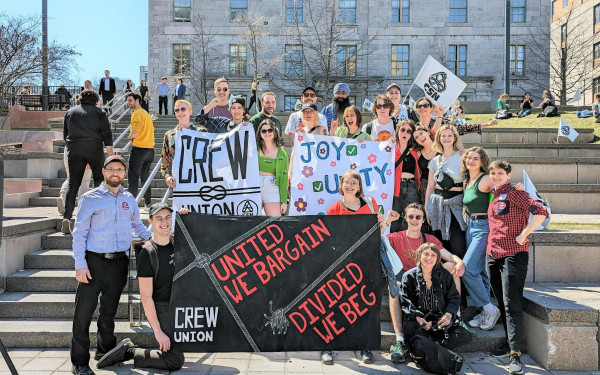
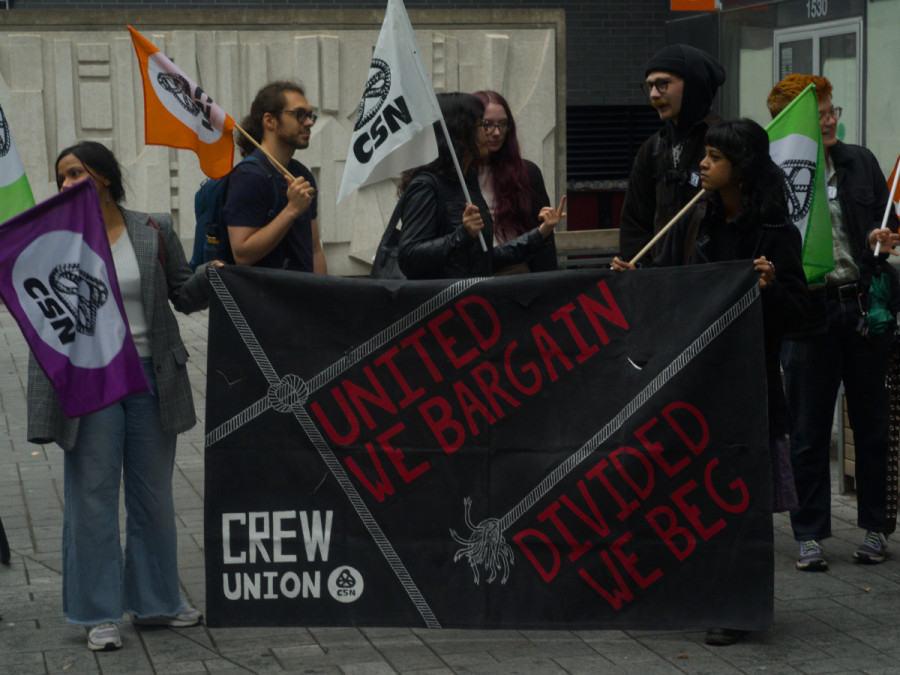
On Sept. 28, executives and union-affiliated members marched from Mackay St. to the outside of the Guy-De Maisonneuve (GM) Building, where they protested while the bargaining team negotiated the terms for future open bargaining.
Open bargaining is a form of negotiation in collective bargaining agreements in which all union members are present during negotiations between the members and the employer.
CREW-CSN general coordinator Liam Riley believes that this form of negotiation should be a part of the union.
“Open bargaining is a core principle of our union. We want to allow our membership to be part of the process of bargaining democratically,” Riley said. “[It shows] the employer that our bargaining team has the support of its membership and that we are strongly committed to these demands.”
According to members, the union adopted a mandate of open bargaining last spring. Despite this, when the first round of negotiations began, Concordia denied access to outsiders.
According to bargaining team members Rachael Alguire and Tamsyn Riddle, the union has done open bargaining in the past with much success.
They explained that for this year's negotiation period, the university refused to do it again since the conversation would now be more complex due to the university’s financial crisis.
“We argued that open bargaining makes communication much more effective and efficient for all parties,” Alguire said. “The university refused to accept that.”
CREW-CSN’s external affairs officer Ryan Dumont corroborated that open bargaining lets them put more pressure on the university and strengthen solidarity within the union.
“If we’re in the room [...] we [add] a different perspective, we fact-check, we can contribute in different ways, and ultimately this can improve our position at the bargaining table,” Dumont said.
After coming out of negotiations, Alguire and Riddle mentioned how during the meeting, CREW-CSN presented the university with a code of conduct and protocol that all members would follow during the open bargaining sessions. Concordia’s team looked it over but did not sign it.
In a statement to The Link, Concordia’s deputy spokesperson, Julie Fortier, said the university does not use open bargaining.
“While the university agreed to open bargaining during the previous round with CREW-CSN, that agreement was specific to that round and did not extend to future negotiations,” Fortier said.
Every three years, the union drafts a list of demands for its collective agreement to negotiate the terms of its workers’ contracts with Concordia.
The three-year collective agreement CREW-CSN had expired on May 31; however, due to the union’s open bargaining mandate, renewal can’t move forward until this issue is resolved.
“This is just slowing us down from being able to actually address the issues that we want to address at the table,” Alguire said.
After the meeting’s impasse, the union plans to host another general assembly in the coming weeks, where the open bargaining mandate will be reaffirmed and discussed again with the university.