
CSU holds harm reduction fair and fundraiser
The fair raised over $1,000 for the Drug User Liberation Front
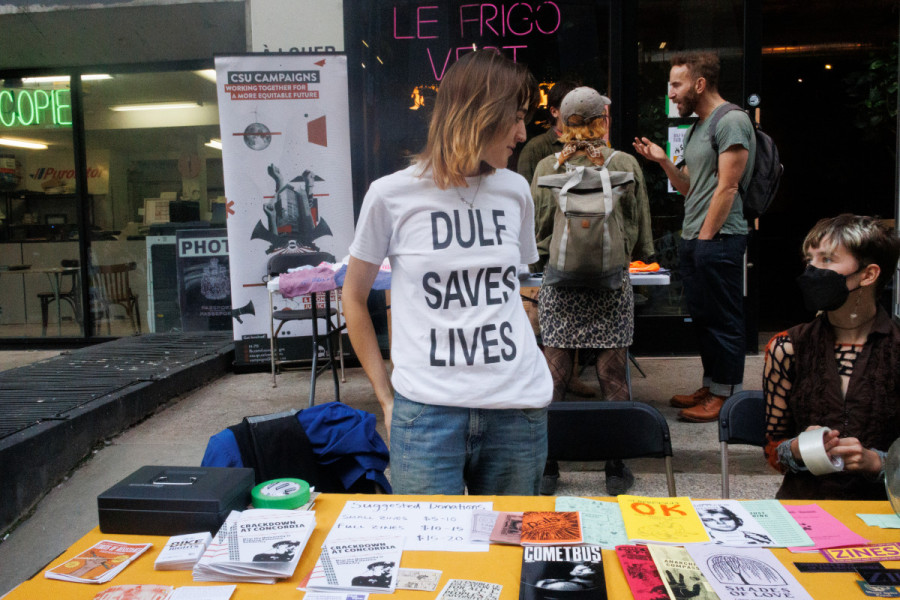
On Sept. 11, the Concordia Student Union (CSU) held a fair and fundraiser in support of the Drug User Liberation Front (DULF), aiming to gather donations and educate students about harm reduction.
DULF, a community coalition from Vancouver, B.C., focuses on the regulation of the drug market through community-led compassion clubs, which they believe is the most accessible way to provide immediate safe supply.
In October 2023, DULF’s co-founders, Jeremy Kalicum and Eris Nyx were arrested for selling heroin, cocaine and methamphetamine following raids at two Vancouver homes and the Vancouver DULF office. The group had bought the substances on the dark web and tested them for contaminants.
A year later, Kalicum and Nyx argued that their rights and the rights of users were violated when the club was shut down and they were arrested.
Kalicum and Nyx are set to appear in court in October 2025.
At the fair, the union encouraged people to donate between $5 and $15 to help DULF with their legal fees, and the event saw over $1,000 in donations.
Harm reduction organizations and their importance
CSU’s harm reduction workshop started at 5 p.m. at the Frigo Vert, where a number of coalitions gathered to educate attendees on harm reduction.
Attendees also had the opportunity to attend a workshop on the administration of Narcan/Naloxone, a fast-acting medication used to temporarily reverse the effects of an opioid overdose. The workshop was followed by a screening of Love in the Time of Fentanyl.
The organizations in participation included the AIDS Community Care Montreal (ACCM), which aims to help people living with HIV/AIDS, prevent HIV transmission, promote community awareness and action, and teach about harm reduction.
An ACCM member, who was granted anonymity for safety reasons, explained that coalitions such as ACCM are important because they save lives.
“Harm reduction approach is really important, just operating from the understanding that human behaviour can never be controlled, authoritarian approaches to things like sex and drug use do not work,” they said. “It kills people.”
Part of ACCM’s work involves providing anti-overdose and safe drug use kits, which can be obtained at ACCM-hosted events. Some of the kits include Naloxone, bump kits and harm reduction kits, snorting kits, and meth and crack cocaine smoking kits.
”If people have clean, safe materials to use, they're much less likely to give or get any STBBI (Sexually Transmitted and Blood-Borne Infections),” they said. “It makes using safer, it reduces risk in general.”
According to Dana Ballantyne, CSU’s external coordinator, having community organizations focused on harm reduction provides vital support to everyone.
“ With orientation where a lot of new students are coming on campus, they're experimenting with new things. Students are drug users. A lot of students are close to people who are drug users,” Ballantyne said. “We, as a union, strongly believe that nobody should suffer harm or be left behind in a time when these things are actively vilified.”
Bill 103 and its effect on harm reduction
In May of this year, the Quebec government tabled Bill 103, which would bar supervised drug consumption sites from being established within 150 metres of a school or daycare. The bill would require the 14 existing consumption sites in Quebec to be reauthorized by Santé Québec every four years.
According to Émilie Roberge, a member of the Montreal-based harm reduction non-profit Spectre de Rue, the 150 metre radius of Bill 103 is arbitrary.
“Is 200 metres better than 150? What’s important is how we are working with people around [us who use] consumption rooms,” Roberge said. “We're in the neighbourhood because that's where people need us. Forcing us to move will force us to close.”
Roberge believes that in order for the bill to help people, the government needs to increase funding for harm reduction organizations. According to her, better funding would mean more help for those in need and a greater variety of services.




_600_375_90_s_c1.jpg)