The chillout room boom
How Montreal DJs are bringing back the ambient vibe of the ‘90s
_900_453_90.jpg)
Walking into the rave organized by the enigmatic homeby6 was overwhelming. The woman scanning tickets slapped stickers over phone cameras, as there were no photos allowed.
Behind the building's inconspicuous facade lay a gargantuan room blasting hard-hitting techno, strobe lights that inhibited you from seeing three feet ahead of you (let alone your friends that you lost in the crowd), and a secret DJ set hidden underground in the basement.
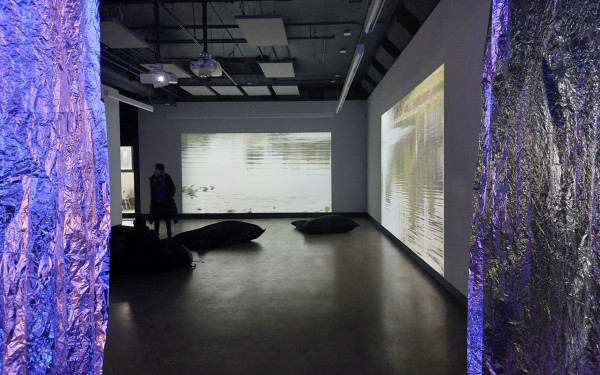
All this noise can become tiring fast, so imagine the bliss of finding a room with beanbags on the floor, people mingling with friends, and a DJ reclining chaise-longue style, spinning slow ambient tracks. A chillout room, hidden inside a house of noise.
The idea of a room just for chilling out may seem novel, but chillout rooms have been a part of rave culture since the early '90s.
Britain introduced chillout rooms to cut down drug overdoses during marathon raves. To keep their licenses, clubs had to provide free water, proper ventilation and cooler rooms where ravers could escape the heat of the dancefloor.
What started as a safety measure soon became a creative frontier for new, forward-thinking talent in the ambient and electronic music scene.
According to David Toop, whose book Ocean of Sound recounts the glory days of chillout rooms, the late '80s ushered in a wave of new vinyls imported from the house music scene in Chicago and New York.
Songs from Boards of Canada, The Orb and The KLF became staples for the chillout scene, soundtracking the ravers’ drug-induced comedowns. During nights at London’s legendary Telepathic Fish club, the room was decorated with holographic foil while partygoers sipped from a fountain of punch.
As the raves of the '90’s died down, so did the chillout room. It’s hard to pinpoint what exactly led to their demise. It could be due to the UK government’s crackdown on illegal raves during this era. Chris Coco, a legendary DJ in the scene, theorised in an interview with DJ Mag that it was due to the UK’s 2007 smoking ban, which pushed attendees outdoors to de-stress.
Whichever it is, a whole generation has been unaware of the benefits a space like this can provide. The chillout room offers a refuge from the energy of the dancefloor—a space to chat with friends, rest your feet and zone out.
“The better the balance, the better the rave,” DJ jamvvis says.
They played a set in homeby6’s chillout room, diving into the sounds of their childhood in the UK. At one point, they looped the line “This makes me proud to be British” (from Babyfather’s “Stealth Intro”) to a hallucinatory degree.
“That was the goal, I’m putting people in a trance,” jamvvis explains. “You’re in this loophole, but it’s not like a nightmare loophole.”
Jamvvis primarily plays jungle and drum-and-bass, but ambient sets unlock a new channel for Wtheir artistry.
They tell me that during a DnB set, “I want people to jump, I want people to dance.”
They add that there’s always the pressure of getting the transitions right, but a looser set allows jamvvis to freely experiment and use effects that they haven’t before. It’s a symbiotic relationship where the DJ has just as much of a chance to veg out as the audience.
Jamvvis also sees chillout rooms as vital for harm reduction.
“If you rest for 10 minutes, you can stay for another hour in the rave,” they say.
They want their set to ensure a good trip, playing music that’s “enough for your frequency to react to your body.”
The chillout room helps counteract the physical effects of drugs as well.
According to the Centre hospitalier de l'Université de Montréal, “party pills” lead to profuse sweating and a higher body temperature. The real threat of heatstroke exists, particularly in a hot room with other people, and the ventilated space of the chillout room provides an essential retreat to lessen the danger.
In an era where harm-reduction groups like GRIP and CACTUS Montréal now offer drug-screening and supervised consumption sites, chillout rooms may be the next step in ensuring a safe environment for party-goers.
So why the sudden return of chillout rooms? After years of silence due to the COVID-19 pandemic, a new generation of ravers is rediscovering what made the chillout rooms of the '90s so great—and reimagining them with a modern twist. During lockdown, ambient music saw a huge spike in popularity. .
Jamvvis believes that, in this modern age, we are constantly overstimulated, and the opportunity to lose touch for just a while presents an offer we can’t refuse.
Attendees of the homeby6 rave were also surprised to see a room like this. Richard Janecek, whose last rave was in Amsterdam, had never seen a chillout room before. Even in a city such as Amsterdam, famed for its nightlife, clubs are struggling to stay afloat and the opportunities to go to a chillout room have become slimmer and slimmer.
According to a Financial Times study, the number of clubs running beyond 3 a.m. fell in 12 of 15 global cities surveyed between 2014 and 2024. In Amsterdam, for example, the number of these clubs dropped from 84 to 61.
SYPHEN, an ambient/hardcore techno show in London, has to now find a new home as its usual event space announced it would shut down just last month.
It's not as if there isn’t a market for it. Janecek told me that he saw its appeal and would return to a rave with one again.
“I think it’s a really good idea,” says Tara Campbell-Mansfield, an exchange student from the UK, “for something so intense to have a nice, calm space for people to unwind and, like, have a moment.”
Another guest, Maya Bradshaw, enjoyed the “more intimate sense of community,” but the idea of a room just for ambient music still seems niche.
“It's cool, I just don’t know how to find similar gigs,” Bradshaw added.
Leaving the rave at 5 a.m. to catch the first metro, I couldn’t stop thinking about what I’d seen. I’d assumed chillout rooms had died in the '90s, but what I had witnessed was a rebirth.
As I went to bed in the early hours of the morning, I couldn’t help but wish that I were dozing off in a beanbag instead.
This article originally appeared in Volume 46, Issue 4, published October 21, 2025.




_1_600_375_90_s_c1.jpg)