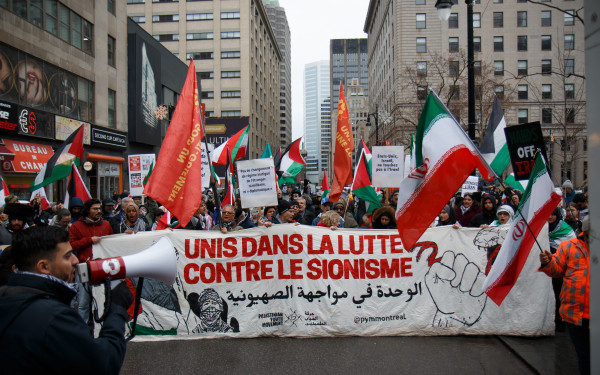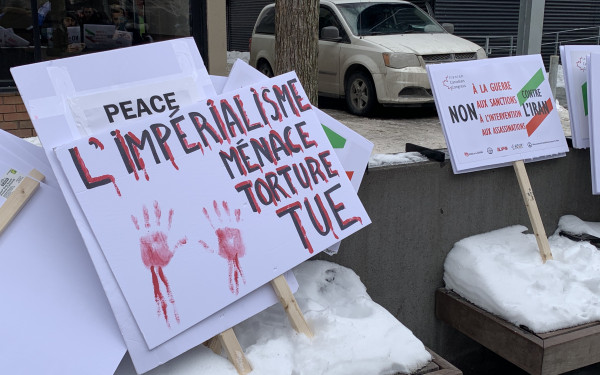
Montrealers gather to protest U.S. imperialism and military attacks against Venezuela
Demonstrators from a variety of backgrounds rallied against the Trump administration’s recent actions
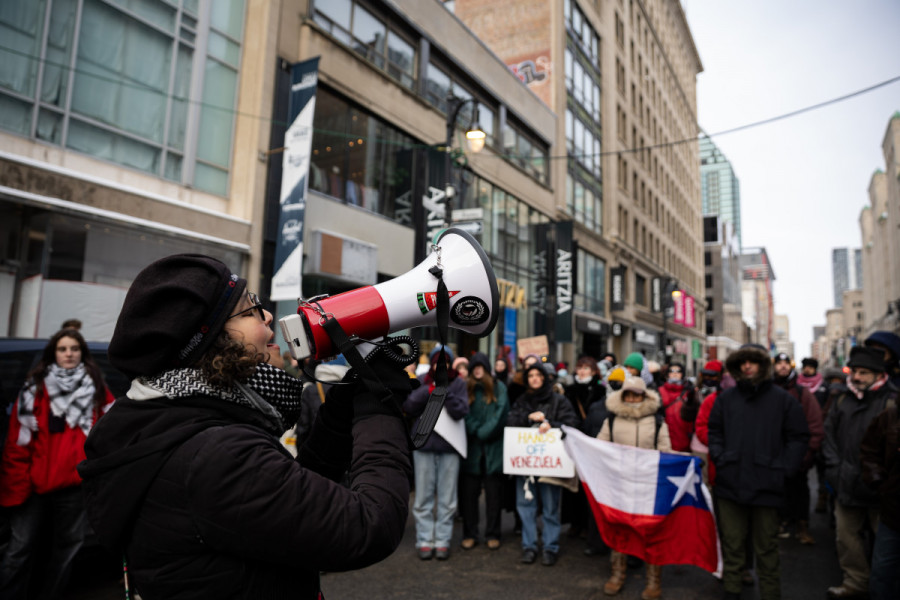
Around 100 people attended a protest in Montreal outside the U.S. Consulate General on Jan. 4 in opposition to U.S. imperialism and the country’s recent military attacks against Venezuela.
Local human rights activist Celeste Trianon organized the demonstration.
Protesters began gathering shortly before 1 p.m. amid frigid temperatures of about –12 C, holding banners and signs, as well as chanting in English, French and Spanish. Chants included “Down, down with the USA,” “Hands off Venezuela,” and “Everyone hates Trumpists.”
Trianon read a speech provided to her by activists located in Cuba, a country whose history is marked by repeated American interference and military aggression. The speech criticized the history of U.S. intervention across the Middle East, Asia and South America.
“Entire countries [have been] transformed into laboratories of horror to sustain the hegemony of a power that has never apologized nor repaired the damage caused,” Trianon said to the crowd, citing the words of Cuban activists.
“Today, Venezuela is once again in the crosshairs. The acts of military aggression, the violation of its sovereignty, and the direct threats against its authorities and its people cannot be interpreted naively or lightly,” she added.
On the night of Jan. 2, American forces captured Venezuelan President Nicolás Maduro and his wife and extradited them to the U.S. Just hours later, loud explosions and numerous aircraft were reportedly seen in Caracas, Venezuela’s capital city.
Legal experts have argued that the U.S.'s actions violate international law.
Romero, a member of the international Filipino youth organization Anakbayan’s Montreal chapter, told The Link that he was protesting in support of the people of Venezuela, “who are under invasion by U.S. imperialist forces.”
Trianon shared a similar sentiment, commenting on the 80 Venezuelans killed in the attack.
“We’re talking about attacks on sovereignty, which is the foundational building brick of international law,” Trianon said to The Link. “People died because the U.S. decided that their lives were worthless.”
During a Jan. 3 press conference, U.S. President Donald Trump told reporters that the American government will “run” Venezuela in cooperation with American oil companies until a “safe, proper and judicious” transition can occur. He added that the U.S government plans to heavily increase Venezuela’s oil production and sell the oil to other countries.
Venezuela is estimated to hold the largest known crude oil reserves in the world, but its oil production declined sharply after the Obama administration imposed sanctions on the country in 2015.
“People died because the U.S. decided that their lives were worthless.” — Celeste Trianon, human rights activist
Another protester, Anita Landolt, said she was attending because she believed it was important to stand against imperialism and support every country’s right to self-determination.
“[The U.S.] invaded Venezuela for their resources. It’s a regime change,” Landolt said.
Landolt, who is Bolivian, drew parallels between current events and past U.S. intervention in Bolivia and Chile. The Richard Nixon administration financed the 1971 coup that installed dictator Hugo Banzer Suárez in Bolivia, while in Chile, the Nixon administration also backed the 1973 coup that installed right-wing dictator Augusto Pinochet.
“It was the U.S. terrorizing Latin America for [its] own benefit and thinking that they could use us,” Landolt said.
Romero said that he believes the Canadian government and Prime Minister Mark Carney should impose sanctions on the U.S. and speak out against the government’s military actions in Venezuela.
He criticized the statement released by Canadian Minister of Foreign Affairs Anita Anand on Jan. 3 as “spineless” and intended to “gloss up” President Trump.
In the statement, Anand denied the legitimacy of the Maduro government and stated that Canada “calls on all parties to exercise restraint and uphold international law.”
“I think we could do a better job in condemning the action and take a step forward as the masses to speak against what’s happening right now,” Romero said.
Trianon shared similar concerns, citing Canada’s close economic ties to the U.S. and Carney's rescinding of Canada’s digital services tax at President Trump’s urging in June 2025.
“At this point, we’re becoming a U.S. vassal state, and we must not allow that to happen,” Trianon said. “The more we try to align ourselves with the U.S., the more we’ll die trying.”
She also urged the Canadian government to condemn the U.S., start “unpairing our public policy and foreign policy,” and “become an independent state.”
Demonstrators and organizers expressed a common desire for Canadians concerned with recent American military aggression to take action and organize together.
“Please stand up. Do something,” Trianon said. “Anyone can organize a protest like this. […] It does not have to be me. It can be anyone, including you.”
The demonstration was briefly interrupted by a verbal confrontation from two bystanders who left the scene shortly thereafter. Protesters dispersed around 2:15 p.m. due to harsh weather conditions.
In the hours following the protest, President Trump made statements to the media threatening further military intervention in Colombia, Greenland and Iran, while also hinting at potential interference in Mexico and Cuba.