Concrete jungle where dreams end
Concordia’s urban campus trades community for efficiency
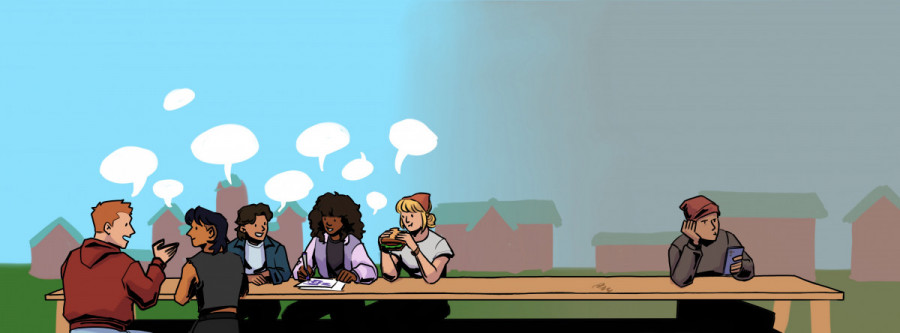
Growing up on university rom-coms, I dreamed of a campus full of life, maybe with a garden, and students sitting around picnic tables.
I still remember the first time I set foot on Concordia University’s campus. It wasn't remotely close to what I’d imagined. It felt soulless, and I remember asking myself, distinctly, where the social life that I’d dreamed of had gone.
Now, after a year at Concordia, I can argue that this feeling had a source. Concordia, especially its downtown campus, never developed a strong sense of community, and the reason for that lies largely in its architecture.
To understand why, it helps to define what a campus actually is. At its core, a campus is a living place shaped by academic pursuits, shared experiences and the rituals of daily life. It’s a place that makes you want to stay and find yourself with peers working toward a shared goal. It's a gated environment that easily fosters a tight-knit sense of community.
Concordia’s downtown campus, on the other hand, is a prime example of a vertical, integrated urban campus. Instead of isolated gates and green lawns, Concordia grew through, around and straight up into Montreal’s cityscape.
As it stands now, the campus feels like a corporate building where everyone comes for a presence sheet and leaves.
The buildings themselves feel corporate. They're built for efficiency rather than longevity, dissolving the boundary between academic life and the city around it.
As a result, the city influences the culture within the campus.
Students don't stick around to mingle; they just leave.
It's hard to buy into the idea of campus life when the metro empties directly into the university's basement atrium. A campus built almost entirely around efficiency, with little thought for community, ends up short on places where people can simply sit and stay a while.
There's the Webster Library and the seventh floor of the Hall building, but neither is enough for the sheer volume of students. Both spaces are also open to the public, not exclusively students, which makes sustaining a social life through these spaces extremely hard.
McGill University’s downtown campus has an incredible social atmosphere with students who feel a strong connection and sense of belonging. It's more contained, and its architecture doesn't funnel students straight into the metro, so they linger on the lawn, grab coffee and stay past class hours.
Concordia’s campus isn’t doomed and helpless. For decades, groups have pushed to pedestrianize Mackay St., the strip between the Hall building and Concordia's downtown annexes, arguing the campus needs the kind of communal outdoor space it currently lacks. In 2023, a blockade during Climate Rage Week renewed the push, with organizers citing both safety and the simple absence of anywhere to gather outside.
As it stands now, the campus feels like a corporate building where everyone comes for a presence sheet and leaves.
This feeling of emptiness within the downtown campus will still haunt me every time I set foot there.
This article originally appeared in Volume 47, Issue 1, published September 8, 2026.