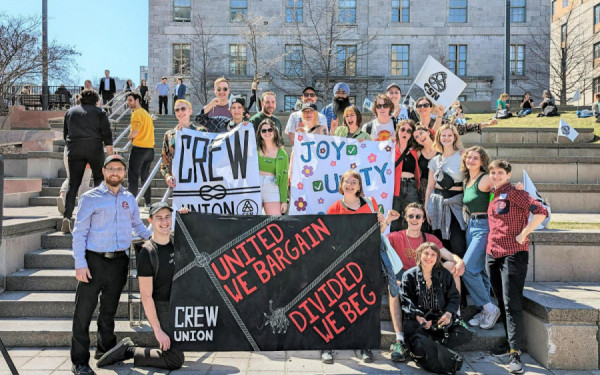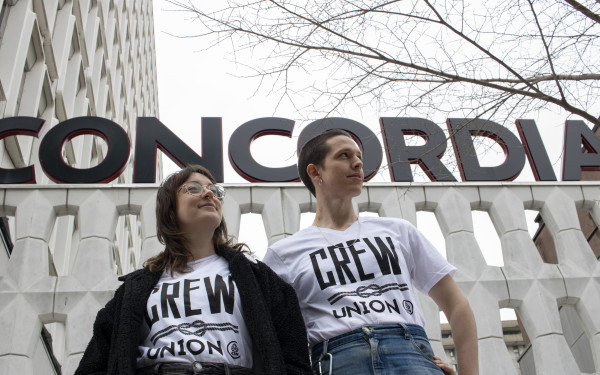
Concordia unions join forces to face university at negotiation table
“Concordia works because we do,” Concordia University Support Staff Union general vice-president says
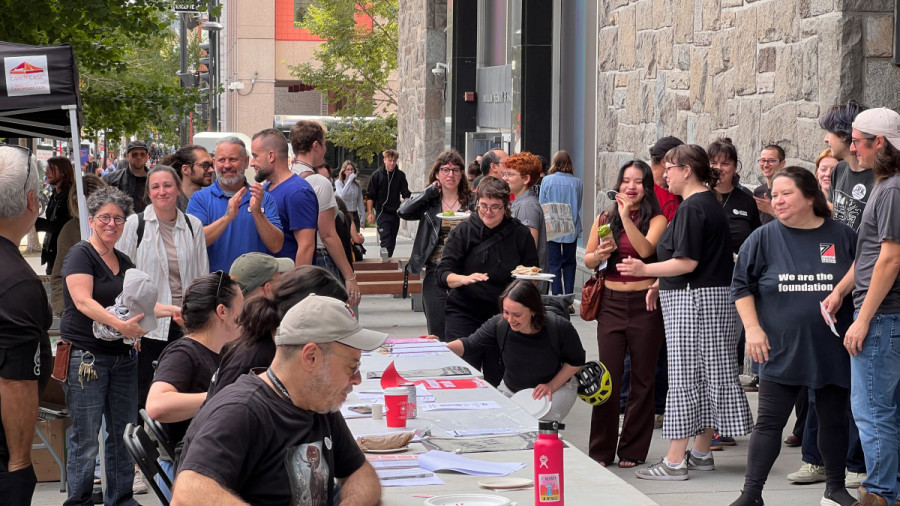
Six Concordia University unions gathered for a lunchtime rally on Sept. 16 at the Sir George Williams campus to launch a new strategy for negotiations: negotiating with the university collectively instead of individually.
The Concordia inter-union group brought together the Concordia Research and Education Workers Union (CREW), the Concordia University Support Staff Union (CUSSU), the Concordia University Faculty Association (CUFA), the Concordia University Union of Support Staff-Technical Sector (CUUSS-TS), the Syndicat des travailleuses et des travailleurs des metiers de Concordia (STTMC), and the Concordia University Continuing Education Part-time Faculty Union (CUCEPTFU).
"It's exciting because we basically have, in this inter-union group, representation in almost all aspects of workers at Concordia," Nicole Farrell said, the group's mobilization officer. "We are stronger together in the sense that without us, you can see the impact—services for students or anyone at Concordia will be eliminated."
Workers from the various unions shared food and exchanged views on their working conditions at Concordia. Various union leaders gave speeches calling for unity and solidarity ahead of this year's negotiations.
According to Théa Bashore, CREW’s bargaining officer, the coalition formed after the university offered most unions a two-year extension to their collective agreements with no wage increases. Most of the unions involved saw their collective agreements expire this summer, making renegotiation routine.
"We couldn't lose our wage increases to inflation," Bashore said, adding that CREW fought hard in its last round of bargaining to bring wages for teaching assistants (TA) and research assistants closer to the provincial average.
Bashore said the group also wants contract language that protects workers as positions go unfilled.
"If people are doing more work, they're either being compensated for it or just to prevent them from overworking in the first place," Bashore said.
Bashore said CREW, founded in 2023, will hold its first meeting with the university in the coming weeks to help determine the administration's posture and attitude heading into negotiations.
She said the union remains focused on securing stable working conditions that let staff do their jobs and, by extension, protect services students rely on, pointing to CREW's past win of guaranteed minimum TA hours per undergraduate student to ensure timely feedback and grading.
“Concordia works because we do.” — David Babcock
David Babcock, CUSSU's general vice-president, told the crowd the union's bargaining team would continue to say no to unacceptable sacrifices as talks begin.
"Concordia works because we do," Babcock said.
Bashore echoed that sentiment in her own remarks, noting that workers are already doing more for the same pay after a wage rollover that did not keep pace with the rising cost of living.
"We don't roll over," Bashore said. "That's it."
With bargaining just getting underway, organizers hope the coming months will test whether the university responds differently to a united front than it has to individual unions in years past.



_600_375_90_s_c1.jpg)