Complainants fail to appear at CSU judicial board hearing over student handbook
The board proceeded with their first case in four years despite the absence of Hillel Concordia

Three students who filed a complaint to the Concordia Student Union (CSU) judicial board over the union's 2025-26 student handbook failed to appear at their hearing on Jan. 16.
On Nov. 3, 2025, Hillel Concordia’s vice president of student life, Samantha Chankowsky, filed a complaint to the CSU's judicial board (JB) against the union’s entire executive team.
Chankowsky filed the complaint alongside Chabad Concordia’s president, Chana Leah Natanblut, and StartUp Nation Concordia’s president, Anastasia Zorchinsky.
The complaint claims that the union’s executives “created a hostile environment in which minority communities, especially Jewish and Israeli students, cannot feel safe expressing their views or identities on campus” with the publication of the CSU’s 2025-26 student handbook.
The plaintiffs also claim the handbook’s strike guide “encourages hard picketing, which translates into denying students who choose not to participate in any given strike the right to attend the classes they paid for.”
They also claim that the handbook’s page titled “We’ve got rights! A guide to counter repression,” which outlines tactics to conceal protesters’ identity, “creates a reality in which students holding minority views have limited options to protect themselves.”
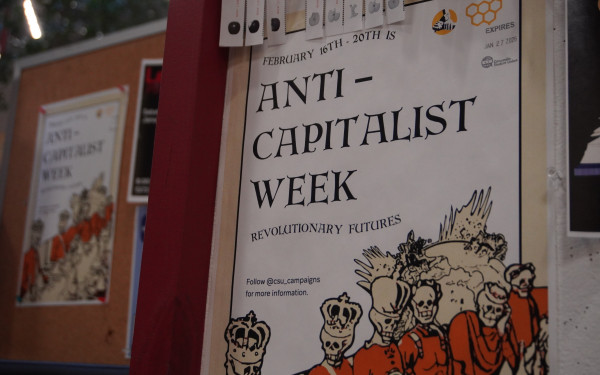
The plaintiffs further claim that the CSU handbook spends a “disproportional amount of time on the Palestinian-Israel Conflict, creating the sense that students must adhere to the viewpoint pushed by the CSU,” and that such attention puts students who disagree in danger.
The CSU has been printing a handbook for students at the start of the fall semester for years. It serves as an agenda and one-stop shop for students to learn about campus services and student rights.
First judicial board hearing in four years
On Jan. 16, the JB met to hear the plaintiffs and the respondents in the case.
This was the first hearing of the JB in over four years following the CSU council's reinstatement of the union's judiciary branch after two failed attempts in 2025.
The hearing started at 10:10 a.m., 10 minutes after its scheduled start, with no plaintiffs present.
As Chankowsky, Natanblut and Zorchinsky weren’t present to present their complaint, the CSU executive team presented their defence, stating that they had not broken any CSU bylaws or regulations.
In her argument, CSU’s external affairs and mobilization coordinator Danna Ballantyne claimed that the complainants had not only failed to show up to the hearing, but that they had also provided no real evidence or data proving the handbook’s alleged hostility toward Jewish and Israeli students.
Ballantyne also clarified that the handbook had already been discussed at the union’s council meeting in September 2025, where a similar motion to retract the handbook was rejected.
In defence of the union’s pro-Palestine content in the handbook, Ballantyne explained that “the CSU has a long-standing, democratically adopted position on Palestinian solidarity, and this has been reaffirmed through multiple general assemblies and council motions over the past two decades.”
Ballantyne also responded to the accusations that the strike guide in the handbook was discriminatory, stating that none of the union’s bylaws were broken and that it was solely published to educate students.
“Inclusion of related educational or advocacy material in the handbook, therefore, falls squarely within the CSU's mandate to inform members about its political positions and campaigns,” Ballantyne said.
Such information, according to Ballantyne, is necessary due to the increase in student strikes at Concordia over the last three years.
“This information is not only relevant; it's actually something that we as an executive team would consider necessary for us to inform our student body on,” Ballantyne said.
The JB will take five business days to post a written decision on the complaint sent to both parties involved.
In an email to The Link, Zorchinsky said she had not received direct communication about the hearing and would have attended if she had known it was taking place.
This is a developing story.