
Combining the worlds of visual art and theatre
Samuel Rancourt, a multidisciplinary artist and Concordia alumnus, processes the world around him through creativity
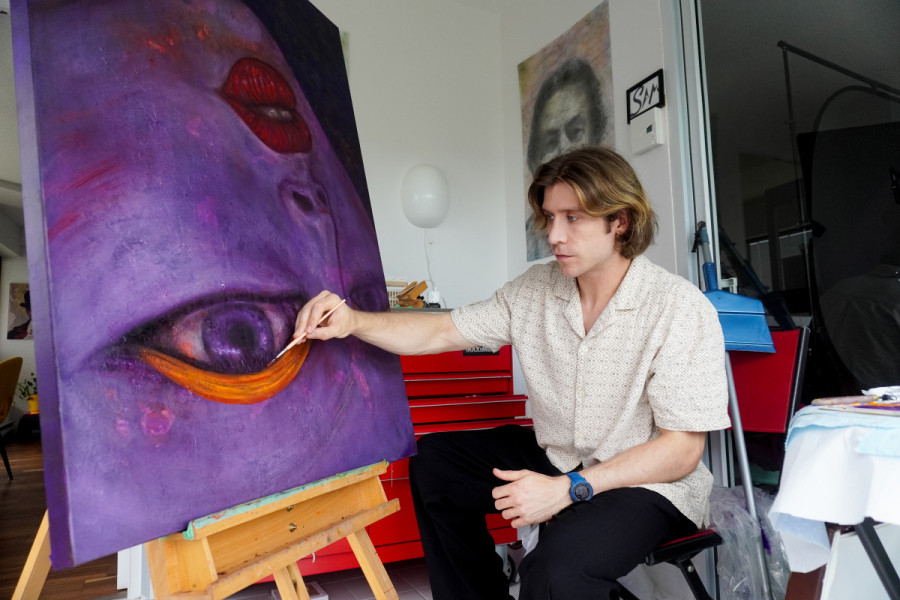
Concordia alumnus and artist Samuel Rancourt’s paintings focus on the human face rendered using unconventional colours, with a special emphasis on eyes. He also plays with texture by building forms beyond the canvas.
He is not just a painter, he is also an actor and writer whose work pushes boundaries.
He takes inspiration from the people he sees day to day. He takes their expressions or their faces and reproduces them in his unique style.
The paintings are shown off vividly in his two music videos.
Rancourt’s venture into music came about when Rancourt was approached by his friend Travis Maclean to make a song.
“I had never done that in my life, but I was like, 'let’s do it,'” Rancourt said.
Rancourt decided to expand the project to include a video that combined elements of dance, visual art and theatre into a single experience. Out of this came the song “Tika Tika Tak,” which also served as a virtual exhibition of his paintings and work.
“Futur Zéro” is an expansion of this concept, showing even more people from all over dancing to the music and displaying Rancourt’s paintings. The video also includes clips that were sent in after Rancourt posted a callout on social media, which allowed many more people to participate. The song was created with Caroline Boivin, who mixed and produced the music.
The video features a variety of people: young and old, men and women.
“I think that art can have this power of bringing people together, and at a time like we live in now, I think it’s more important than ever,” Rancourt said.
Several other creatives helped make Rancourt’s vision possible. One of them is Milo Lees-Greene, a model for Next Canada who first worked with Rancourt as a stylist for the video. They are currently working together on Rancourt’s first feature film.
Lees-Greene described Rancourt as very sociable. They told a story about how Rancourt was invited to dinner with the owners of the house the crew were filming at.
“He’s always so polite and talking to everyone,” Lees-Greene said.
The two met at a bar, where Lees-Greene was first introduced to Rancourt’s work.
“One of the things I like about him is that he goes out of his way to make his own projects happen,” Lees-Greene said.
Lees-Greene said that Rancourt’s working style involves jumping in headfirst and trying to sort out the details as he goes. They said that while he does plan ahead, he is more spontaneous and adaptable as he goes along.
“He’s a very surprising artist, because he’s a painter, he’s a singer, he’s an actor, he’s a writer. He can do everything.” — Marie-Catherine Massie, writer, Référendum d’été
Rancourt’s first feature film is called Référendum d'été. The movie will take place during a hypothetical third referendum for Quebec's sovereignty. It will follow a cabaret dancer, played by Rancourt, and a sovereigntist librarian who finds fake ballots against the referendum in a car they are stealing. The two men fall in love as they are being chased by a mercenary sent by the prime minister of Canada.
The goal of the movie is not to sway the audience to one side or the other of the referendum debate, but to poke fun at and show the complexity of both arguments.
“We’re laughing at everyone,” Rancourt said.
Rancourt co-wrote the movie with Marie-Catherine Massie, a fellow writer, actor and director. Massie echoed Lees-Greene’s sentiment that Rancourt is kind and courteous to those around him.
She also noted that Rancourt is extremely creative.
“He’s a very surprising artist, because he’s a painter, he’s a singer, he’s an actor, he’s a writer,” Massie said. “He can do everything.”
The two had worked together as actors before Massie approached Rancourt to write the film.
“I think at first he was a little nervous about trying to do a big project like this, but very quickly he just jumped in,” Massie said.
She described Rancourt as someone who prepares a lot for his roles as an actor.
The two wanted to stray away from clichés, whether regarding the queer characters or the women.
“We wanted to have a lot of very interesting roles for women, and women over 55,” Rancourt said.
They also push against typecasting by writing characters for well-known Quebec actresses that are the opposite of what they usually play.
Rancourt’s grandmother taught him how to paint when he was young. He used to play pretend and make theatre shows with her.
“I’m an extroverted person, but I’m also very introverted when I paint, so it’s very balanced, and that’s what I love about bringing these two mediums together,” Rancourt said.
He noted that while painting is an activity in which he’s isolated, he inevitably does it as a way to reach out to other people. He wants to see other people’s reactions and know what they think.
“To me, it’s all related, you know. It’s all about communication, but through painting or acting or stories,” Rancourt said.
When Rancourt did his first theatre show in Montreal, he was concerned that no one would attend. The show sold out.
Rancourt mentioned that he loves Montreal for its art scene and how there always seems to be something going on.
He had a unique schooling path. Initially, Rancourt studied communications at l’Université du Québec à Montréal. While there, he took evening classes in radio and television at Promédia, where he discovered his love for journalism. Afterwards, he completed a graduate degree in the field at Concordia.
He found that the journalism professors at Concordia took the time to push him to try new things and experiment. He said that while he paints, he thinks about all the people he met through the program, whether they be mentors, peers or people he met while doing interviews.
Rancourt noted that the program also helped him get to know the city better through his assignments.
During his graduate degree, he interned at CBC Montreal, where he became an employee. He later moved to Western Canada and worked for CBC Vancouver, Edmonton and Winnipeg.
When he returned to Montreal six years later, he decided to throw himself into his art. He studied at l’École des Beaux-Arts de Montréal and pursued training in acting while continuing his work with the CBC.
In terms of acting, getting to meet so many people in different fields helped him understand their jobs better and bring more realism into his performances.
“Even if you don’t feel like it, you have to go out there and ask questions and take it in and listen,” Rancourt said. “I think that those are skills that are very important when you actually act.”
Rancourt’s curiosity and open-minded approach means he has many diverse projects under his belt as well as many more to come.
“I’m at a point where I’m really happy with what I’ve achieved, and I have so many other goals and projects and ideas,” Rancourt said.
A previous version of this article stated that Caroline Boivin worked on the song Tika Tika Tak. This is incorrect; Boivin worked on Futur Zéro. The Link regrets this error.
This article originally appeared in Volume 47, Issue 1, published September 8, 2026.