
Archiving a DIY history
People gather for the opening of Owning Our Histories: Celebrating Queer & BIPOC DIY Archives
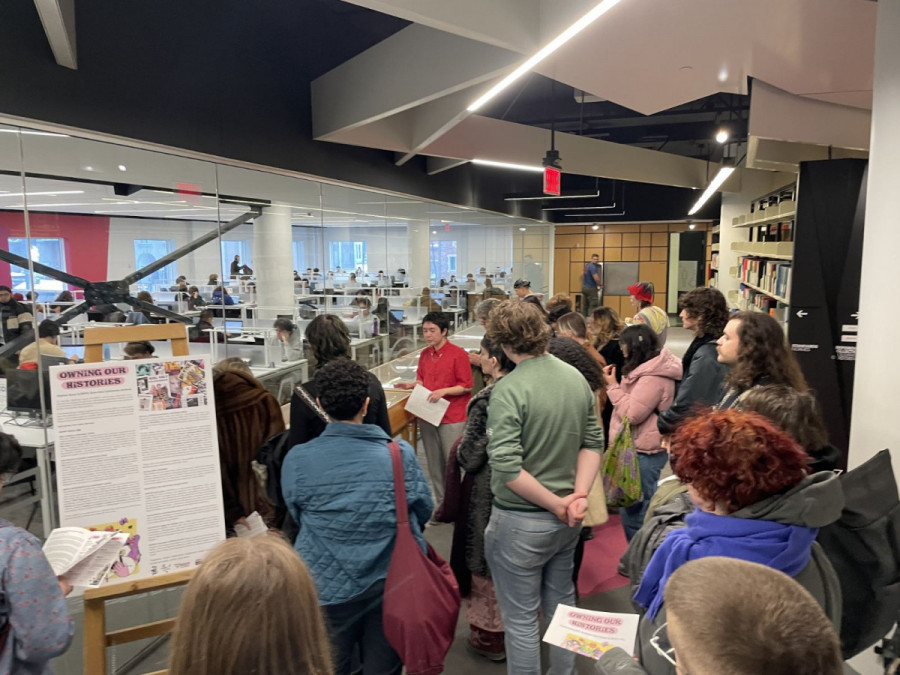
On Feb. 13, the Friends of the Library Room at LB-361, usually a quiet study space, was filled with people for the opening of the Owning Our Histories zine exhibit.
Chloe Martin coordinated the opening. They are part of ARCMTL, a non-profit organization that archives and promotes local independent culture.
“We wanted to kind of create a project that was really exploring these small organizations that were just preserving, documenting communities themselves,” Martin said.
The opening marked the first in a series of 10 free, public events celebrating queer, trans and BIPOC archival work.
Hannah Blair, ARCMTL’s staff archivist, helped curate the exhibition alongside Martin and other collaborators. The collaborators included the Archives gaies du Québec, the Quebec Public Interest Research Group (QPIRG) at Concordia University and McGill University, and the Concordia Fine Arts Reading Room.
Blair spoke on the difficulty of archiving self-published work.
“They come in all sorts of different formats and often there's no author, often there's no date, so it's a lot of detective work,” she said.
ARCMTL also hosts Expozine, Montreal’s annual small-press fair.
Martin and Blair began the reception by giving a short speech, elaborating on the intentions behind the project.
“The special thing about zines is that anyone can make a zine about anything,” Martin said.
Martin emphasized that zines represent an important medium of expression for marginalized people, a point echoed by Blair.
“Zines are cheap to produce, easy to distribute and impossible to censor,” Blair said.
Blair added that the anonymity of zines serves as a form of protection for their authors. Their uncensored nature allows zines to explore topics outside the mainstream, such as BIPOC and queer resistance or sex work.
Martin also included a land acknowledgment in the speech, where they spoke to the importance of zines for disseminating information about Indigenous communities.
“Reflecting on what I wanted to say during this land acknowledgement, I realized that a lot of my knowledge about current and past Indigenous resistance has come from zines,” they said.
After the speech, Martin and Blair led attendees on a walk-through of the exhibit on the second floor of the library.
Zines sat in glass boxes, with visitors unable to touch them. Curators struggled with the dual values of preservation and display.
“It was really tough to kind of set up an exhibit where people couldn’t physically touch them,” Martin said.
Because of this limitation, the curators chose zines with striking covers or interior spreads that could offer viewers a sense of their content.
Free programs for the event series were placed on top of the glass boxes. Materials on display included booklets, fold-out pamphlets, poems and more. The zines varied in language and size.
Clara Griffin, a friend of Martin’s, attended the event.
“I thought it was a really nice mixture of different zines,” Griffin said.
Griffin noted that she enjoyed how the zines were displayed. Some were held open or folded out, allowing observers to read select pages.
One fold-out zine expanded into a miniature living space with tiny paper furniture and pink, drawn-on details.
A few of the “zinesters” joined the audience on the tour. Martin invited each to speak about their work as the group moved through the exhibit.
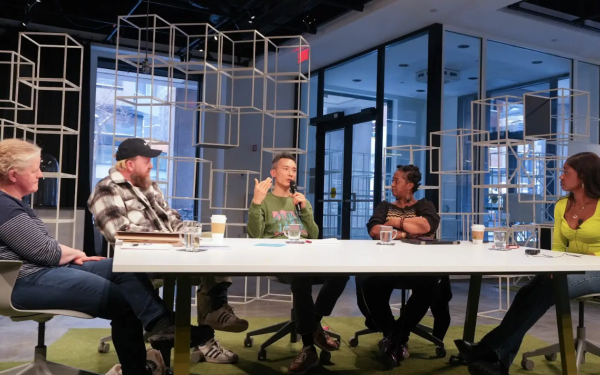
The group returned to the Friends of the Library Room to participate in a Q-and-A with some of the curators. People sat wherever they could, with many gathering on the floor.
The curators in attendance were Martin and Blair, as well as Isa Fuentes from the Concordia Fine Arts Reading Room and Carl Bystram from QPIRG McGill.
“Zines kind of have this ephemeral nature where they're in constant circulation,” Martin said.
The curators reflected on the challenges of archiving deeply personal or community-specific work.
“How, as archivists, can we handle those with care?” Martin said.
Blair also expressed concern about disseminating information that was meant to stay in one social sphere or to be ephemeral.
“Zines really belong in community archives,” Bystram said.
Bystram added that these archives can lend out material, putting community involvement at the forefront.
The exhibit will remain open until March 17.



_600_375_90_s_c1.JPG)