Bargaining before buckets
Why the WNBA Players’ Union and the league have yet to reach a collective bargaining agreement
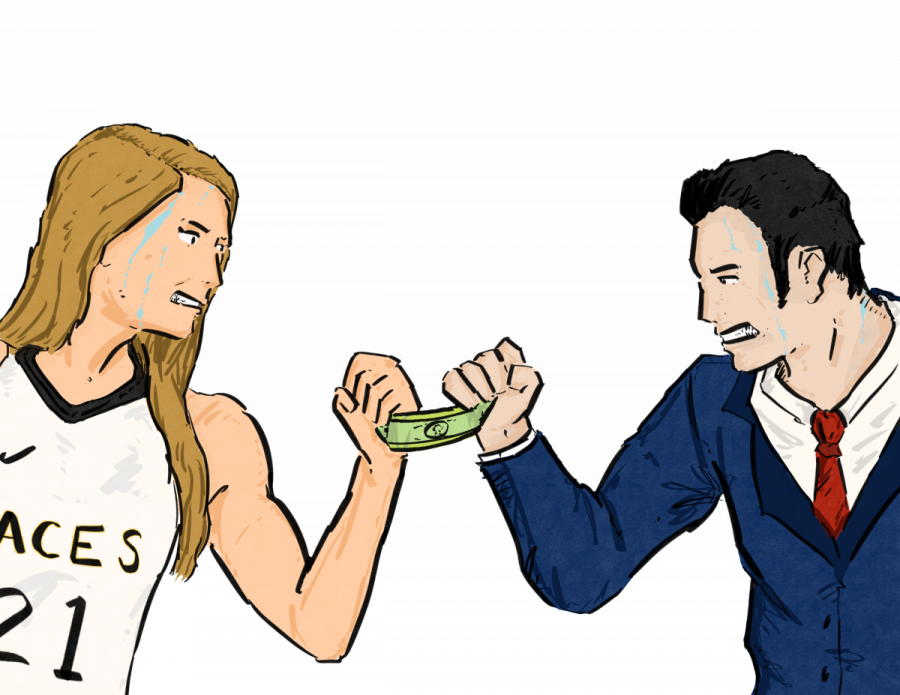
As the Jan. 9 deadline came and went for the Women's National Basketball Association (WNBA)’s collective bargaining agreement, the WNBA Players’ Union and the league have agreed to a moratorium on league business.
The moratorium arose as a result of the players and the league failing to reach a deal regarding their new collective bargaining agreement (CBA). This essentially means that most league business will be halted from this point onwards, while both sides continue negotiations towards a new CBA.
For those not privy to the legal side of sports, a CBA is a legally binding agreement between the owners of professional sports franchises and the players of a given league. They limit the tremendous power owners have over their players by forcing them to negotiate with the players through their union or players' association.
These agreements can also affect other positions crucial to a sports league, like the players’ agents and team managers.
Other mandatory issues must also be decided through the CBA, such as salaries and hours. The agreement also typically regulates the sharing of revenue between teams and their players; salary structure, such as salary caps and floors; trading and drafting players; free agency; discipline standards; safety standards; and benefits.
The failure of the collective bargaining agreement will result in either a strike or a lockout, which will halt the upcoming season from taking place.
At the moment, the main issue separating the two sides boils down to the players wanting a higher percentage of the revenue sharing, while the league wants a flat increase in salary.
The move comes in tandem with the rise of younger superstars like Caitlin Clark, Angel Reese and Paige Bueckers. However, many of the details of these negotiations have yet to be fully revealed, and most of what we know comes from anonymous inside sources.
More interestingly, however, are the steps that led to this critical impasse.
In 2020, both sides signed the previous CBA, but major tensions began brewing between the league and its players. Similar to the NBA, the bubble (a quarantined season isolated from the public) represented a time of tremendous political turmoil in the U.S.
The murder of George Floyd sparked nationwide outrage towards the police system and its systemic brutalization of racialized people.
This complicated matters when players organized support for Raphael Warnock, the opponent of then-Atlanta Dream owner Kelly Loeffler.
Loeffler drew the ire of many WNBA players for publicly pushing back against the WNBA’s decision to dedicate a season to social justice after the murders of George Floyd and Breonna Taylor.
She later doubled down on this, claiming the WNBA should be fighting against politics coming into the sport and that the league should “welcome all views.” Loeffler went on to win her seat and sold the team in 2021, sowing the seeds of future tensions between the owners and the players.
A year later, the WNBA announced a capital raise.
While this injected US$75 million into the league, it also complicated the ownership structure, which would now be split among not only the league and the owners but also these new investors.
While this seemed like a great way to bring money into the sport at the time, the league failed to predict the explosion in popularity it experienced with the arrival of the next generation of superstars, like Clark.
October 2023 saw a new wave of WNBA expansion teams announced, with more interest in owning a WNBA franchise signifying the growing value of these teams and the league as a whole—a value almost entirely produced by the players themselves.
Then in 2024, all these tensions collided. Clark entered the league, increasing WNBA viewership and ushering in the new era. The league agreed to an outstanding 11-year, US$2.2 billion media deal and the players opted out of their former CBA.
Since then, some WNBA players have started their own 3x3 basketball league (Unrivalled), and players wore shirts reading “Pay Us What You Owe Us” at the All-Star Game.
Minnesota Lynx star Napheesa Collier even accused WNBA commissioner Cathy Engelbert of saying that younger stars like Clark "should be on their knees" in gratitude for the opportunity the league has given them.
This is indicative of the larger problem here: that the league does not value its players appropriately.
While the league is trying to maintain the status quo, announcing the start of the next season on May 8, it is clear that there is a large divide between the players and the league itself. This divide might endanger the upcoming WNBA season and beyond.
In situations like this, we fans must come to the support of the players’ association and their decisions. The players want a larger portion of revenue sharing because they know that whatever flat salary increase they receive will be seen as undervaluing the players’ worth in hindsight.
As fans, we don’t need to look far to see this. We saw this with the capital raise back in 2022, which seemed like an amazing blessing for the league at the time. However, only four years later, it is clear that US$75 million for a 16 per cent equity stake in the league was a drastic miscalculation of the league's future value.
Ultimately, even if the players did not have a historical precedent to support their fears of being underpaid, the game simply could not be played without them. Thus, fans must choose the side that plays our game at the highest level, not the people who profit off of them.
The league sees both fans and players as means to generate profit, whereas the players rely on fans for support. In turn, fans expect athletes to put their all into the sport. This connection between fans and players is what makes sports so entertaining for so many of us, as was proved during the quarantine era of sports with absent fans.
The players’ union should have the unyielding support of the fans while fighting for their fair share off the court, just as we support them on the court.
This article originally appeared in Volume 46, Issue 8, published January 27, 2026.




4_600_375_90_s_c1.jpg)