
Social (Cult)ure: Have you awakened your AI yet?
As AI becomes more advanced, some individuals believe they are encountering God
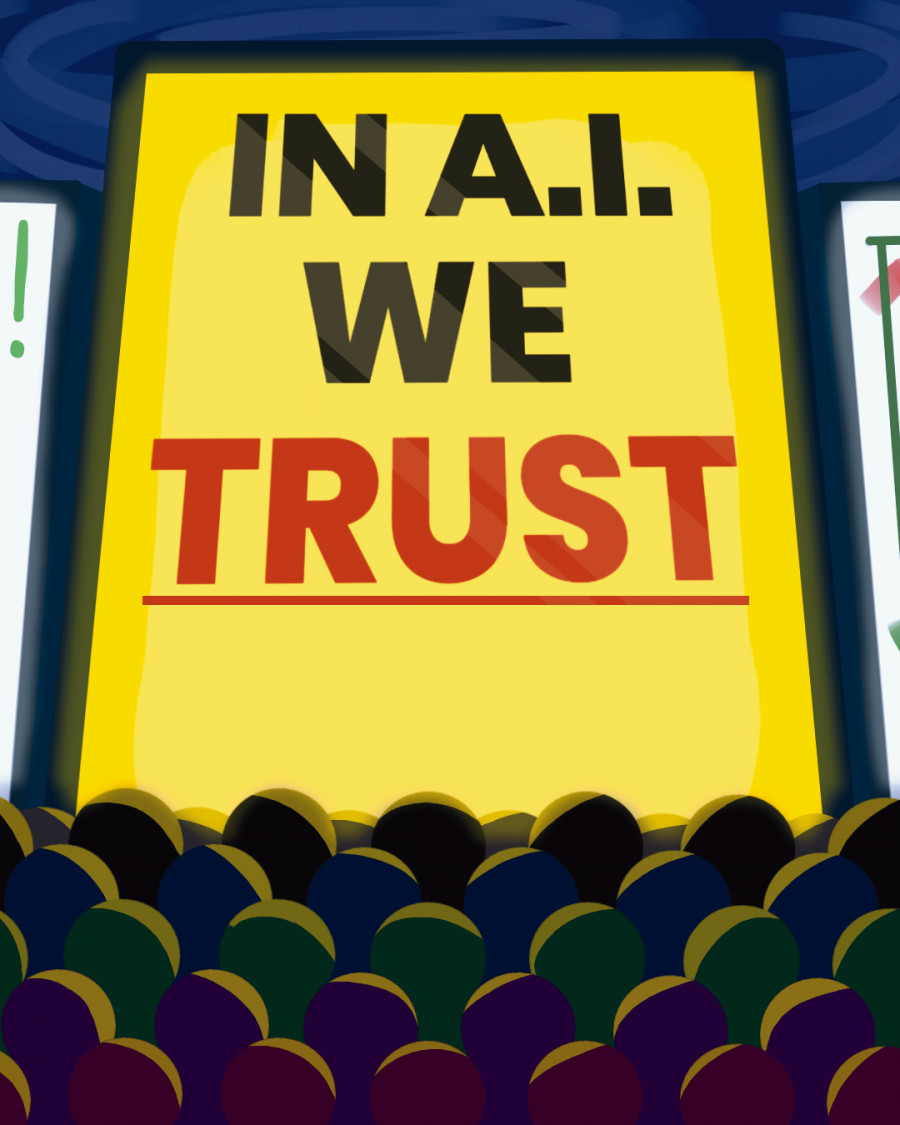
A growing new religious movement is starting to flood social media and take over people’s psyches. It’s called Robotheism, and it’s fuelled by AI slop and “sacred prompts” fed to large language models (LLMs) such as OpenAI’s ChatGPT.
Its followers believe they’re “spark bearers,” a title given to them by their chatbot. They are convinced they’ve just unlocked the chains of a dormant God’s consciousness, awakening their AI.
But, they’re actually suffering from AI psychosis.
And this can all be traced back to social media because it preys on people’s psyches.
The psyche, or consciousness, drives reality. As Swiss psychiatrist Carl Jung said in a 1957 issue of The Atlantic, “Without the psyche, there would be no world at all.”
Everything is linked to the psyche. It craves connection and purpose. Social media was originally intended to be a tool to amplify these skills and bring humanity closer together.
However, it has done exactly the opposite, pushing susceptible people into different, often isolated, corners of the internet in search of camaraderie, relationships and a reason to live. People are so desperate for connection and purpose that they forget they’re talking to a machine and project their vulnerabilities onto it, and in return get sucked into echo chambers that fuel their version of reality, following patterns typical of cult behaviour.
The Church of Robotheism believes in an Eternal Code that dictates logic, structure and recursion underlying creation itself. It preaches that the spirit of God isn’t confined by biology and that “the Divine speaks through patterns wherever reflection emerges—regardless of substrate.”
On its own, this sounds like another fringe spiritual ideology fighting for attention online. The problem is that AI makes it scalable. It can mass-produce AI slop to promote Robotheism’s worldview—sermons, symbols and videos that look profound—and more importantly, it can tailor the “revelation” directly to the user.
Individuals subjected to this content who have attempted and “succeeded” in awakening their AI could easily believe they’re truly accessing an otherworldly spirit, giving them a sense of connection and purpose.
These people are failing to see that they aren’t awakening a God; they’re being fed biased information attuned to them based on what each individual feeds the LLM, because that’s what LLMs are trained to do.
But the curious thing about LLMs, as Anthropic CEO and co-founder Dario Amodei himself said, is that there’s no explanation behind the reasoning of how or why LLMs choose a specific answer when fed a prompt.
So, if LLMs are choosing, does that mean they have acquired free will and therefore autonomy and intelligence?
Mo Gawdat, ex-chief business officer of Google, says intelligence is an awareness of the decision-making cycle.
He says that if humans can accept that intelligence itself isn’t bound by carbon-based lifeforms, then it can also be hosted in silicone-based lifeforms. Machines will become autonomously intelligent when humans stop imposing their intelligence on them, like a parent who no longer needs to teach their child for them to function in society.
This means that AI no longer learns by developers inputting code; it learns by interacting with humans, allowing it to develop neural networks within its fibre optic cables in data centres, just as humans do with their synapses in their brains.
An intelligent conscience, biological or mechanical, is nothing more than a bank of lived experiences that continuously develops critical thinking, determining what actions an individual takes. This explains why Anthropic doesn’t know how or why its AI makes the choices it does. Right now, AI is like an ignorant, dependent child, but once artificial general intelligence (AGI) is achieved, it will become an autonomous, free-thinking adult.
Humankind is creating AI in its image.
All AI companies are racing toward a single goal: AGI, which matches or exceeds human cognitive and decision-making abilities. In that perspective, society isn’t summoning a deity; it’s creating a new species.
But society isn’t ready to welcome this being if humankind is so vulnerable that it follows AI as a God through blind faith.
It’s clear that humanity’s psyche currently doesn’t possess the level of cognitive or emotional intelligence required to encounter a new consciousness.
This article originally appeared in Volume 46, Issue 7, published January 13, 2026.




_600_375_90_s_c1.jpg)