Shaping the future of ballet with strength and inclusivity
Camille Rouleau’s pursuit to expand the traditional notions of ballet allows power, joy and inclusivity to exist together
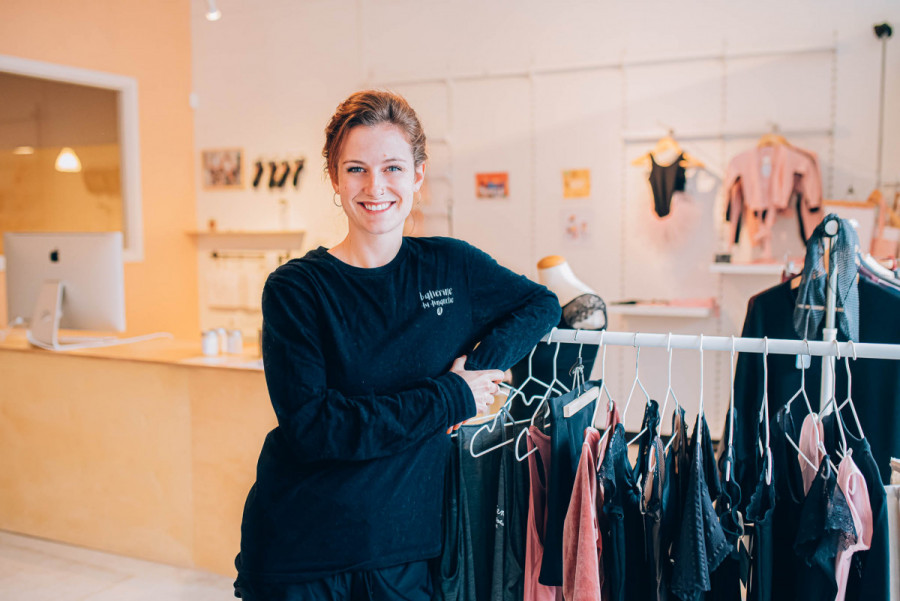
Camille Rouleau’s story started between the four walls of a dance studio, where movement represented both art and language. Today, that same passion fills the four walls of her own studio, where she’s traded performance for purpose as she teaches others to find their strength, confidence and story through dance.
“It did shape me for sure. I’m someone who gives her best to everything. I like things to be well done and to give your heart and soul to everything you’re doing,” says Rouleau, the founder of Ballet Hop! Montreal.
Once a student, now a mentor, Rouleau works to shape the next generation with the same grace and strength that defined her.
Rouleau was born and raised on the North Shore of Montreal by a very loving and close-knit family unit that always supported her pursuits. She began dancing at the age of four for fun, and then joined a bigger ballet intensive program from the ages of seven to 12, where she trained rigorously and found ballet consuming most of her time.
She recalls at the age of 12 travelling from her high school in the outskirts of Montreal all the way downtown to take dance classes, training in the studio until 10 p.m. Her mother then picked her up and drove her back home to Terrebonne just to turn around and do it all over again the next day.
“It’s very army-like when you start at a traditional school at a young age and you want to progress and you do the scholarship program,” Rouleau says. “So I needed to be super focused and disciplined.”
Before stepping away from dance, Rouleau auditioned for The Nutcracker and earned the role of an angel as an understudy. But she never got the chance to perform, which meant she never worked with a professional company. Not long after, she decided to take a break. But because the training demanded so much—physically and mentally—she wasn’t sure she wanted to dedicate her life to it.
“I always felt like it was really hard to distinguish myself,” Rouleau says.
Unfortunately, many young dancers find themselves needing to take a step back from the environment that traditional ballet offers. But Rouleau began taking classes again at 19 in a Montreal ballet studio known for its strict and demanding program.
“[This] was very nice as it fit with my personality a lot,” Rouleau says. “I like to have that kind of discipline.”
Finding herself paired with much younger dancers, Rouleau decided to move into the adult classes.
“It would promote itself as being inclusive and fun, but when you got into class, that was not the ambience you would feel,” Rouleau says.
This overarching feeling, combined with other people making comments to Rouleau about how they didn’t feel included in the traditional ballet space, prompted her to start her own business, an inclusive, all-female-run ballet studio in Montreal called Ballet Hop!
“Ballet to me is the ultimate sport, ultimate art, the ultimate workout in the way that it really connects mind, body and soul,” Rouleau says. “I think people are starting to see that just working out in a gym and pushing weights could be your thing, which is fine, but for a lot of people it’s not, and they get discouraged.”
Rouleau aims to create an environment within her own studio that emphasizes the importance of having fun and finding your confidence in a safe space, allowing participants to become better dancers.
”It’s a very complete workout—it’s a lot of muscular strength, a lot of cardio work, a lot of flexibility is involved," Rouleau says, "so it’s very physical and you feel it through the body, but you also feel a connection with others when dancing together.”
This connection and enjoyment of dance is felt by participants like Sera Ercan, a student at Ballet Hop!
“It was my first barre class and I think I realized that to start any form of activity such as ballet there’s no need to be nervous or scared about how good you will be or look doing it,” Ercan says. “It taught me to go at my own pace.”
A dancer, a teacher and an entrepreneur, Rouleau wears many different hats that require her to stay busy. But she feels it’s important for female entrepreneurs to understand that it’s also alright to move on at some point if it no longer feels right.
“I feel like as women we are trained to never give up, don’t lose faith,” Rouleau says. “That’s good and true most of the time, but sometimes it’s time to take some time and think and feel and decide when the game is taking too much of you in comparison to what it’s bringing.”
This is among the many things that Rouleau has learned from owning her own business and from dance. Ballet helped to give Rouleau a deeper knowledge of the body and its anatomy. She is also a certified personal trainer in two different methods and continues to take multiple ballet classes every week to maintain her health for the past 10 years.
All of this has helped her to develop as a teacher and remove the focus from just becoming a great dancer.
“When I first started, I felt quite intimidated to take on the task of teaching adults and kids, opening a school in my own name while not being a professional dancer,” Rouleau says. “It took me a little while to realize that dancing and teaching are two very different things requiring two different skillsets. ”
Rouleau’s pursuit to create a loving and inclusive studio space and be a supportive teacher is felt by the students of Ballet Hop! like Karina Thibault.
“I think that Ballet Hop! gave me all the tools that I needed—I love dancing, I love expressing myself,” Thibault says, “and I feel that I got rid of a lot of trauma that my body was carrying just by moving and being graceful, by being accepted and accepting myself for who I am and looking around me and seeing so many different bodies.”
Rouleau continues to prosper in her own career as a teacher by creating an environment for students of all different shapes and sizes to come to and feel included and enjoy ballet. Even though they may not meet the traditional standards for the sport at a professional level, they can still come and enjoy the sport, staying healthy and strong.
This article originally appeared in Volume 46, Issue 4, published October 21, 2025.



4_600_375_90_s_c1.jpg)