Uncensored: One bed, two standards
Sexual exploration earns men admiration while leaving women with a reputation to defend

Apparently, sexual liberation has a gender requirement.
Stereotypically, men are almost always given a pass when it comes to their sexual activities, especially in university. Women, on the other hand, are expected to navigate an entirely different set of societal expectations.
The difference in treatment and expectations between genders is part of a much larger societal issue. Since childhood, my male counterparts have always been granted a certain leniency for their behaviour when pursuing someone romantically.
"Boys will be boys," anyone?
Later, in high school, they were crowned kings of the hallways after taking someone’s virginity, turning an intimate experience into a bragging point among friends. Now, in university, they are encouraged to experiment, explore their sexuality and figure out what they want. Their experiences are framed as personal growth.
Sex is an experience shared between people, not a trophy for one and a stain on the other. If we are going to celebrate sexual freedom, it cannot be a privilege reserved for one gender.
Yet, as a woman, I was never granted these same freedoms and privileges.
The root of this disparity is something we have all heard before: the patriarchy. Rather than over-polarizing a sensitive topic, I aim to assert this point as a woman who is tired of the sharp contrast in how we experience and discuss sexuality.
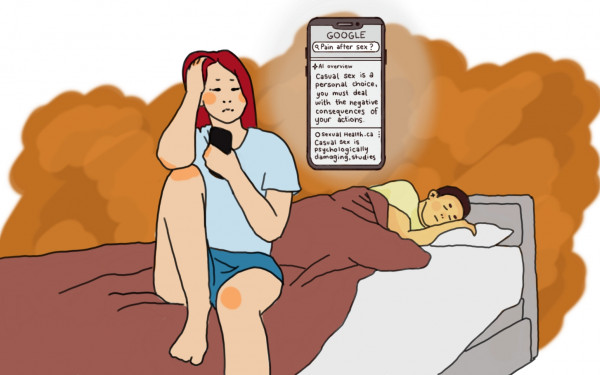
Consider the seemingly innocent question of body count. Often asked out of simple curiosity, reactions vary wildly based on the number and who’s answering. For men, a higher number can be a source of pride, an indication of experience or even social status. For women, that same number often becomes ammunition for judgment. Suddenly, she is “ran through,” “easy” or somehow less deserving of respect. The same experience that earns a man admiration can cost a woman her reputation.
This double standard also extends beyond the bedroom and into our daily lives. Women frequently caution their friends to watch their drinks, question someone’s intentions and think twice before going home with someone. These precautions are not without reason. Experiences of sexual coercion and assault are realities that shape how many women navigate hookup culture.
Nevertheless, while women are taught to anticipate the worst, men are often encouraged to celebrate and expect positive sexual experiences without any fallout afterwards. One group is taught to be hypervigilant; the other is often taught that sexual exploration is simply part of growing up.
Even the language we use reinforces this mentality. Men “take” someone’s virginity, as though sex is a conquest and a woman’s virginity is something to be stolen. Women are left carrying the social consequences of an experience that supposedly involves two people. When it comes to sexual acts, women are made to feel dirty and devalued afterwards, while men are given bragging rights.
The disparity also extends beyond just heterosexual relationships. Gay men have become increasingly visible in mainstream culture, while lesbian relationships remain widely fetishized and are often viewed through the lens of male desire. Even a woman’s sexuality outside of heterosexual relationships is often evaluated according to how men perceive it.
Sex is an experience shared between people, not a trophy for one and a stain on the other. If we are going to celebrate sexual freedom, it cannot be a privilege reserved for one gender. Men should not have to diminish their experiences, nor should a woman have to defend theirs.
Until we can have the same conversation about a man and a woman without changing our opinion based on who is involved, we are not nearly as sexually liberated as we like to think.
This article originally appeared in Volume 47, Issue 5, published November 10, 2026.