Concordia’s radical history of student activism
A look at over 57 years of student organizing at Concordia
From Palestine solidarity to climate justice, Concordia University has a lengthy and celebrated history of student organizing.
“Coming to Concordia comes with a legacy of taking up the voice of the voiceless,” Bilal Harper said, the director of research at Students for Palestine’s Honour and Resistance's [SPHR] Concordia chapter. The Link has granted Harper a pseudonym to protect his anonymity.
“Concordia has always had that reputation for being the most progressive, the most outstanding, in terms of calling for justice and equal rights for everyone,” Harper added.
Kevin Gould, an associate professor in Concordia’s geography, planning and environment department and member of the Jewish Faculty Network’s Montreal chapter, views student activism as an important part of a university education.
“It’s not just what’s in the book. It’s also [about] these things happening around us,” Gould said. “The classroom can be a space to discuss what is going on and also to educate.”
Concordia Student Union (CSU) campaigns coordinator Julianna Smith echoed a similar message.
“Student organizing has always been a fundamental part of the student experience at Concordia, even before Concordia was officially Concordia,” Smith said.
In 1968, over 400 students at Sir George Williams University (now Concordia’s downtown campus) occupied the seventh-floor computer lounge and ninth-floor Computer Centre for 13 days to protest racial discrimination following nearly a year of inaction from the university administration.
After about half the students left the building believing that an agreement had been reached, the university called the police to remove the remaining students. A fire broke out, and thousands of computer punch cards were tossed out of the windows of the Hall building. Eighteen-year-old Coralee Hutchinson was struck on the head by police and later died. Ninety-seven students were arrested.
Rosie Douglas, one of the occupation's organizers, later became the prime minister of Dominica, while organizer Anne Cools went on to found one of Canada’s first women’s shelters and later became a Canadian senator.
The occupation was a defining moment in Concordia’s history and began a tradition of student organizing. Anti-racist organizing at Concordia continued throughout the 1980s, when students worked to divest the university from South African apartheid, and that anti-racism activism continues to this day.
Concordia also has a lengthy history of anti-imperialist organizing—particularly concerning Palestine.
“My father, who came to Concordia in 1978, talks about protests that happened for Palestine on campus,” Harper said.
A riot occurred outside the Hall building in 2002, where hundreds of students gathered to protest and successfully prevent a scheduled speech from Israeli Prime Minister Benjamin Netanyahu. The riot and its fallout were later recorded in the documentary Discordia.
In 2001, the Concordia student body voted in favour of a referendum to support a Canadian boycott of Israel and the removal of armed occupying forces in Palestine. The CSU adopted an official position against Israel’s occupation of Palestinian territories following a second referendum in 2014. Concordia students voted to endorse the Boycott, Divestment and Sanctions movement later that year.
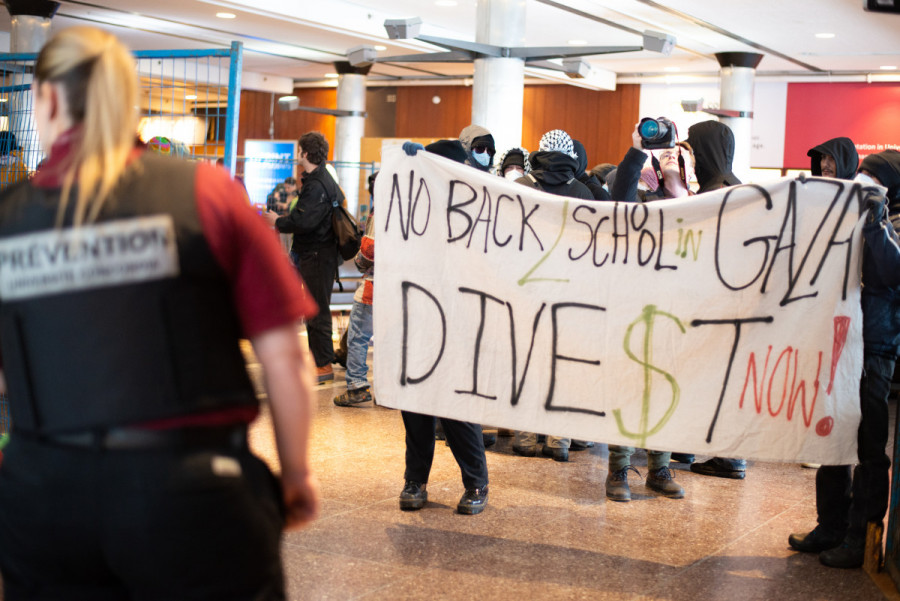
Student organizing in support of Palestine later saw a resurgence with the encampments on McGill University's campus—organized in collaboration with students from Concordia and other universities—which lasted from April to July 2024.
Harper noted that even organizers from the 2024 Gaza Solidarity Encampment on Columbia University's campus (which inspired the encampments at McGill) were amazed by how long the encampments lasted at McGill.
Students at Concordia and across Montreal also went on strike in solidarity with Palestine in November 2024 and October 2025.
Smith pointed to the significance of striking around an international issue, as opposed to previous strikes surrounding tuition and austerity.
The historic 2012 Quebec student strikes against tuition hikes saw over 250,000 students from across the province go on strike for nearly seven months.
“On a personal level, I was deeply inspired that students were willing to put their bodies on the line to stand up for an accessible education, not just for themselves, but for future generations of students,” Gould said.
He recounted a protest by a geography student against a meet-and-greet with then-president Alan Shepard. The student successfully shut down the event by repeatedly chanting “What do you do when your education is under attack? Stand up, fight back!”
“[The student was] saying that university protocols cannot just go on as normal in the midst of this,” Gould explained.
Gould also pointed to the importance of faculty supporting student activism.
“Students are really visionary in terms of figuring out what needs to be done and recognizing the things that we need to respond to,” he said. “Faculty’s role can be to amplify student voices.”
The 2012 strikes were not the first time that Concordia students organized against tuition increases. The CSU’s first documented campaign against tuition hikes occurred in 1987, and a three-day student strike also took place in 1999 amidst a broader campaign against neoliberalism and corporate advertising on campus.
A previous province-wide student strike occurred in 2005, and Smith notes that the CSU organized against international student tuition the same year. She mentioned that in one past CSU campaign, students protested by “submitting $1 cheques every single day to the Birks Student Service Centre” to protest potential tuition hikes.
Tens of thousands of students at Concordia and McGill also repeatedly went on strike against tuition hikes targeting anglophone universities in 2023 and 2024.
Smith also pointed to Concordians Against Tribunals (CATS), an initiative that began in response to the academic sanctions and potential expulsions faced by many students who participated in 2015 province-wide student strikes against austerity. She notes that CATS returned in 2024 following sanctions and bans from campus faced by many students who organized in solidarity with Palestine.
She also discussed the CSU’s organizing against sexual violence beginning in the late 2010s, which has pressured the university to take victim-centric approaches to combatting it.
The 2010s also saw Concordia students organize around fossil fuel divestment and climate justice, and activists eventually successfully pressured the university to divest.
Harper emphasized the importance of students being aware of Concordia’s complicity in global atrocities.
“I think they really need to be aware of how complicit Concordia is, not just in Palestine, but in atrocities around the world," Harper said. "Because their push for technological development means that people in underprivileged countries like Congo and Sudan and Palestine must suffer.”
Smith called for students to get involved in activism and organizing.
“The worst thing that you can do right now is to give in to apathy,” she said. “We have to be working together. We have to be standing up, because if we don’t present some sort of resistance, it’s only going to get worse.”
This article originally appeared in Volume 47, Issue 5, published November 10, 2026.