Federal government falls short on youth demands for good green jobs
The campaign, which demanded an annual investment of $1 billion, received $40 million in federal funding for a pilot program
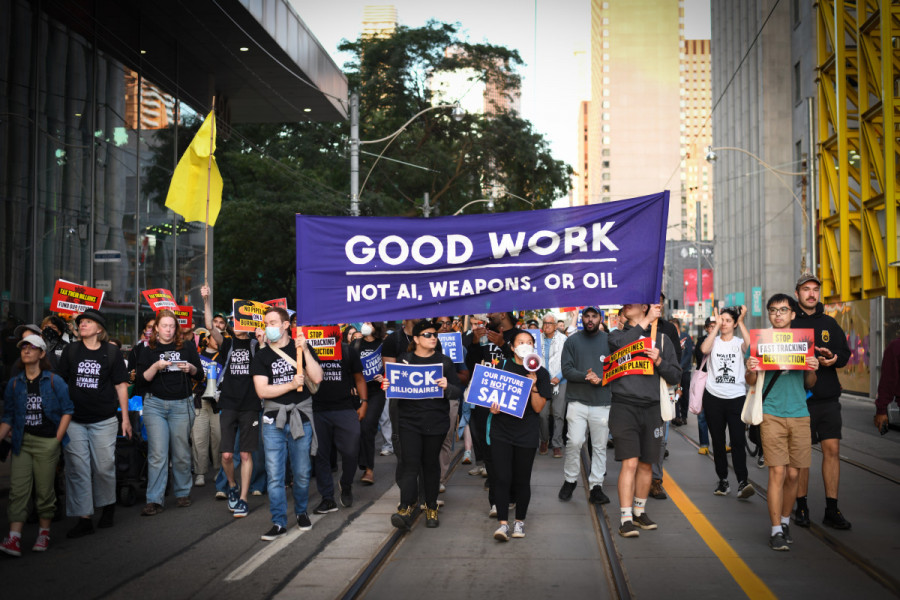
The Government of Canada's anticipated rollout of the Youth Climate Corps (YCC) pilot falls short of the ambitious demands required to tackle the climate and unemployment crises, advocates say.
The YCC is a national advocacy and mobilization campaign demanding that the federal government invest $1 billion annually to create 20,000 two-year, living-wage job training and placement opportunities for youth aged 35 and under to tackle the climate crisis.
The campaign, launched by the Climate Emergency Unit in 2023 and now housed under the Small Change Fund, envisions three job domains aligned with local climate priorities and solutions: building infrastructure to reduce emissions, strengthening climate resilience and providing emergency response support following extreme weather events.
Through these streams, the campaign aims to build the labour capacity needed to meet Canada’s climate targets, while giving young people in-class and hands-on learning opportunities, as well as a certification to pursue climate-related careers.
In November 2025, the federal budget committed $40 million over two years, starting in 2026-27, to create a YCC pilot, which is far short of the ambitious goal proposed by its campaign.
Bushra Asghar, the campaign’s executive director, recently learned that Employment and Social Development Canada plans to roll out a wage subsidy program in which employers would be required to cover 25 per cent of the salary and receive up to $12,000 in funding.
She said rolling out a similar model to the Canada Summer Jobs program does not meet the widespread mobilization required to tackle the climate and youth unemployment crises.
“We are deeply concerned that the federal government's Youth Climate Corps pilot has been scaled down to the point of irrelevance," Asghar said. "As it stands, it will not meaningfully challenge skyrocketing youth unemployment or advance climate action."
She criticized the pilot’s proposed parameters, which would pay youth a minimum wage instead of a living wage, compress the training from two years to four months, exclude non-citizens and cap the age limit at 30 and under.
The YCC campaign is inspired by the New Deal era, when millions of jobs were created to rebuild the economy after the Great Depression in the United States.
The Civilian Conservation Corps was part of this large-scale effort, which employed 3 million young men to build America’s national park system and restore lands and forests.
“It’s this idea that in moments of extreme turmoil, if you invest money into young people, they can build the things that we need, like public interest projects for public good,” Asghar explained.
While the federal government and approximately 650 municipalities have declared a climate emergency, she said the actions should reflect a similar sense of urgency, including by “spending what it takes to deal with it.”
“If you call this an emergency, how are you going to act in that manner? Are you moving at the speed and scale that is required?” Asghar asked.
Asghar said the program is an opportunity to address both the climate emergency and the unemployment crisis. According to Statistics Canada, the unemployment rate for youth aged 15 to 24 years old is 12.9 per cent, higher than the pre-pandemic average of 10.8 per cent from 2017 to 2019.
“We are deeply concerned that the federal government’s Youth Climate Corps pilot has been scaled down to the point of irrelevance. As it stands, it will not meaningfully challenge skyrocketing youth unemployment or advance climate action.” — Bushra Asghar, YCC executive director
As youth are pushed to join the military and artificial intelligence (AI) risks eliminating jobs, Asghar said there is no economic recovery plan for young people being left behind.
The World Economic Forum, for instance, found that entry-level jobs in the United States have fallen by 35 per cent in the last 18 months, largely because of the rise of AI.
The support for the YCC is widespread among young people. A 2023 poll showed that 65 per cent of people aged 18 to 35 would consider enrolling in the program.
Luisa Ndiaye, a human environment student at Concordia University, said the program puts young people in a position to actively build the nation amidst the climate crisis.
Ndiaye says that the initiative would give youth optimism.
“We can actually take our own destiny into our hands and build towards the future that we want to live in,” said Ndiaye.
Similarly, Mika Sauvageau, a law student at the Université de Montréal, said the program embodies a long-term vision.
She said that while many young people are reluctant to have children due to the climate crisis and anxiety about the future, the YCC invests in future generations.
“That’s what we are trying to do with this program: look to the future, to our children, and to our grandchildren,” Sauvageau emphasized.
Shathvahi Ramesh made a day trip from Scarborough, Ontario, to Montreal to attend a YCC workshop on organizing for climate justice in August.
Ramesh said she was eager about the program's prospects because it would allow youth to pursue more meaningful opportunities.
Ramesh highlighted that many young people, especially from immigrant backgrounds, are forced to take on more “stable” careers to support themselves and their families amid the cost-of-living crisis.
“It’s kind of discouraging if I have to sit in front of a computer for eight hours a day and just make a billionaire even more money,” Ramesh said.
Asghar said that while the pilot program is designed to fail, the campaign will continue to demand that the government expand the scope, ambition and accessibility of the YCC.
“Young people deserve real pathways into climate careers and genuine belonging, not bureaucratic shortcuts,” said Asghar.
There is no clear timeline yet for the implementation of the YCC pilot.
This article originally appeared in Volume 47, Issue 2, published September 22, 2026.