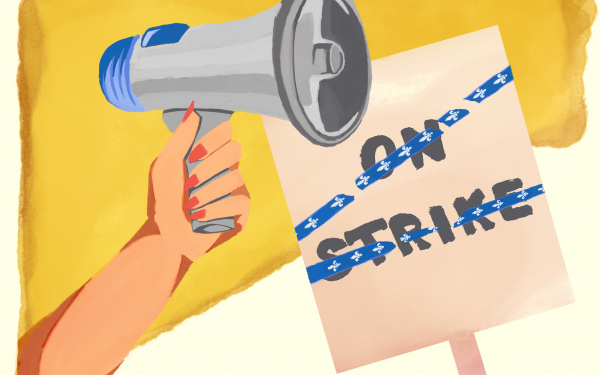
Editorial: Protect your right to strike

If you paid attention to the Société de transport de Montréal (STM) strike in late 2025, you likely saw how quickly public discussion turned on transit workers. Online threads filled with accusations of workers holding the population “hostage,” coupled with demands that the government intervene and claims that unions were harming people’s lives.
That response didn’t only come from political elites or corporate executives. It came largely from workers themselves—people who rely on public transit, who work fixed shifts, who balance jobs, family obligations and rising costs.
It is in this climate that Quebec’s Law 14, formerly Bill 89, now operates.
The law presents itself with reassuring language. It promises to “give greater consideration to the needs of the population” during strikes and lockouts. To the aforementioned frustrated folk, this might sound like a quick fix.
But herein lies the problem: the “population” this law claims to protect is overwhelmingly composed of workers. And when workers are led to believe that other workers stand in the way of their well-being, something has gone wrong.
During the STM strike, the focus shifted away from why negotiations stalled for so long and instead toward how fast the strike could be shut down.
Law 14 formalizes that shift. It gives the labour minister the authority to intervene in strikes and lockouts deemed to cause serious or irreparable harm to the population’s social, economic or environmental well-being. This criteria so broad that almost any large-scale labour action could qualify.
What was once political pressure is now legal power.
Strikes are not spontaneous acts of disruption. They are the outcome of unsuccessful negotiations, democratically voted on by workers who understand the risks involved.
The right to strike exists because inconvenience is often the only leverage workers have when employers refuse to bargain.
By lowering the threshold for government intervention, Law 14 changes the balance at the bargaining table. Employers now have a reason to wait. Why compromise if the state can just step in once pressure builds?
François Legault’s CAQ government didn’t just wake up one day and start worrying about your commute.
In practice, unions argue this turns a core bargaining tool into a switch the government can flip off once the pressure starts working. That’s why major federations like the Confédération des syndicats nationaux went to court almost immediately after the law came into force.
Even Québec solidaire’s Alexandre Leduc raised that concern during the STM strike, arguing the dynamic was already shifting before the law had even officially taken effect.
So yes, the public suffers during strikes; that is the leverage. That is what forces powerful institutions to treat workers like human beings instead of line items.
What’s changed lately is how quickly the suffering gets redirected, not toward governments that underfund services or employers who stonewall, but toward the workers who keep those services alive.
We’ve watched the same reflex beyond Quebec. In federally regulated sectors, Ottawa has increasingly leaned on Section 107 of the Canada Labour Code. It’s a mechanism unions and critics say has been used to shut down strikes and lockouts by forcing disputes into binding arbitration.
And let’s not pretend this is brand new. When Canada Post workers struck in 2018, Justin Trudeau’s Liberal government passed Bill C-89 to legislate them back to work.
Every time a government normalizes strikebreaking, whether through a vote in Parliament or a quiet referral mechanism, it lowers the political cost of doing it again.
This isn’t just a Quebec story, or even a Canada story. In France, unions have repeatedly turned to mass strike days in response to budget cuts and austerity, and the public reaction there is often just as furious.
The difference is that France has a stronger cultural muscle memory of collective disruption: the idea that sometimes nothing moves because the people who make everything move are demanding to survive.
We need that memory here because the backlash has begun to do the government’s work for it.
When workers turn on workers, power wins twice: it gets to keep wages down and keeps us blaming each other for the mess.
Let’s be clear about what’s at stake: strikes are not meant to be comfortable. They exist because, without disruption, those in power have no reason to move. Hostility toward labour action doesn’t just hurt unionized workers; it erodes the only leverage most people will ever have against employers or governments that benefit from exhaustion and delay.
Our power as workers exists only so long as we act together. When the right to strike is treated as a nuisance rather than a democratic tool, that collective power is deliberately weakened in the name of the status quo.
But workers are not acting against “the public.” Workers are the public. And when we accept laws that hollow out the right to strike because the disruption is inconvenient, we aren’t protecting ourselves. We’re making it easier to be ignored.
This article originally appeared in Volume 46, Issue 8, published January 27, 2026.