Have Quebec workers lost their right to strike?
Quebec’s Law 14 draws criticism from unions, who say workers have lost a crucial bargaining tool
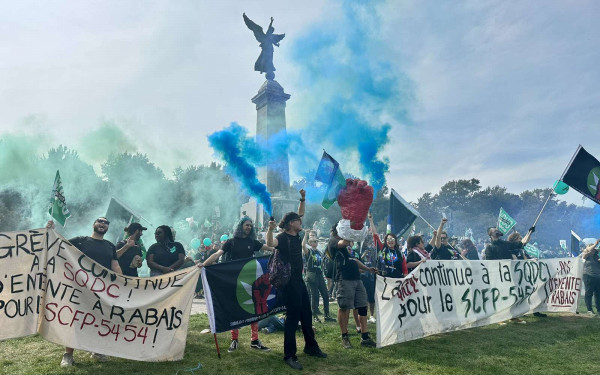
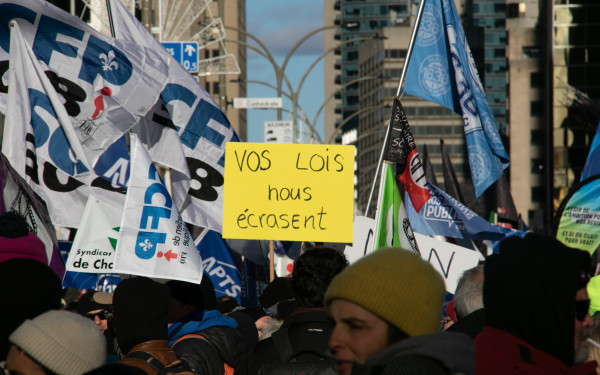
Recent legislation by the Coalition Avenir Québec (CAQ) government has drawn criticism and large demonstrations from both workers and unions across the province who see Law 14 as an attack on the entire labour movement.
Quebec’s Law 14, formally known as Bill 89, was assented to on Nov. 30, 2025, as an act “to give greater consideration to the needs of the population in the event of a strike or a lock-out.”
“It doesn't respect the jurisprudence of the Supreme Court of Canada,” said Québec solidaire MNA Alexandre Leduc. “[The principles] in the law are way too vague, way too vast.”
Law 14 allows the labour minister to intervene to stop a strike or a lockout to maintain “services ensuring the well-being of the population.” It aims to prevent disproportionate impacts on the social, economic or environmental security of vulnerable groups, as written in the bill.
“[Negotiation outcomes] might become political decisions instead of working relations decisions,” said Caroline Senneville, president of the Confédération des syndicats nationaux (CSN), the second largest trade union federation in Quebec.
“Health and security are already secured by [these] essential services," Senneville added. "That's why we strike. [...] It's an economic inconvenience for the employers.”
Senneville said she believes the law will infringe on workers' rights across the province, depriving unions of the right to strike, a crucial negotiating tool.
“The first change will be that employers won’t negotiate. I think it’s an incentive to employers not to bargain fairly. That will be the main impact.” — Caroline Senneville, Confédération des syndicats nationaux system
“[If] any government can end a strike that has been democratically voted on, do I really have the right to strike?” she said.
Leduc said the law gives too much power to Jean Boulet, Quebec’s labour minister.
“Almost everything can fall under this criterion, so we had a hard time defining or restraining this criterion. It's an all-included buffet at this point,” he said. “I think that's what [Boulet] wanted, to have the power to unilaterally cancel any strike anywhere in Quebec.”
Boulet attempted to implement Bill 89 earlier in November 2025 to stop the strike of maintenance workers and bus drivers of the Société de transport de Montréal (STM).
However, the attempt failed because workers suspended the strike, following a last-minute deal between the transportation workers' unions and the STM.
Leduc claimed he warned Boulet that Law 14 could undermine unions’ bargaining power by providing employers a reason to wait for ministry intervention. Leduc said this shift in structural dynamics had already started during the STM strike in 2025, even though the law had not yet been enacted.
“Some people at the bus service and the union [said,] ‘Why should the [STM] negotiate and try to find some compromise?” Leduc said. “'The issue is going to be solved by the government in a few weeks by using this law.'”
Senneville said she had the same concern.
“The first change will be that employers won't negotiate,” Senneville said. “I think it's an incentive to employers not to bargain fairly. That will be the main impact.”
Senneville said that if workers bargain through collective action, Quebec employers could call on the government to appoint an arbitrator, insisting that the strike has caused economic damage, which, under Law 14, would allow the government to suspend their right to strike.
Law 14 grants the labour minister the authority to direct the dispute to an arbitrator if he considers that a strike or lockout “causes or threatens to cause serious or irreparable injury to the population.”
This clause gives the Tribunal Administrative du Travail the right to determine whether stalled services must be maintained during a strike or a lockout, effectively suspending unions’ striking power.
Five labour unions filed a legal dispute against Law 14 with the Quebec Superior Court in December 2025.
These included the CSN, the Fédération des travailleurs et travailleuses du Québec, the Centrale des syndicats du Québec, the Centrale des syndicats démocratiques, and the Alliance du personnel professionnel et technique de la santé et des services sociaux.
The Supreme Court of Canada ruled that a strike is a constitutional component of the freedom of association under Section 2(d) of the Canadian Charter, explained Mathilde Baril-Jannard, former CSN lawyer and labour law course lecturer at McGill University.
“If the minister interrupts that [labour law process] and forces the arbitration mechanisms—of course, a third party can help, but this third-party arbitrator will impose a solution that the parties didn't negotiate—I'm not sure that the conflicts between the parties will be resolved,” Baril-Jannard said.
She said that the International Labour Organization has consistently defined an “essential service" as a service whose interruption would endanger the life, personal safety or health of the whole or part of the population.
“The Canadian law should follow the international law regarding essential services,” Baril-Jannard said.
She drew attention to the Supreme Court’s 2015 ruling in the Saskatchewan Federation of Labour case, which ruled that the right to strike is constitutionally protected under and essential to meaningful collective bargaining, in alignment with international law.
“We should always understand labour law as a dialogical process between an employer and a union,” Baril-Jannard said. “To maintain this [process] is essential to resolve conflicts.”
This article originally appeared in Volume 46, Issue 8, published January 27, 2026.