
Concordia bars student union staff member from campus
The ban follows Julianna Smith’s work during the Oct. 6 student strike for Palestine
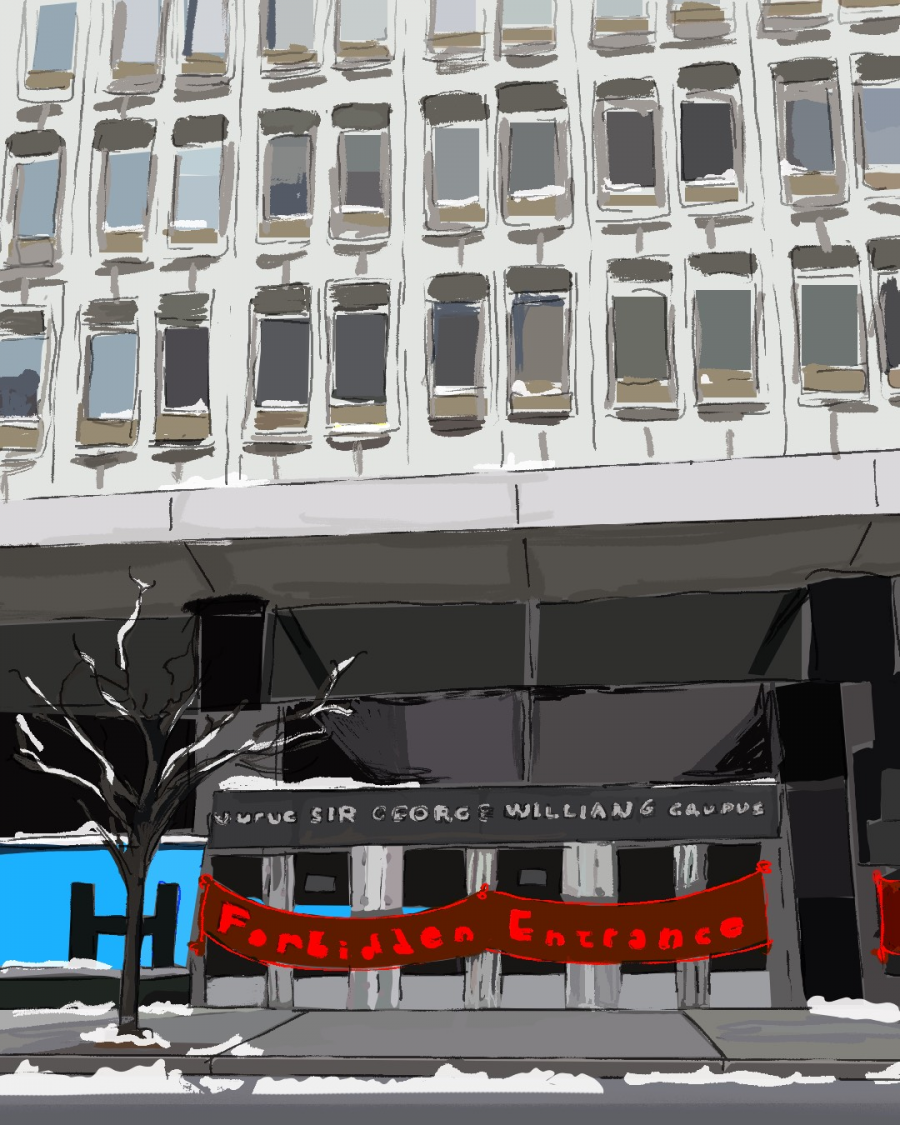
Julianna Smith, a Concordia Student Union (CSU) full-time staff member, was working from her office when she received an email from Concordia University’s director of Campus Safety and Prevention Services (CSPS), informing her that she had been barred from campus indefinitely.
The email, sent on Oct. 29, accused the CSU campaigns coordinator of helping student protesters in the Oct. 6 pro-Palestine strikes by allegedly “participat[ing] in preparing and equipping persons who then engaged in aggressive harassment of students and others and caused many class disruptions.”
The email further claimed Smith “assisted others in gathering and wearing disguises and masks, all so that the individuals could not be identified or face consequences for their behaviour."
Context matters
As the campaigns coordinator at the CSU, Smith’s role is to mobilize students and assist in the coordination of mobilization efforts on campus. She said it is her responsibility to work with students on campaigns aligning with political positions held by the CSU that undergraduate students have collectively voted on.
“Undergraduate students have all had the opportunity to voice their opinion on the different political positions that the student union takes,” Smith said. “As a staff member, I don't have a say in what these political positions are.”
On Oct. 6 and 7, ten Concordia student associations went on strike, demanding that Concordia divest from companies complicit in Israel’s genocide in Gaza.
Alongside Concordia, student associations from McGill University, Université de Montréal, Université du Québec à Montréal, CEGEP Saint Laurent, Maisonneuve College and CEGEP Marie Victorin were also on strike. This totalled over 80,000 students officially on strike, according to Students for Palestine’s Honour and Resistance Concordia.
On the morning of Oct. 6, Smith said she was present at Le Frigo Vert as part of her CSU responsibilities, which included listening to student concerns, documenting testimonies after altercations between students and CSPS, and ensuring safe and successful mobilization.
Le Frigo Vert was the students’ home base for strike action and is a self-described anti-capitalist, anti-colonial and anti-oppression food collective.
According to CSU external affairs and mobilization coordinator Danna Ballantyne, although the CSU was not officially part of the strike, the union still has responsibility towards students.
“The CSU had no part whatsoever in picketing or blocking of classes. We did have a role to play in educating students on what purposes strikes can serve in an academic context,” Ballantyne said. “When it came to the strikes, there was a lot of work done to educate students on their rights as students and to protect themselves from repression on campus.”
As part of her CSU responsibilities, Smith is expected to be present during any student mobilization events.
“Anytime there's a strike, I'm working 14-hour days to make sure that there's someone there to help support students and be on the ground making sure that things get done,” Smith said. “There's a lot of logistical work that happens when there's a big event.”
Smith also clarified that, because strike action had become a common occurrence at Concordia in recent years, her help was not as necessary.
“The students already have the institutional knowledge within their communities,” Smith said. “They don't need me, and so I'm not going to hold their hands when they don't need that.”
The Oct. 6 strike ended in two arrests and a case of CSPS officers kneeling on one protester’s back. The university at the time also accused protesters of being violent towards other students and CSPS officers.
Accusations of repression of pro-Palestine voices on campus
After receiving the letter barring her from her workspace, Smith spoke to her lawyer and decided to fight the ban.
Smith’s lawyers sent a cease and desist letter to CSPS director Darren Dumoulin. Communication regarding the ban is continuing only through the lawyers of each respective party.
Smith claims that she was not given any prior warning for her ban, nor was the CSU as her employer. She said she was not given any resources to contest the claim, nor provided with any evidence supporting the university’s claims. The claims that led to her ban include Smith assisting in the preparation and equipping of protesters who then engaged in aggressive harassment of students.
Despite being in what she calls “solution mode,” as time passed, Smith became increasingly frustrated by what she sees as the university repressing her.
“They were weaponizing a policy that is meant to keep dangerous people off of campus, and they were using it to target me,” she said. “Just the accusation that I could ever be dangerous or a threat to a student, [...] it really hurts me.”
Ballantyne says the university’s reaction is part of what she calls an ongoing suppression of pro-Palestine voices on campus.
“The university is bypassing good faith conversations with student leaders, student activists and organizers,” Ballantyne said. “It really does just come down to the fact that the administration is making these choices and removing people from campus based purely on unfounded or unproven allegations relating to their political activism on campus.”
Ballantyne explained that the university’s decision to ban a CSU full-time staff member is an escalation.
“[The ban] is a step further than they had gone in the previous years,” Ballantyne said. “The targeting of a CSU staff member, a full-time employee of the student union, is one step further than [sending] students to the Office of Rights and Responsibilities (ORR).”
Brittany Allison, the CSU Student Advocacy Centre’s interim manager, says the centre has seen a large increase in ORR complaints in the past three years.
In the 2022-23 academic year, the centre saw an average of 15 ORR complaints. The following academic year, 2023-24, they saw approximately 50 cases. The 2024-25 academic year has seen a similar number of cases to the year prior: since the start of this academic year, the centre has already seen close to 15 cases.
Ballantyne stressed that the CSU is taking the university’s ban very seriously, as she believes it might set a “dangerous and harmful” precedent for future student organizations.
Concordia spokesperson Julie Fortier denied that the university is suppressing speech or action on campus, “unless it turns violent.”
Fortier also outlined the Code of Rights and Responsibilities, which states that obstruction or disruption of university activities, unauthorized entry into any university property, concealing one’s identity, and encouraging community members to engage in such disallowed activities are prohibited.
“Individuals external to the university, including CSU employees, are expected to conduct themselves in line with our Code and policies,” Fortier said in an email to The Link. “Both the Code and the Policy on Campus Public Safety and Security outline that external individuals who do not respect this can be banned from university premises.”
Activists have widely criticized Concordia’s policy prohibiting the wearing of masks or face coverings on campus, due to their importance in protecting against doxxing and academic repercussions for activists, as well as infectious diseases more generally.
Where do we go from here?
As Smith is barred from Concordia’s campus, she is working from home or from Le Frigo Vert.
Despite being able to work remotely, Smith said she still feels affected by the ban.
“I have a team of people that I work with. Now, I can't be in the office with them and work together,” she said. “We work extremely collaboratively together. The thing that's been impacted is the richness of that collaborative nature, which I think really is a shame.”
Smith’s department at the CSU has released an open letter for students to sign in her support.
The letter demands that the university take immediate action to reverse the indefinite ban from campus; issue a formal apology; restore the suspended students' full rights and access to campus; and mitigate further instances of security and police violence against students and community members on campus, by emphasizing de-escalation as the primary mode of response and limiting police presence.
According to Ballantyne, since the news of the ban has spread among the community, Smith has received an enormous outpouring of support.
“With that came a lot of confidence that we are doing the right thing. That we are supported not only by our community within Concordia but by many communities on the outside,” Ballantyne said. “Any attempt by the university to repress that kind of mobilizing is not only clear repression and clear interference in student politics, but it's also an affirmation and a testament to the effectiveness of those kinds of strategies.”
This article originally appeared in Volume 46, Issue 6, published November 18, 2025.





_(1)_600_375_s_c1.png)
