
The rebirth of a league
After 41 years, Division 1 men’s university hockey will return to Quebec
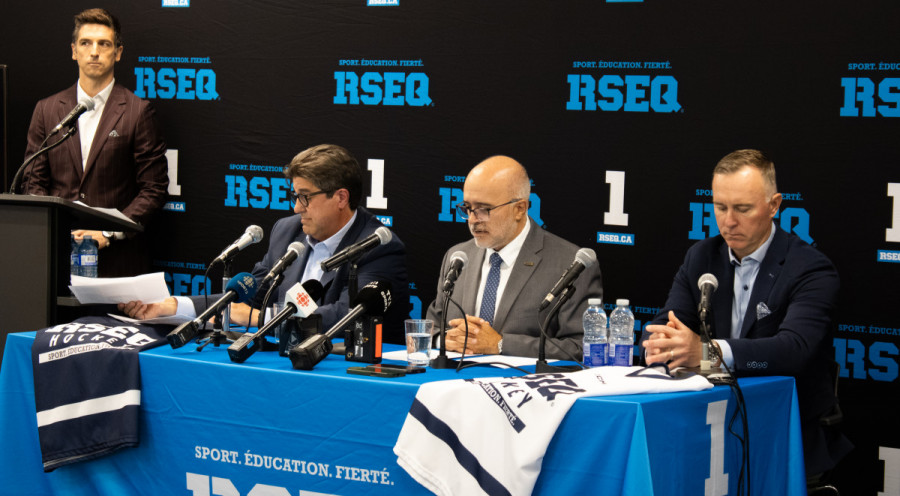
Forty-one years after men’s Division 1 university hockey left Quebec, a new league will rise in its place. The Réseau du sport étudiant du Québec (RSEQ) has announced the return of the Division 1 men’s hockey league, aiming to create an upward pathway for Quebec players through high school, CEGEP and university.
“It's a really good day in Quebec, and it's a really good day for U SPORTS Hockey across the country,” said Pierre Arsenault, chief executive officer at U SPORTS. “When you look at one of our core sports in men's hockey, this is the most significant growth story that we've had in a long time.”
Six teams: Concordia University, McGill University, l’Université du Québec à Trois-Rivières (UQTR), l’Université du Québec à Chicoutimi (UQAC), École de technologie supérieure (ÉTS) and l’Université de Sherbrooke will join the conference for its 2027-2028 inaugural season. The league will be the newest instance of a Quebec men’s university hockey first division since the Quebec Universities Athletic Association (QUAA) dissolved in 1987.
Concordia, McGill and UQTR will play their final season in the Ontario University Athletics (OUA) conference this season before heading to the RSEQ. UQTR, the defending league champions, has won four of the past five OUA titles, with Concordia taking home the Queen’s Cup in 2025.
Concordia Stingers men’s hockey head coach Marc-André Élément, who served on a decision-making committee with other coaches, praised the opportunity for Quebec student-athletes to choose their opportunities on the ice and in the classroom.
“It's going to be great for hockey in general and for all the kids to have the chance to choose which institution fits best for their profile,” Élément said.
The three non-OUA schools—ÉTS, UQAC and Sherbrooke—will make the move up from Division 2 to join the new RSEQ. According to Gustave Roel, the RSEQ’s chief executive officer, each team involved voluntarily joined the expansion talks while leaving room for future additions.
Despite the disparity in program strength, Élément praised the new teams for their development, adding that it created pressure on the top schools to perform.
“The teams are recruiting well, so I'm not worried about the calibre at all of this league,” Élément said. “It's just going to force everybody to get better. You've got to find ways to recruit better, get better and all.”
Roel mentioned that around 13,000 student-athletes compete in hockey across all the RSEQ’s levels. The conference’s goal is for Quebec university hockey to represent a leading option in the careers of provincial players who hope to play at higher levels.
“Our ambition was clear: to allow these young people to continue developing on the ice while, of course, building a future through a quality university education,” said Roel at the league’s press conference on Sept. 15.
Stingers mentor coach Jim Corsi pointed out that many Quebec players compete against each other in junior hockey, but end up going out of province to continue their hockey careers. He said the new league would allow them to stay close to home while competing at a high level.
“Many of the junior kids are going to be going to these universities today as opposed to trying to find a spot in the rest of Canada or even in the NCAA [National Collegiate Athletic Association] and continue to express their hockey abilities,” Corsi said. “So now the competition is even tighter. It's going to mean a lot more.”
Roel also emphasized the strengths of Quebec’s education system and the benefits of continuing one’s education into university at an RSEQ school.
“Student-athletes will be able to continue their development in a Quebec-based Division 1 circuit, proudly represent their universities and advance through an academic pathway,” Roel said. “In summary: study here, play here, develop here and graduate here.”
The return to Quebec marks a new chapter for Concordia, which has established itself as a national powerhouse throughout the past several seasons. The Stingers won the aforementioned 2025 Queen’s Cup and looked set to challenge for another conference title in 2026, before a stunning 2-0 series defeat against Queen’s University knocked them out of contention.
Concordia Stingers captain Alexandre Nadeau acknowledged the importance of a Quebec university league as it strengthens provincial teams and promotes the continuation of players’ careers.
“We were playing in Ontario, but it's different there,” Nadeau said. “We're happy to have a league here and have an opportunity for the guys playing LHJMQ [Ligue de hockey junior majeur du Québec] and all the colleges.”
As the new league prepares for competition, both the RSEQ and U SPORTS will keep an eye out for signs of success. Benoit Doloreux, the RSEQ’s university division director, praised the league’s potential for a quick return to excellence across the board.
“We're going to get to a point that the level between the first team and the last team is just the closest possible to have exciting games and an exciting league,” Doloreux said. “That's essentially the goal, to provide a great experience for student-athletes and fans and the university community as a whole.”
While Nadeau expresses his excitement for the challenge, he’s not overlooking the year ahead, where he hopes to lead the Stingers to further success.
“We're pretty happy to have it, but we have a season to do, and we want to win this year,” Nadeau said. “I think we have a pretty good team, so that's the first thing we want to focus on.”
As some of the nation’s top teams prepare to unite under the same umbrella, Arsenault sees the potential for exponential growth within the province.
“To see the reaction in these new communities, to see the reaction of the pride of Quebec having their own league again, that will be a really big driver of success,” Arsenault said.



_600_375_90_s_c1.jpg)