Building rockets in between classes
Space Concordia Solid Rocketry members spend 40 hours a week on their rocketry projects
Space Concordia Solid Rocketry launched its newest creation at the Launch Canada competition last month on Aug. 18. CR26, also known as Icarus-Daedalus, reached 47,975 ft. in the air, an absolute feat of achievement for the team.
Solid Rocketry is the newest division of Space Concordia. Helia Borran, project manager of Solid Rocketry, believes this year’s launch was especially challenging.
“This was the first two-stage rocket in the history of Concordia,” Borran said. “No one has ever made a two-stage rocket.”
The launch also became the division’s highest-reaching rocket, breaking not one but two Concordia University rocketry records simultaneously.
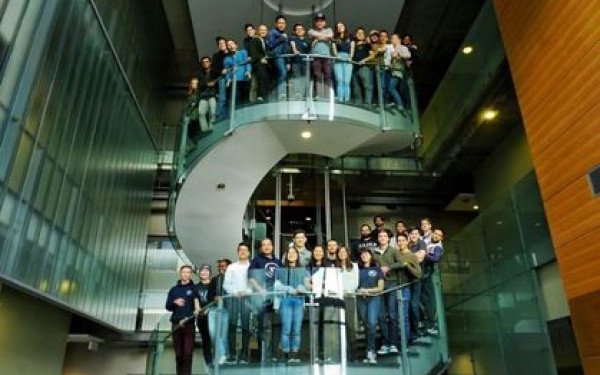
The club recruited members through a thorough interview process and introductory task. Although it’s not simply a sign-your-name-on-a-welcome-sheet kind of gig, it isn’t inaccessible.
“They explain to us: over here it’s okay to be a beginner; the only thing you need to bring is your desire to learn and be curious,” Solid Rocketry member Fiza Khan said.
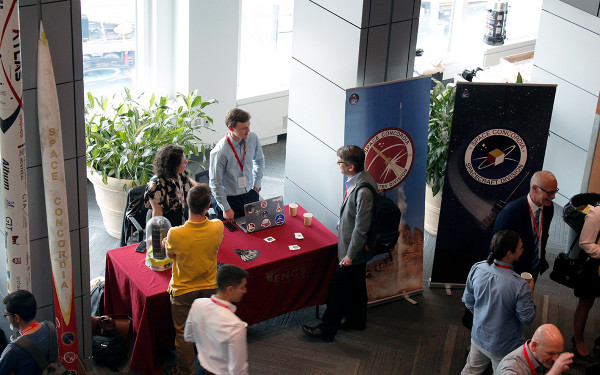
Space Concordia is one big umbrella club; the separate divisions work essentially as standalones under a unified body. Once a student chooses to join, they can pick from five divisions: robotics, liquid rocketry, solid rocketry, spacecraft and space health, with other sub-sections under each.
“We have a strong Space Concordia team around us, working side by side in the lab even though for the most part our projects remained separate,” Habakkuk Stephen said, a former member of the space health division.
“They explain to us: over here it’s okay to be a beginner; the only thing you need to bring is your desire to learn and be curious.” — Fiza Khan, Solid Rocketry member
The team is an essential part of this project and is entirely volunteer-based, with no academic or monetary compensation.
Sponsors, the university, and the club fee levy cover the cost. Although none of the monetary cost comes out of the student members’ pockets, they pay a hefty price for their passions.
Their workload often comes to 40 hours a week, equivalent to a full-time job on top of a full course load.
“There is a point where you have to establish a balance, and the balance established might not be the healthiest," said Khan.
Space Concordia devours time from these members, a student’s most prized commodity.
“It humbles you,” said Khan when talking about the workload.
In return, they get to see Icarus-Daedalus fly, their rocket named after the Greek myth of ambition and innovation. The students say it’s clear what they receive in return is unquantifiable.
“From my time at Space Concordia, fun was what I mostly got out of it. But when I got a job in my field thanks to my work in space health at Space Concordia, I realized how much more than that it gave me,” said Stephen.
The Solid Rocketry division is still in its early years; they have built a rocket every year since 2023, and a month ago, a year of passion and teamwork culminated in a record-breaking two-stage rocket they hoped might fly too close to the sun.
Now the team and the rocket have begun their uphill climb, as last year’s successes are now in their arsenal, and they’re ready to reinvent.
“We launch it, we do a post-mortem report, and we close it. We put it on the shelf, and the new one starts,” said Borran.
This article originally appeared in Volume 47, Issue 2, published September 22, 2026.