
Why student democracy doesn’t feel like democracy
Low turnout, insider rules, and closed circles make Concordia’s student democracy feel hollow
It’s campaign week at Concordia University.
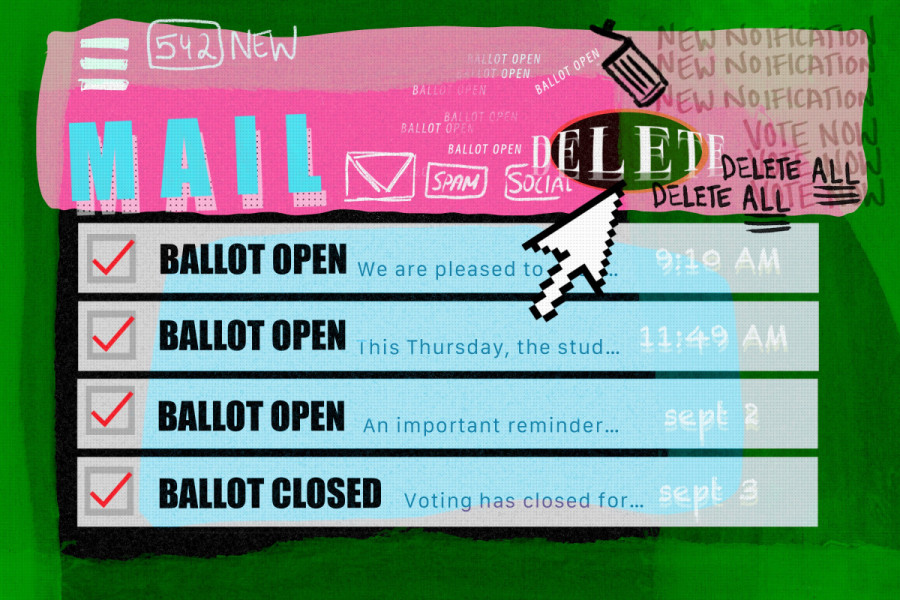
Bright posters plaster the Hall Building stairwell walls, which most people pass by without turning their heads or even giving them a second glance. Online, Instagram feeds cycle through candidate reels—smiling headshots, pastel slogans, promises of “transparency” and “community.” For most students, it’s just another week of their winter semester. Ballots land in their inboxes and move to the trash without a thought.
When the turnout is released, Winter 2025’s general election records a 14.7 per cent turnout from more than 30,000 undergrads. That’s a slight improvement over 11.2 per cent in Fall 2024 and 12.4 per cent in Winter 2024. Still, over 85 per cent of students didn’t participate. Low numbers can often be read as apathy.
But what if they’re telling us that the system itself discourages engagement?
On paper, student associations appear democratic: constitutions, elected executives and governing councils. In practice, they centralize power in small groups and bury the rules in procedural language.
The Concordia Student Union (CSU) bylaws require students who want to run for executive or council positions to gather physical signatures during a narrow, often poorly advertised window—sometimes right in the middle of midterm season. Miss it, and you’re out for the year.
To bring a motion forward—whether to a regular or special council meeting—you must submit it in writing, with supporting signatures, before a hard deadline that’s tucked away in PDFs. For those already involved, these hurdles are known. For everyone else, they’re invisible.
Leadership pipelines often run through the same social circles, making elections less about winning over the student body and more about mobilizing networks. This continuity keeps the machine running but narrows the range of voices in decision-making.
The contrast becomes obvious when the stakes feel real.
In January 2025, nearly 1,000 students packed a special general meeting to debate Concordia’s relationship with Israel. After hours of discussion, voters cast over 800 ballots in support of two Boycott, Divestment, and Sanctions (BDS) motions. Students will show up when they believe their participation can directly change the university’s direction.
So why can’t regular elections do the same?
If student democracy and its impact want to evolve beyond a ballot once a year, Concordia needs more than symbolic fixes—it needs structural change.
While students can technically access meetings through Zoom, the system doesn’t make it easy to follow along. The minutes are supposed to be publicly available, but they haven’t been updated since 2024—leaving a backlog that makes it impossible for students to stay up to date. Recordings, minutes and agendas should be archived in a single searchable space, with plain-language summaries so students can quickly catch up and get involved before decisions are finalized.
Even though the CSU already sets aside money for student-led initiatives, most students never see where that money actually goes—the budget hasn’t been updated online in years. Giving students more power to pitch ideas and decide where the money flows would turn abstract “engagement” into something you can actually see and use.
Power also needs to become decentralized. Faculty associations, departmental groups and recognized collectives should have the right to bring motions directly to the CSU council without executive approval.
Universities are civic training grounds. The habits we form here—whether active engagement or quiet resignation—follow us long after graduation.
Low turnout isn’t proof that students don’t care; it’s proof that our system isn’t worth most students’ time. If we can’t get democracy right at Concordia, how can we expect to get it right anywhere else?
The next election is your chance to make that change happen. Show up. Speak up. Make it count.
This article originally appeared in Volume 46, Issue 1, published September 2, 2025.



_600_375_90_s_c1.jpg)