
Where is my tuition going?
A full breakdown of some of the fees behind your Concordia bill
Buried in every Concordia student’s tuition is a patchwork of compulsory fees and student-association levies, often cents per credit, that fund some of the most-used services on campus.
Buried in every Concordia student’s tuition is a patchwork of compulsory fees and student-association levies, often cents per credit, that fund some of the most-used services on campus.
All of the services are administered by the Concordia Student Union (CSU), but not all CSU fee levies are.
"The CSU manages the budgets of all the fee-levies," Adey Singer said, the CSU's finance coordinator. "Our budget is approved by the Council of Representatives every year, and can be found on our website."
The dozens of other fee-levy groups on campus, such as the Quebec Public Interest Research Group (QPIRG), the Concordia Greenhouse, Frigo Vert and the Centre for Gender Advocacy, are a separate story.
"The non-CSU fee levies manage their budgets independently, with no oversight from us," Singer said.
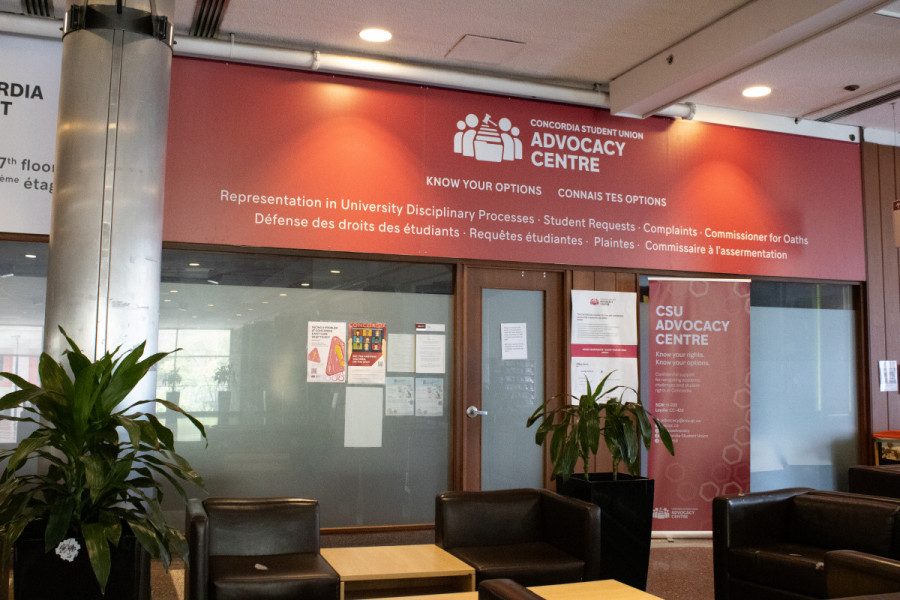
According to Singer, most of what the CSU collects goes toward administering the Health and Dental plan, services such as the Housing and Job Resource Centre (HOJO), the Advocacy Centre and the Legal Information Clinic, which help and inform students on social engagement initiatives, student jobs, bursaries and project funding.
Ates Balsoy, a HOJO assistant, says that funding, currently at $0.31 per credit, keeps a busy office running. Between drop-ins, online consultations and workshops, the HOJO logged roughly 1,300 appointments last year, averaging around five a day.
A lot of that traffic comes down to landlords testing what students know.
"Deposits in general are illegal in Quebec," Balsoy said. "But especially for international and out-of-province students, a lot of the landlords still ask for deposits: security deposits, key deposits, cleaning deposits.”
The HOJO's staff spend a good part of the year correcting that through one-on-one appointments and a rotating slate of workshops on tenant rights, employment rights and how to navigate Quebec's housing system.
For more serious disputes, they'll help students prepare for hearings at the Tribunal Administratif du Logement by building evidence folders to strengthen their case.
Balsoy was candid about how visible that funding chain is to the average student, noting that they're not financing it directly but rather through the CSU.
The CSU daycare and nursery runs on the same principle. It costs undergraduates $0.51 per credit.
"Depending on the semester, over half the daycare is for student families," Loyola coordinator Kinsey El Tanani said.
According to El Tanani, the levy isn't symbolic; it's what keeps the doors open.
"It's a not-for-profit centre, so the student levies make maintaining the service possible," El Tanani said. "This way we can pay our staff accordingly to offer a quality service."
Without that funding, El Tanani estimates that costs would roughly double, making it inaccessible to most student parents.
The CSU collects roughly $6.60 per credit across the Advocacy Centre, general operations,
clubs, the Legal Information Clinic, Diversity Services, mental health, Student Space Accessible Education and Legal Contingency (SSAELC), HOJO and daycare, plus $269.95 a year in flat fees (Legal Essentials, Health and Dental and Telemedicine), all before a single dollar of tuition is counted.
None of these fees are large on their own, and they add up to a kind of mutual insurance.
Students may think they'll never need a housing lawyer, a daycare spot or an academic advocate, but the money is there so that if one day they do, someone is already trained, funded and available.
The CSU's budget is voted on by student representatives and published. Concordia posts its own fee breakdown on the university's tuition and financial aid page.
A handful of these fees, including the Health & Dental Plan, Telemedicine and the Legal Essentials Service, can even be opted out of during set periods each term, for students who are already covered elsewhere or simply don't need them.
This article originally appeared in Volume 47, Issue 1, published September 8, 2026.




_600_375_90_s_c1.jpg)