
The politics of silence at Concordia University
Students are pushing discussions on Palestine amid faculty caution

Silence surrounds Palestine in Concordia University’s political science classrooms, even as students crave discussion.
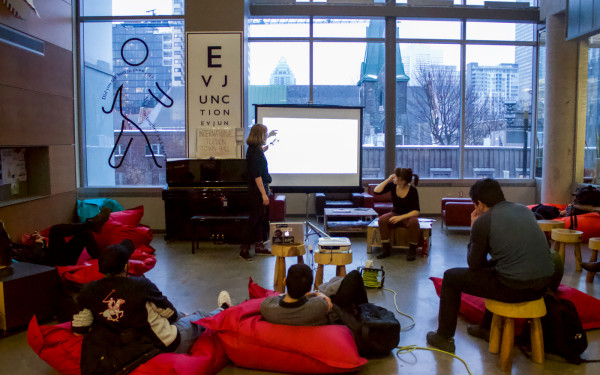
On Sept. 25, the Palestine Interdisciplinary Research Group held a “Teaching Palestine” workshop at Concordia, bringing together professors and graduate students to discuss incorporating Palestine into their classrooms and syllabi.
Presenters opened by reminding the room that universities deprive students of spaces to discuss Palestine, and that “once they realize your classroom is a safe space, you can see how thirsty they are to talk about it.”
As a political science graduate student, this resonated with me as I found silence or reluctance to discuss Palestine to be the norm in my classes.
Notably absent, however, were any political science faculty, either as attendees or as members of the Palestine research group. One would think that the discipline producing genocide scholars, diplomats and foreign policy analysts would stand up first to look for support in discussing Palestine.
The content of the workshop was certainly relevant—presenters suggested readings on settler-colonialism and academic freedom, and texts from the likes of Edward Said and Noura Erakat. A key takeaway was the need to de-exceptionalize Palestine and normalize discussions about it—something the political science department could stand to learn.
When I expressed my disappointment about the missing political science faculty attendance after the workshop, a professor from another department looked at me with pity and said, “Well, poli sci is generally compromised.”
In two separate conversations I had from the workshop, professors within political science alluded to fear of reprisals, with one noting the department’s generally risk-averse culture. The workshop did, however, acknowledge this fear and stressed that including Palestine in a syllabus has not led to dismissals in Canada.
So, can we truly justify this self-silencing?
Younger faculty in precarious positions may have legitimate concerns about subtle repercussions, but tenured professors don’t have that excuse.
Perhaps the structural design of Concordia’s political science program itself demands reconsideration.
The department encompasses the Political Science program, the Public Policy and Administration program and several institutes. One of those institutes is the Azrieli Institute of Israel Studies, which cannot be ignored when discussing censorship of Palestine within the department.
The Institute was founded in 2011 with a $5 million gift from billionaire David Azrieli, who at the time of his death was the 9th richest person in Canada. Azrieli was a proud Zionist who fought in the Haganah, a Zionist paramilitary force that was instrumental in the 1948 ethnic cleansing of Palestine. The Institute claims to be apolitical and only focused on the culture of Israel, but this superficial distinction erases the ongoing colonial project of Israel and helps launder the pariah state’s reputation through academia. Concordia’s acceptance of that funding entrenched Azrieli’s colonial legacy into the university itself.
Coupled with the Public Policy and Administration program, which places career-minded students into government internships, the departmental design cultivates an environment that rewards caution and discourages critical inquiry on sensitive topics like Palestine, lest they jeopardize a government position.
Yet academic freedom remains essential for democracy and advancing human knowledge, precisely because it creates space to challenge power and widen the spectrum of debate to a diversity of views.
Perhaps the Political Science department should consider splitting from the Azrieli Institute and Public Policy to encourage a culture of discussion rather than restraint. Most universities in Canada, including McGill, the University of Toronto and the University of British Columbia, all keep the programs separate.
Even so, self-censorship during a crisis is profoundly political and must be challenged.
Students, by contrast, stand unflinching in their bravery.
At the Concordia Student Union’s annual “Get Radical” political organizing course, they opened the seminar with a presentation on the securitization and surveillance of student activists on campus.
Organizers warned attendees: as a student activist, you will be surveilled—take these steps to navigate it and follow these instructions if you face discipline. They challenged the university administration’s false binary between two types of student protesters: the “good and respectable” kind that protests for topics such as climate inaction, and the “bad and deviant” kind, which stands in solidarity with Palestine.
As a final note, they shared resources like Concordians Against Tribunals (CATs), a 2015 student campaign opposing the university’s suspension of protesters, to prepare the new cohort of organizers for the struggles ahead.
Political science likes to see itself as a “scientific” discipline that exists beyond current affairs. Yet the refusal to discuss Palestine—the most significant geopolitical crisis in many students’ lifetimes—is an inherently political decision.
If the discipline claims to foster critical inquiry and train the next generation of political scholars, it cannot afford to stay silent. At the very least, tenured professors must use their secure position to open space for discussion and advocate for a different departmental design. Anything less abdicates the responsibilities of scholarship.



_600_375_90_s_c1.jpg)