The Concordia commuting experience
Montreal’s transit agencies and the Concordia administration are influencing Concordia student commutes
Concordia University welcomes tens of thousands of students every day, commuting from across Montreal and its off-island suburbs. Students can get to campus in many different ways, such as by metro, bus, walking, car or bike.
Connecting the suburbs
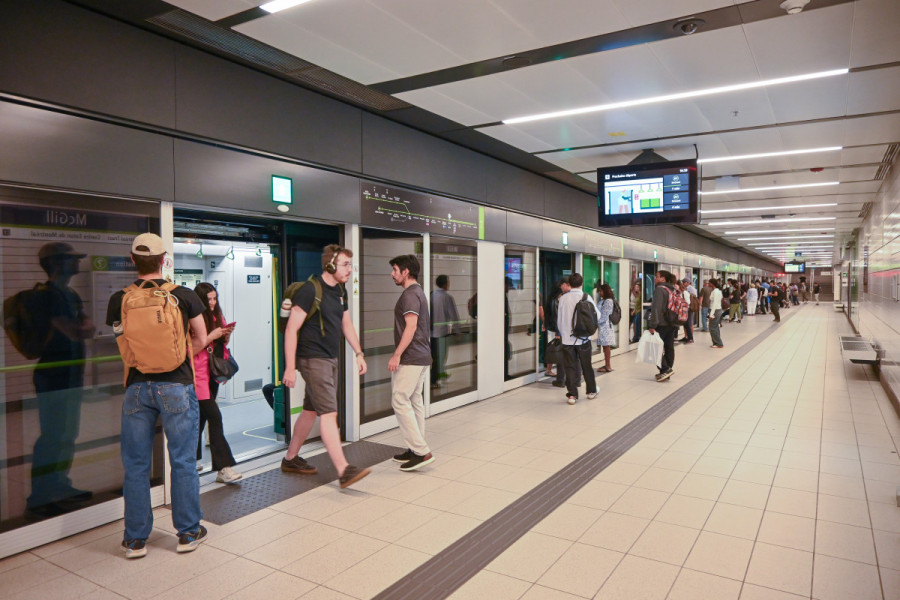
A recent addition to the commuting options available to Concordia students has been the Réseau Express Métropolitain (REM). It has made commuting to Sir George Williams campus easier for students living in the suburbs.
Concordia student Océanne Gravel is from Montreal’s South Shore and uses the REM network to commute to university. She says the REM is a reliable way for suburban students to get to their classes.
According to Gravel, however, when service interruptions do happen, there are limited alternatives available.
“On several occasions, people I know and I had to find alternative ways to get to school because of these interruptions, or completely miss class,” Gravel said.
She also believes that while the network offers temporary alternatives to interruptions such as buses, they cannot hold the same ridership capacity comfortably during rush hour.
Last year, a new REM branch opened in Montreal’s North Shore, and the West Island branch opened last spring. Université de Montréal urbanism professor Jean-Philippe Meloche thinks the newly opened REM lines will benefit students more than anyone else.
“We know students are major consumers of public transit,” Meloche said. “To have an upgrade of the public transit network for commuters who were already using it, such as those who were using the old bus network in the West Island and found it challenging to get downtown, [...] is a gain for commuters.”
Biking to campus
Biking is another method Concordia students use to commute to both campuses, especially outside of winter. The ever-expanding Bixi network has made biking in Montreal more convenient.
Bixi is now available in many municipalities across Greater Montreal, recently expanding to the West Island and North Shore this summer.
Concordia student Thomas Jallais is from Plateau Mont-Royal and commutes with Bixi bicycles on a regular basis. Jallais says the service is appealing to students who live in areas further away from metro stations.
“I use both Bixi and the metro to get to campus,” Jallais said. “Bixi [bicycles] are great when combined with public transit.”
In 2023, the Bixi service became available year-round, but winter service had yet to reach Loyola campus last winter.
A Bixi docking station at Concordia’s Sir George Williams campus. Photo Francis Turcotte
Loyola is left out
Unlike the Sir George William campus, which has improved accessibility with the REM, there have been no improvements to Loyola campus commutes. The university scaled back its free shuttle bus service in 2024 due to budget cuts, removing service in the early mornings and late evenings, causing student discontent.
The Concordia Student Union has been advocating for a return to extended shuttle bus hours. However, no agreement has been reached with the university yet.
“Whenever we upgrade our transit network, as much is done for highways and roads,” Meloche said. “I don’t see in the future how we could change things for the better if we continue doing the same we’ve been doing these past few years.” — Jean-Philippe Meloche
Public transit is student transit
Car commuting is not convenient for most university students.
According to Meloche, even university students from Montreal’s suburbs are more likely to use public transit or move out of their parents’ homes to get closer to campus because of expensive parking fees.
Improvements to public transit are upgrades to student commutes. However, Meloche is uncertain if public transit in Montreal will improve in the future.
“Whenever we upgrade our transit network, as much is done for highways and roads," Meloche said. "I don't see in the future how we could change things for the better if we continue doing the same we’ve been doing these past few years.”
Montreal public transit has been in a fragile state. The STM has been facing budget cuts and has been requesting additional funding from the Quebec government.
The STM’s ridership fell in 2025 due to strikes; ridership this decade has not recovered to pre-pandemic levels, and many metro stations are in disrepair.
The future of student commutes depends on whether Concordia's administration will eventually restore regular shuttle service and whether Quebec’s next government will better fund public transit.
This article originally appeared in Volume 47, Issue 1, published September 8, 2026.