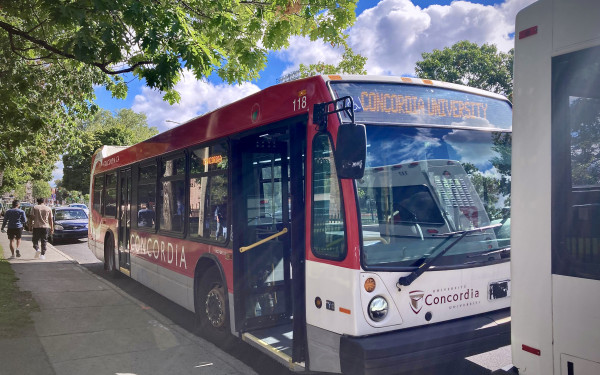
Students face transit crisis as the STM prepares for month-long strike
Concordia students say they fear losing access to school and work this November
Concordia University students are concerned about how the upcoming Société de Transport de Montréal (STM) strike in November will impact their lives inside and outside school.
STM maintenance workers are going on strike once again due to wage disparity and working condition problems.
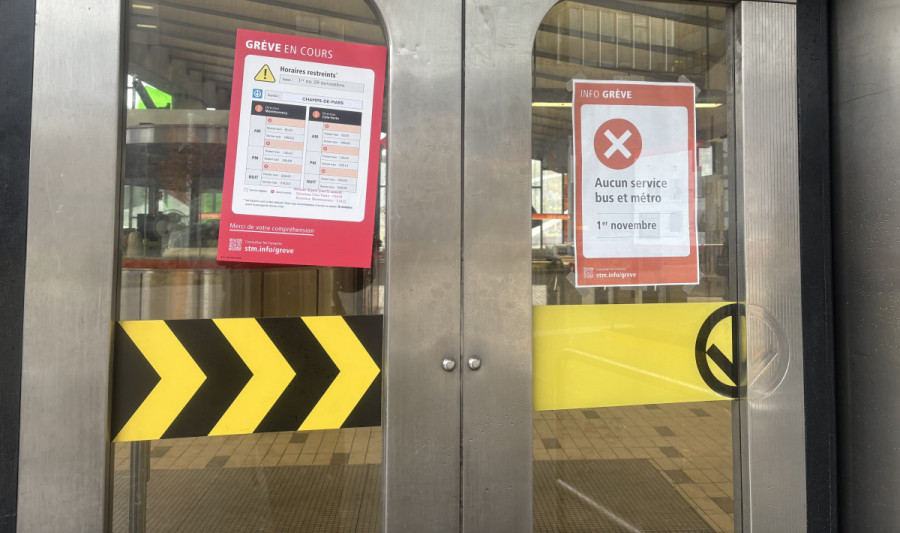
Maintenance workers at the Société de Transport de Montréal (STM) announced a 28-day strike starting Nov. 1, with bus drivers and Metro operators organizing a walkout and subsequent suspension of all bus and Metro schedules on Nov. 1. Other driver and operator walkouts are potentially scheduled for Nov. 15 and 16.
Every day from Nov. 2 until Nov. 28, buses and Metros will operate only at peak hours of the day, unless an agreement is reached between parties. Despite requests from the STM, the Tribunal administrative du travail has granted no exception to this schedule for Nov. 2, the day scheduled for municipal elections.
“We are doing everything we can to avoid a strike through an intensive round of negotiations, but we cannot compromise our financial capacity or the level of service in the future,” said Amélie Régis, a corporate advisor for the STM.
Some Concordia students say they are worried about how the potentially lengthy strike action will impact their lives if no tentative agreement is reached before Nov. 28.
“I live in Châteaugay, so if the strike goes through, my access to classes, work and much of my social life will be cut back,” said Jonoliah John, an engineering student at Concordia.
Besides missing classes and work, other students have expressed that the strike will also hinder aspects of their everyday lives.
"The delays will cut into my personal time, so I’ll have less time to study, rest and keep a healthy lifestyle," said Maria Chitoroaga, another Concordia student.
The inconvenience is not only felt by the students in Montreal, but also by the president of the Syndicat du transport de Montréal-CSN, Bruno Jeannotte.
Jeannotte stated after a press conference on Oct. 23 that the workers and their unions would also like to avoid the impending strike, but that the only way this can be done is if the STM becomes more flexible in the negotiation process.
“You can’t negotiate alone,” Jeannotte said after the press conference. “We have made several movements, [but] the STM remains frozen.”
This will be the third time in the past five months that Montreal residents will be forced to find alternative routes to get to their jobs and schools. The STM maintenance workers have previously gone on strike from June 9 to 17, and from Sept. 22 to Oct. 5.
Some students say they don’t even have enough to pay for their monthly OPUS card passes, let alone the cost of alternative transportation means. Depending on which zone they reside in, monthly passes can range from $62.75 to $98.75 for students and from $104.50 to $164.50 for the general public.
“Being a student is very financially taxing, and many, myself included, don’t have the funds to travel the city in any other way,” said Adriana Tassie, a first-year Concordia student. “For a large amount of people, any disruption to the public transit service greatly reduces their ability to leave the house at all.”
Régis understands that this is not an ideal situation for customers who may be impacted by the STM’s strike schedule, but she said that it’s important for unions to hold the right to strike.
“The right to strike is a union prerogative,” Régis said.
For students and Montreal residents such as Chitoroaga, paying a steep monthly fee for a card that cannot be used as often throughout the entirety of November seems a waste.
“My OPUS card has always eaten quite a chunk of my monthly budget, and now that piece of plastic is completely useless,” Chitoroaga said. “It feels like the STM doesn’t care about anyone at all.”
According to Jeannotte, the Syndicat du transport de Montréal-CSN and the STM have engaged in “more than 115 negotiation meetings,” and after five months of intermittent striking, there is still no resolution brought to the table.
However, Jeannotte said that the STM did announce 300 job cuts due to financial hardships.
“It is understood that the financial situation of the STM is difficult due to government underfunding,” Jeanotte said. “But it is always on the backs of workers that budget cuts fall.”
In a statement to The Link, a spokesperson for the Arts and Science Federation of Associations (ASFA) wrote that while ASFA fully supports the strike, it also sympathizes with students and any potential commute struggles they may experience.
“[We] recognize that public transit disruptions disproportionately affect lower income students and those who live further out from the immediate downtown area,” the spokesperson wrote. “We have a responsibility as ASFA to help keep students in the loop, and advocate for their continued access to education throughout the strike period.”
The spokesperson added that ASFA is providing assistance to students in the form of social media and newsletter updates, as well as by asking all departments within ASFA to consider offering hybrid class options and waiving attendance penalties for students impacted by transit disruptions.
With files from Maria Cholakova.