Concordia students share shuttle bus concerns at CSU town hall
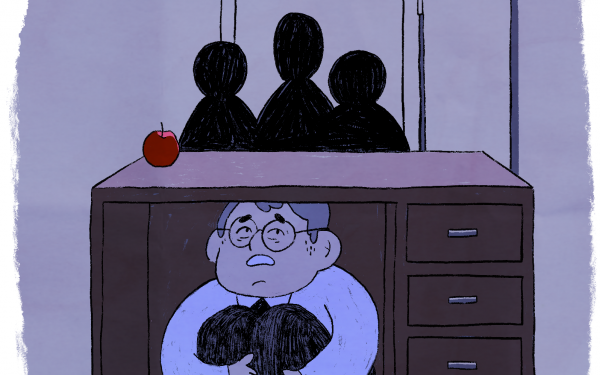
While shuttle bus funding was cut, CSPS staff salaries increased by $200,000
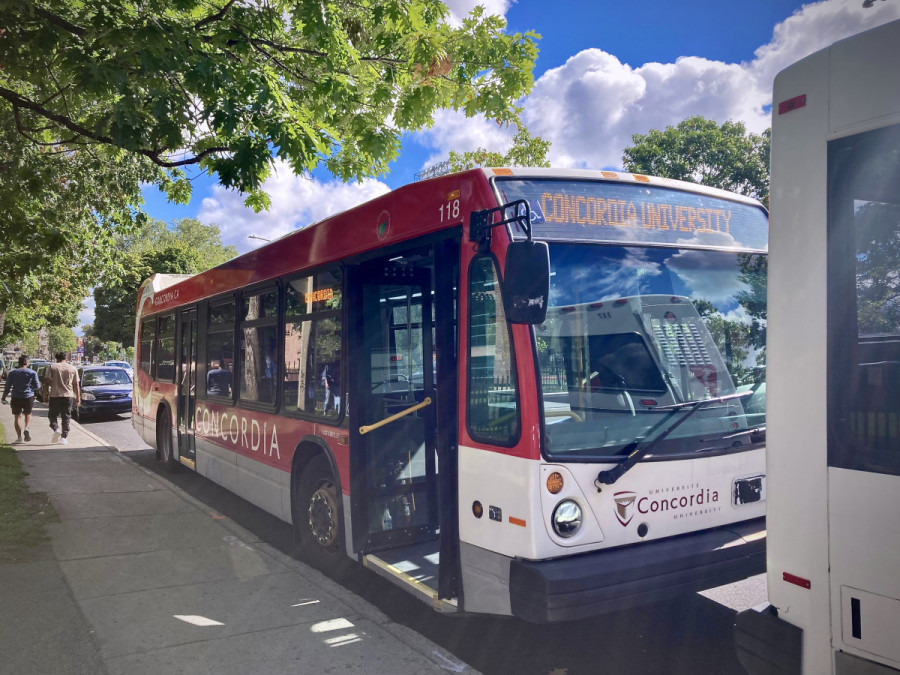
The Concordia Student Union (CSU) held a town hall on Sept. 24 to discuss last year’s continued shuttle bus schedule cuts and propose possible solutions to students’ rising frustration with the situation.
The town hall was hosted by CSU Loyola coordinator Aya Kidaei at the Loyola G-Lounge, with around a dozen students and several student association representatives in attendance.
“I’ve been trying to do more things since [the shuttle bus cuts] started to get more information about it, to understand why the cuts were made and who decided on those cuts,” Kidaei said during the town hall. “I wanted to know if it was decided in a way that was democratic and if the students had anything to say about it.”
Kidaei said she met with Concordia University’s VP of Services and Sustainability, Michael Di Grappa, in August. She said she was told by Di Grappa that the initial decision to reduce the shuttle bus hours was made due to Concordia’s ongoing financial constraints, with the university currently facing an $87 million deficit.
According to Concordia spokesperson Julie Fortier, the shuttle bus cuts are expected to save the university around $350,000 over two years.
Kidaei expressed concern that the decision to reduce the shuttle bus service was not made fairly.
“The decision was not made at the [Concordia] board of governors,” she said. “There was not any student consultation before making this decision.”
Students push back
Kidaei revealed that—according to information obtained in an access to information request the CSU sent to the university—while funding for the shuttle bus was cut in 2024, the budget for Campus Safety and Prevention Services (CSPS) was not, despite both CSPS and the shuttle bus being under Di Grappa’s jurisdiction.
In fact, Kidaei said that in the 2024-25 fiscal year, CSPS staff salaries were raised from $1.8 million the year prior to $2 million, with the budget for third-party security contracts remaining at around $6 million.
In an email statement to The Link, Fortier clarified that salary costs generally always go up from one year to another due to the salary increases negotiated with unions and associations as part of collective agreements. She added that differences also occur if unionized positions were vacant one year and filled the following year.
“Even though both CSPS and the shuttle bus are under Services and Sustainability, there isn’t one pool of money for all the departments that fall under a vice-president,” Fortier said. “These are separate budgets and funds cannot be transferred from one to the other.”
Additionally, according to Kidaei, a survey on the effects of the shuttle bus cuts on students’ lives compiled last year by representatives of the Arts and Science Federation of Associations was sent to the university’s administration, where its validity was denied. .
“The conclusion that [the administration] came to was that the survey was not valid,” Kidaei said. “They said that the methodology was bad, and they said that the way the questions were framed was biased.”
Fortier countered that the administration did not deny the survey’s validity, but that it did have concerns around its methodology.
“More importantly, we understand that the scaled back bus schedule has affected some community members but given our difficult financial situation, we have had to make hard choices and cannot afford to return to the previous schedule,” Fortier said in the email. “The shuttle bus was never meant to replace public transportation or be the only transit option for students.”
In 2024, a petition to reinstate the regular shuttle bus schedule was also circulated among students, garnering over 1,500 signatures, according to a CSU zoom moderator present at the town hall.
“The argument I would make is from a student price angle: it is fundamentally unfair that people at Loyola who don’t have access to all the [downtown] services pay for them.” — Colin Slack, student
Ongoing concerns with the bus
With the reduced schedule maintained this year, students in attendance at the town hall aired their frustrations with the situation.
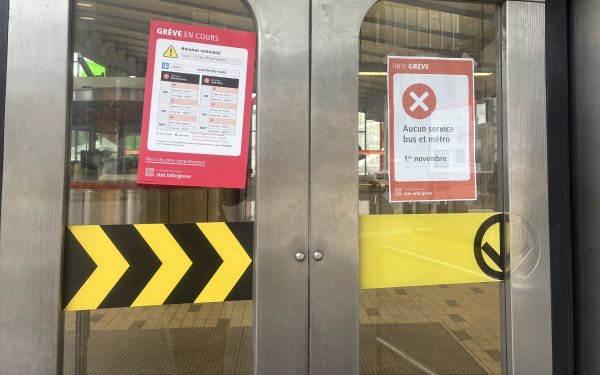
“There are very few ways to get to school now, especially since, in Montreal, students take the metro,” said student Simon Tardy, referring to added difficulties caused by the ongoing Société de transport de Montréal (STM) maintenance worker strike.
“And to get to [Loyola] you need to take a bus and metro from downtown, which is why the shuttle is so convenient,” he added.
Colin Slack is a physics major with a minor in computer science at Concordia. He said that with his physics classes being at Loyola campus and his computer science classes being at the downtown campus, his daily commute gets tricky.
“I’m basically forced to be half-half between both campuses for at least half of my degree,” Slack said.
He added that, if the shuttle bus schedule is to remain reduced, at the very least, students who live and operate mostly at the Loyola campus shouldn’t have to deal with student fees that might pertain to services offered only at the downtown campus.
“The argument I would make is from a student price angle: it is fundamentally unfair that people at Loyola who don’t have access to all the [downtown] services pay for them,” Slack said.
One of the main frustrations relayed by many attendees at the town hall was that the shuttle bus begins operating only after the earliest morning class has started, and stops operating before most late classes have ended. As such, several students said that the bus was no longer a viable option for them to get to and from class.
Tardy, along with several other attendees, also raised the question of whether having overcrowded shuttle buses was a safety violation.
“The shuttle these days is completely packed,” Tardy said. “The lines to get on [at Loyola] go past the library.”
A potential future for the shuttle
With the university’s financial constraints in mind, several attendees of the town hall proposed compromises and amendments to the shuttle bus schedule.
Tardy proposed a fee levy system, in which students pitch in to maintain the shuttle bus’s regular schedule, with the option for students to opt out of these fees as well.
“This is kind of the worst case scenario because it’s the students paying,” Tardy said. “But a fee levy type of thing that could be opt-in or opt-out might be a better, realistic [solution].”
Another option widely discussed at the town hall was having the shuttle bus run at reduced hours during slower periods of the day, but maintaining the normal schedule during peak periods, such as for morning classes and when night classes end.
Finally, the possibility of the university working with the STM to provide free or further reduced price OPUS cards for students was discussed, to help students deal with the costs of transit at a time when the shuttle bus is not always an option to get from campus to campus.