How pole dance lost its roots in studios
Strippers speak out to break the stigma about sex work in the dance world
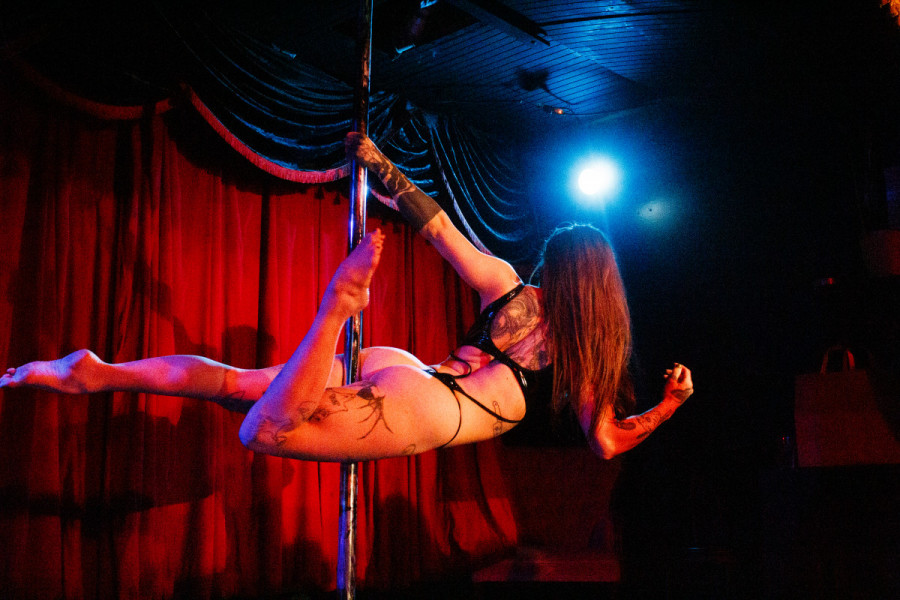
Pole dancing has become increasingly popular in recent years, moving beyond strip clubs into studios, gyms and performance spaces.
On Instagram, "#poledancer" has amassed over 5.7 million posts, and new studios continue to open in major cities. Even mainstream gyms like Callisthenics Montreal now offer pole classes. In a city with a strong circus and dance presence, pole is increasingly embraced as both a fitness practice and an art form.
However, for most people, the image that comes to mind when thinking of pole dance is a stripper—and for good reason. Modern popular pole dancing developed in strip clubs, particularly by Black dancers in U.S. cities like Atlanta and Houston.
Chris is a retiring stripper who now primarily performs pole at events and shows. His name, like those of the other sex workers interviewed for this article, has been changed for safety.
Chris began learning pole in the strip club. He started working at gay clubs to make quick money.
One day, one of his coworkers noticed his potential and began mentoring him. Over time, Chris became far more interested in pole dancing as a sport and performance, rather than giving private dances and flirting with clients.
“I have good memories of working at [a specific club], but it’s really taxing, mentally. It’s hard work, and it can really take a toll on your mental health," Chris said. "Now I work at [a different club], where I get to dance on stage a lot more, and I’m way happier.”
The use of a pole in dance can be traced back to ancient Indian and Chinese sports, but these disciplines have little bearing on what is taught in most pole studios today. Instead, these distant references are often used to distance the practice from its much more recent, club-based origins.
“There’s a lot of stigma at auditions. People really discredit what you do in the club,” Chris said. “As soon as you tell them, ‘Oh, I started dancing at clubs, that’s my background,’ they kinda shut you down, like, ‘Maybe stay in the club then.’” — Chris
Scrolling through pole content online, you’ll often find "#notastripper" in the caption of a post. As Instagram becomes a key site for visibility and advertising, associating with sex work in the public eye is still viewed as unsafe or unprofessional by many.
This lack of respect exists just as much offline.
Many strippers are also in the greater pole scene, where many of them continue to face significant discrimination despite a growing cultural openness around sexuality.
Chris’s goal is to perform on stages full-time and he is working toward applying to the National Circus School of Canada. However, when moving into Montreal's broader performance world, he encountered numerous barriers.
“There’s a lot of stigma at auditions. People really discredit what you do in the club," Chris said. "As soon as you tell them, ‘Oh, I started dancing at clubs, that’s my background,’ they kinda shut you down, like, ‘Maybe stay in the club then.'”
Even in a city like Montreal, with a booming sex industry, judgment remains pervasive. While a stylistic change may be inevitable when your audience is different, sex workers are often expected to cover their tracks to be considered legitimate artists completely.
Chris’s experience highlights how clubs and performance spaces function as two separate economies.
While they require many similar skills, such as stamina, creativity and stage presence, it can feel difficult to transfer the skills from one area to another. Formal training is often treated as the marker of legitimacy, where who taught you can matter more than what you learned.
Julie is an active stripper and a coach at a circus studio. She first learned pole in studios before beginning work at a strip club during university, an experience she says gave her valuable, often overlooked skills like style and presence.
As a coach, much of her labour involves translating those embodied skills into teachable techniques for students with little or no dance background. While she doesn’t actively hide her work, she doesn’t tell just anyone, even within pole studios.
“The studio I train at most of the time was very sex-worker-friendly, thankfully," Julie said.
Even in safer spaces like this, judgment persists. Julie shared a story about being in the changing room of that very same studio and chatting with a friend, who is also a stripper, about work. A girl she barely knew came up to them to say, “Wow, you guys don’t look like strippers.”
“What does that even mean?” Julie said. “What do you think strippers are supposed to look like?”
Beyond studios, sex workers face additional structural barriers.
Various pieces of legislation, particularly in Bill C-36, or the Protection of Communities and Exploited Persons Act, often put sex workers in harm’s way.
Alice Quezada is an outreach worker at PIaMP, a non-government organization supporting the needs of sex workers, usually regarding finances, food and housing.
Quezada has seen firsthand how the legislation fails to protect workers and actively makes sex work more dangerous. Although strippers exist in a legal grey zone and cannot be prosecuted for their work, that status does little to protect them from everyday discrimination.
“Housing is the big one, really,” Quezada said. “As soon as you tell a landlord that you’re a sex worker, they’re significantly more likely to refuse to rent to you. Buying a house can be near impossible.”
Explicitly pro-sex work shows and events are becoming more prominent in Montreal’s nightlife, but these spaces remain relatively small.
Outside of them, sex workers are often alienated from the broader art world not only because their labour is dismissed as illegitimate, but because their lived experience of dance is so different from those who were classically trained.
One person working to bridge these gaps is U.S.-based dancer Redd. A stripper since 2017, Redd launched Redd Light Therapy in 2024, a virtual studio and resource hub by and for strippers that prioritizes mutual aid and self-organization where traditional infrastructures fall short
“Working at studios, it can be very gymnastics, pole-sports [centred], kind of, and that wasn’t what I was doing,” Redd said. “It felt like there was just a barrier between what I was passionate about in pole dancing and what I was expected to teach.”
Redd spoke about how sanitized pole dancing has become. In her experience, many dancers seek the sensual expression inherent in pole’s connection to stripping, while maintaining a careful distance from sex workers.
Julie echoed this tension, saying that studio culture is often marketed to "young corporate women" who she says may not have many opportunities for self-expression, but do not want to be associated with sex work.
In response, Redd has worked to create spaces that centre sex workers rather than alienating them. Her studio doesn’t just teach dance but also offers meditation, breathwork, community meetings and financial workshops.
As pole continues to explode into studios and onto stages, the question is no longer whether the art form can evolve, but whether it can do so without erasing the people who built it.
“Everyone is scared to come near sex workers,” Redd said. “Like, ‘That’s dirty, I don’t wanna touch that.’ I wanted to create a space where strippers don’t have to feel dirty. Where they can feel appreciated like everyone else who puts hard work into their career.”
This article originally appeared in Volume 46, Issue 8, published January 27, 2026.


_600_375_90_s_c1.JPG)