Retelling Montreal history through street photography
Photography exhibition Pounding The Pavement seeks to tell the story of Montreal’s streets since the 19th century
_900_600_90.jpg)
A new exhibition showcasing Montreal’s history through street photography will be on show at the McCord Stewart Museum until Oct. 26.
Pounding the Pavement, sectioned by artists, features 30 series of photographs curated from the McCord collection, representing different points of views of Montreal’s culture since the 1800s.
The show features six main themes, such as “Events and Incidents” and “Talking to the Street,” as well as a short film featuring Concordia University photography students Daniel Cross, Jack Belley and Japhy Saretsky, as they shoot photos at night.
The idea for the exhibition first came to curator Zoë Tousignant in 2019 as a reaction to the museum’s most recent acquisitions, as a way to showcase the McCord collection. The images, consisting of over three million items, are almost entirely handpicked.
The project, which blends social, urban and political photographs, aims to show the legacy street photography in Montreal's history. Some series aim to represent day-to-day life in the city, while others are more political and show protests throughout the years.
Tousignant calls the exhibition an “homage to the city” and said she wanted to highlight multiple perspectives, portraying all sides of Montreal, flattering or not.
“The history we have of Montreal is often one-sided,” she said. “I wanted to find these different voices that explore the different sides.”
She wanted the exhibition to not only celebrate the city but also showcase critical elements, to expose both the good and bad sides of its history.
Stylistically, the exhibition features not only traditional street photographs as we know them, taken spontaneously, but also images that show urbanism and architecture.
“I included artists that might not see themselves as street photographers but nonetheless depicted the city in very dedicated ways,” Tousignant said.
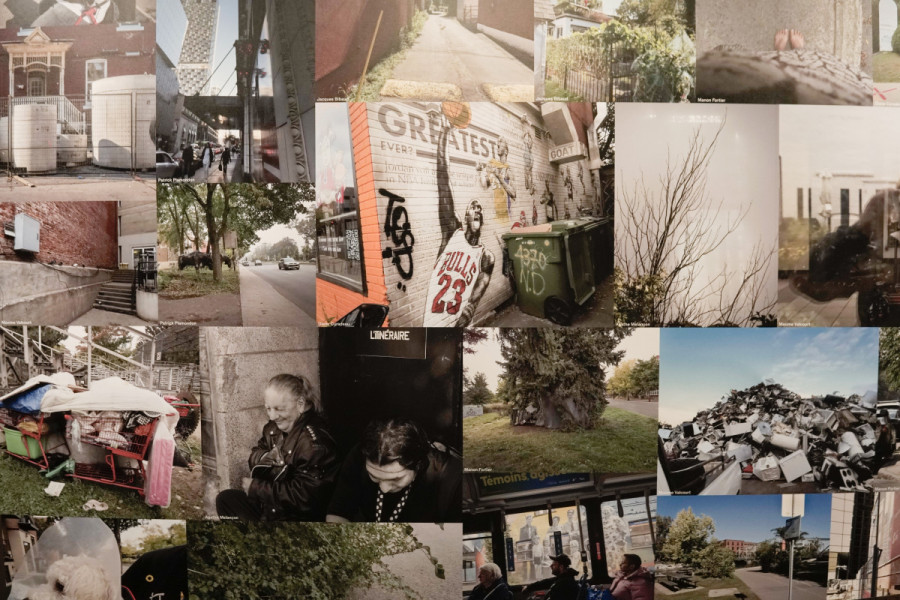
The exhibit also has a special focus on the artists, featuring full series instead of individual photographs. This way, viewers experienced a bigger body of work from each artist and appreciated their unique style and technique.
Among the featured photographers is Concordia professor and acclaimed artist Clara Gutsche. After moving to Montreal in 1970, she quickly fell in love with the city and with photographing it.
Her series “The Windows” (1976-1980) documents storefront displays across Montreal.
“Windows are a visual expression of urban culture. The conscious or unconscious decisions of the shopowners reflect the culture of the city and neighbourhoods,” Gutsche said of her work.
Her series centres more around aesthetics and urbanism. She talks about finding the juxtaposition of unlikely objects amusing, and the photos reminiscent of her summer walks through the Mile End.
Bertrand Carrière’s series “Chronique Nocturne” marks another highlight, with one of its images as the face of the exposition. Carrière reflects on his experience as a street photographer in the ‘70s.
“It was the trend, influences were huge, from Robert Frank to [William] Klein,” Carrière said. “American photography had a huge impact here.”
He also mentioned Weegee as an inspiration for his series, saying he would go to big events and use the crowd as camouflage to get his pictures.
“I was looking to do something humanistic, a testament to this period of time,” Carrière said.
His series offers a deeply human and cultural side of Montreal, revealing his affection for the city.
The exhibition has many more series to explore, from acclaimed photographers like Brian Merrett, Serge Clément and Gilbert Duclos. It also spotlights lesser-known but equally striking artists, including Edith H. Mather, David W. Marvin, Alan B. Stone and John Taylor.
This article originally appeared in Volume 46, Issue 3, published September 30, 2025.