
NDP leadership candidates share views on genocide in Palestine
The NDP leadership candidates debated over their stance on Palestine to reshape the party’s principles

New Democratic Party (NDP) leadership candidates shared their views on issues related to Palestine during an online debate on Jan. 21.
The debate was hosted by Canadians for Justice and Peace in the Middle East (CJPME), a non-profit organization whose stated purpose is to promote justice, peace and development in the Middle East among Canadians.
“We set up this debate in order to really understand where the NDP stands as a party and where things are headed in relation to Palestinian self-determination and human rights,” said Jason Toney, director of media advocacy at CJPME.
The event was split up into long-form and short-form questions, allowing candidates to outline their views on the genocide in Palestine and what role Canada is currently playing in Palestinian affairs.
Participating in the debate were candidates Tanille Johnston, Avi Lewis, Heather McPherson and Tony McQuail. Another candidate, Rob Ashton, was unable to attend due to scheduling conflicts.
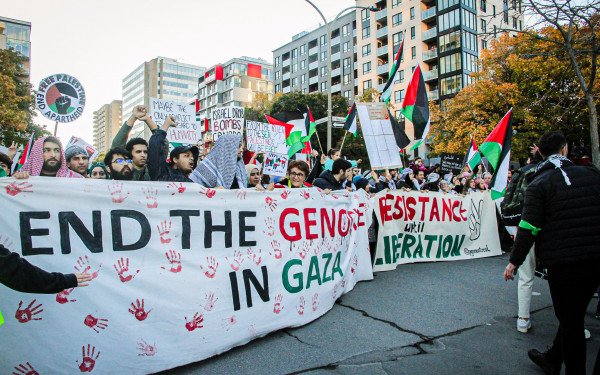
Each candidate present stated that Israel is guilty of genocide against the Palestinian population.
The UN Independent International Commission of Inquiry on the Occupied Palestinian Territory released a report in September 2025 stating that Israel has committed genocide against the Palestinians in the Gaza Strip.
International human rights groups like Amnesty International and Human Rights Watch have reiterated the same conclusion.
The conversation started with the candidates making an opening statement on how they came to understand the issue of Palestine.
For candidates like Johnston, who is a Liǧwiłdax̌w woman from the We Wai Kai First Nation, the situation in Palestine is comparable to the settler colonialism in Canada.
“When I look at the Palestinian struggle, I see a reflection of Indigenous Peoples here in Canada,” Johnston said. “The theft of land, displacement and lawful occupation. We’ve seen this story before. It’s not new.”
McPherson, who is an elected member of the House of Commons for Edmonton, spoke about the frustrations of Palestinian human rights not being raised with the same urgency as other international crises.
“When that illegal invasion of Ukraine happened by [Russia], and the Canadian government said unlimited Ukrainians can come here to shelter; and then there were 90,000 Afghans [who could come]; and then there were 5,000 Palestinians; and then there were 500 Sudanese,” she said, “that is putting a price tag on a human life.”
This debate took place at a critical juncture for the NDP.
The party went from holding 24 seats in parliament to just seven in the last federal election. It lost its recognized party status, which requires at least 12 seats. Official party status guarantees more speaking-time, ensures that Members of Parliament can sit on committees, and provides funding from the House to pay for research and extra staff.
Even so, Yara Shoufani, the president of CJPME and host of the event, said she sees this as an opportunity for Canadians who care about Palestinian rights and self-determination to see an official party adopt views that reflect their values.
According to Francesca Albanese, the UN special rapporteur on the occupied Palestinian territories, Palestine has become a litmus test for our humanity, a fact that politicians are growing to recognize.
The candidates also discussed their concerns surrounding Bill C-9's passing in the House. If implemented, the bill could extend an intimidation offence to a building that is primarily used for religious worship.
These protective zones would prevent demonstrators from protesting the illegal sale of Palestinian land in the West Bank at a synagogue, for example.
According to Lewis, the zones reinforce the concept of "progressive except for Palestine," where activists and organizations state they’re progressive, yet decide not to engage with the Palestinian cause.
“You actually see the mechanisms of the state and local police forces and sometimes municipal governments actually singling out this one movement for justice and peace in our time,” Lewis said.
Lewis also spoke on the importance of having representation in parliament that decouples anti-Semitism from anti-Zionism.
“I’m an anti-Zionist Jewish person, and I will continue to help people understand the political ideology of Zionism and how [it] is linked inextricably to the ethnic cleansing of Palestine as an endgame with the ethno-state, a Jewish state of Israel as its rationale,” Lewis said.
The debate ended with a closed “yes or no” question round, in which all the candidates voted yes to every single prompt.
These votes included promises that the Royal Canadian Mounted Police should investigate Canadian citizens who served in the Israeli military; that Canada should cancel its free trade agreement with Israel; and that Canada should officially recognize and commemorate the Nakba, the ethnic cleansing of over 750,000 Palestinians from their homeland between 1947 and 1949.
According to Toney, the event ended up not being much of a debate, as there was a clear consensus among the candidates regarding the topic at hand.
“That was, I think, very refreshing for a lot of our supporters to see,” Toney said. “[It] shows how successful the Palestine movement in Canada has become in growing the support for the demands of the movement.”



_600_375_90_s_c1.jpg)
_2_600_375_90_s_c1.jpg)