Montreal students continue struggling to access healthcare
Overburdened system leaves 30 per cent of Quebecers without a primary care physician
Students are having trouble accessing health care in Montreal, showing a broader pattern of stifling bureaucracy and burnout in Quebec.
Concordia student Megan Brown saw the impact of these shortages firsthand during a recent ER visit.
“There’s six patients in the back with IVs in their arms, trying to get the help they need, but the nurses can't, because they're doing 15 other things at the same time,” Brown said. “Even the doctors are coming out to get patients as if they're nurses, and I think there's a tendency to not recognize the urgency of situations unless they're dire.”
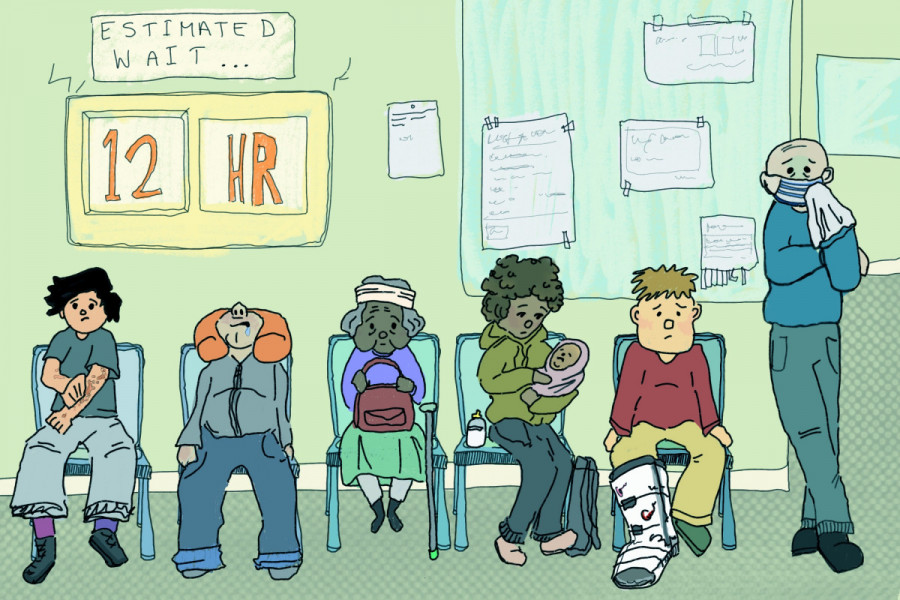
After visiting the Concordia University Health Services clinic and a private physician for a week of non-stop migraines, Brown was sent to the Lakeshore General Hospital ER. She waited 12 hours before receiving IV fluids, a chest x-ray and an electrocardiogram to rule out blood clots or a heart attack—and was ultimately told that it was probably just stress.
“The only concern for them was the fact that it could have been a heart attack, and they didn't really take the time to investigate any further because there were so many people waiting,” Brown said. “The only thing they cared about was if I was dying.”
In Brown’s experience, the hospital was burdened to the point that accessing care was extremely difficult. The difficulty to access care can also be seen in the number of Quebec residents without a primary care physician, which has risen from 22 per cent in 2019 to 31 per cent in 2022, according to an OurCare report.
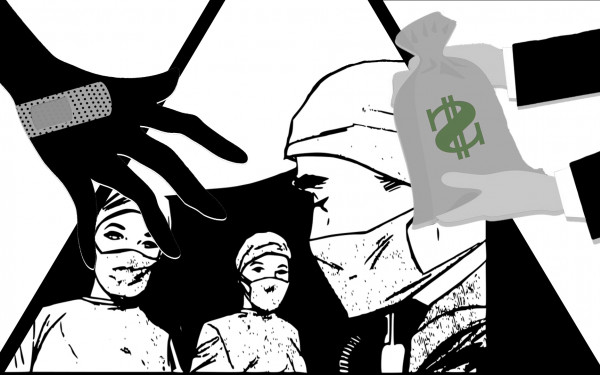
This rise—along with an increase in family doctors going straight into the private sector—has sparked concern in the Quebec government, leading to several reform bills. Among them are Bill 83, which aims to keep physicians in the public system for a minimum of five years after they begin practicing. Another is Bill 106, which aims to tie the payment of family doctors to their achievement of performance goals set by the government.
However, these bills have been met some pushback from doctors.
“As frontline workers, we know what we need, we know what our struggles are, and changes in policy don't always reflect the way that we experience it,” said Laura Sang, a family physician in Montreal. “I think it's very important to consider what we have to say and take it seriously.”
Sang pointed to the fact that family doctors are often a patient’s first point of contact and are responsible for guiding them through the healthcare system. Referrals, bloodwork, doctor’s notes and a large amount of the administrative work all go through family doctors. They must follow strict practice rules, such as working within a designated region where most of their billing must take place, and they are prohibited from working in both the private and public systems.
Sang added that the government is quick to blame family physicians for broader issues.
“There's already a culture of lack of respect,” Sang said. "That's only been worsened by the villainization from the government on family doctors and blaming us for the inadequacies of the healthcare system when we are really some of the duct tape that's holding it together.”
Paul Brunet, the chair of the non-profit healthcare advocacy organization Conseil pour la protection des malades, said that the focus should be on the rest of the healthcare system as well.
“They are pushing on the doctors so that they become more efficient,” Brunet said. “The problem is that there are only 15,000 [doctors], whereas employees in this whole system are more or less 300,000.”
According to Brunet, eight out of 10 no-shows to hospital appointments stem from poor communication and administrative errors.
With the recent passing of Bill 83 and the potential amendments to Bill 106, the efficacy of the bills will be seen in the upcoming months and years. Additionally, an increase in family medicine residents this year could lead to more family physicians in the province.
Brunet said that the solution lies in action, rather than bureaucracy and contemplation.
“The way I've always thought is, ‘What's wrong? What do we need more of?’” Brunet said. “We don't need more managers or thinkers. We need do-ers.”
This article originally appeared in Volume 46, Issue 2, published September 16, 2025.